
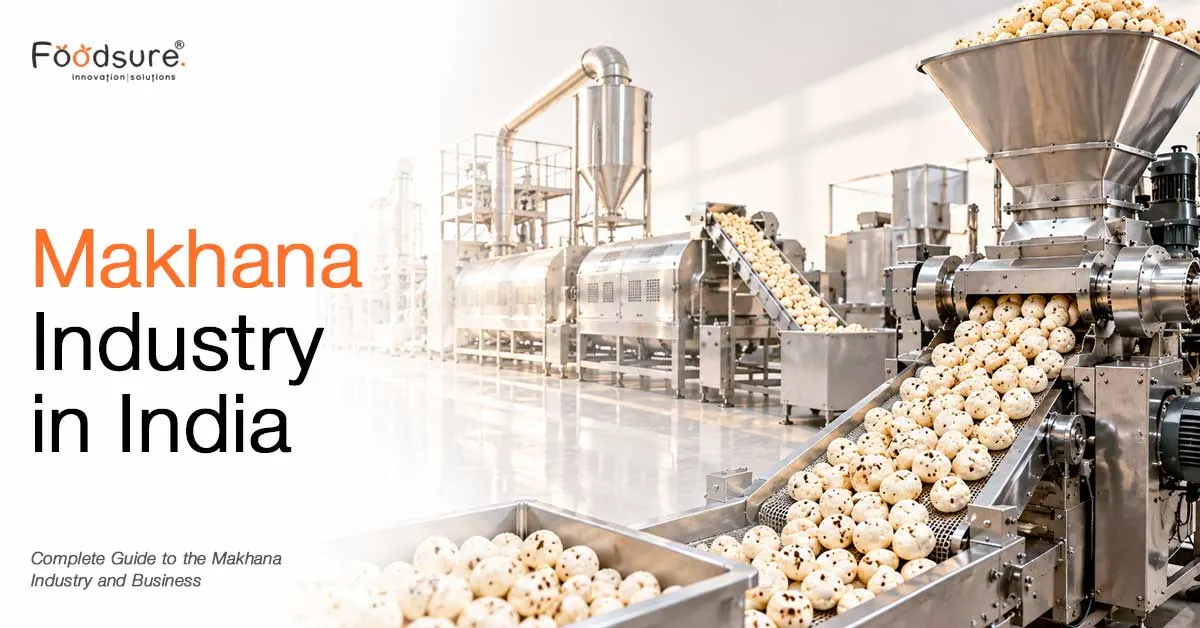
Makhana has transformed from an indigenous food into a processed product used as a snack in retail stores, health foods, packaged snacks, and added-value products. There has been a growing demand for roasted and flavored makhana, which has opened up possibilities for various entities to engage themselves in the value chain.
The Makhana Udyog includes all the aspects associated with handling of Makhana in its raw form, roasting, flavoring, packaging, branding, and distribution. For any new entrant who wishes to join this industry, it is essential to know the process of manufacturing, machinery used, quality issues, and market position.
What Is Makhana Udyog?
The term makhana udyog refers to the broader business and manufacturing ecosystem associated with makhana. It includes raw-material sourcing, processing, value addition, manufacturing, packaging, marketing, and distribution.
The sector may consist of firms having various scales of operations, ranging from small processing facilities to big commercial establishments. There are some firms that concentrate their efforts on performing one particular operation, while there are others who use a full-fledged processing operation system.
A typical commercial workflow can include:
The exact workflow depends on the final product and the level of processing carried out by the business.
Makhana Industry in India
The makhana industry in India is very much connected to areas that have historically had makhana farming and processing. Processing and other added-value products have increased business opportunities for makhana over time.
The market now includes several product categories, such as:
- Plain makhana
- Roasted makhana
- Flavoured makhana
- Seasoned snack products
- Packaged fox nuts
- Private-label products
- Value-added makhana-based foods
In terms of business, there are possibilities for companies beyond merely selling crude or unprocessed makhana. The process of adding value through processing, branding, and packaging can help them reach different market segments.
Why Is Makhana Business Growing?
The makhana business can involve multiple stages of the supply chain, allowing businesses to select a model according to their investment capacity and operational capabilities.
Some companies may concentrate on producing and selling bulk roasted makhana, while others may manufacture their own packaged goods for consumers.
Key areas of opportunity include:
- Commercial roasting
- Flavouring and seasoning
- Packaging
- Private-label manufacturing
- Bulk supply
- Retail distribution
- Online sales
- Export-oriented production
The right business model depends on factors such as target customers, production capacity, available capital, sourcing arrangements, and distribution strategy.
Makhana Manufacturing Business: What Does It Involve?
A makhana manufacturing business requires coordination between raw-material procurement, processing, quality control, machinery, labour, packaging, and sales.
Whereas in a roasted or flavored case, the processing equipment may consist of equipment for cleaning, grading, roasting, cooling, seasonings, and packaging.
The production process can be organised as:
Businesses should design the production flow according to their intended product and required capacity rather than installing equipment without considering the complete workflow.
Machines Required for a Makhana Processing Business
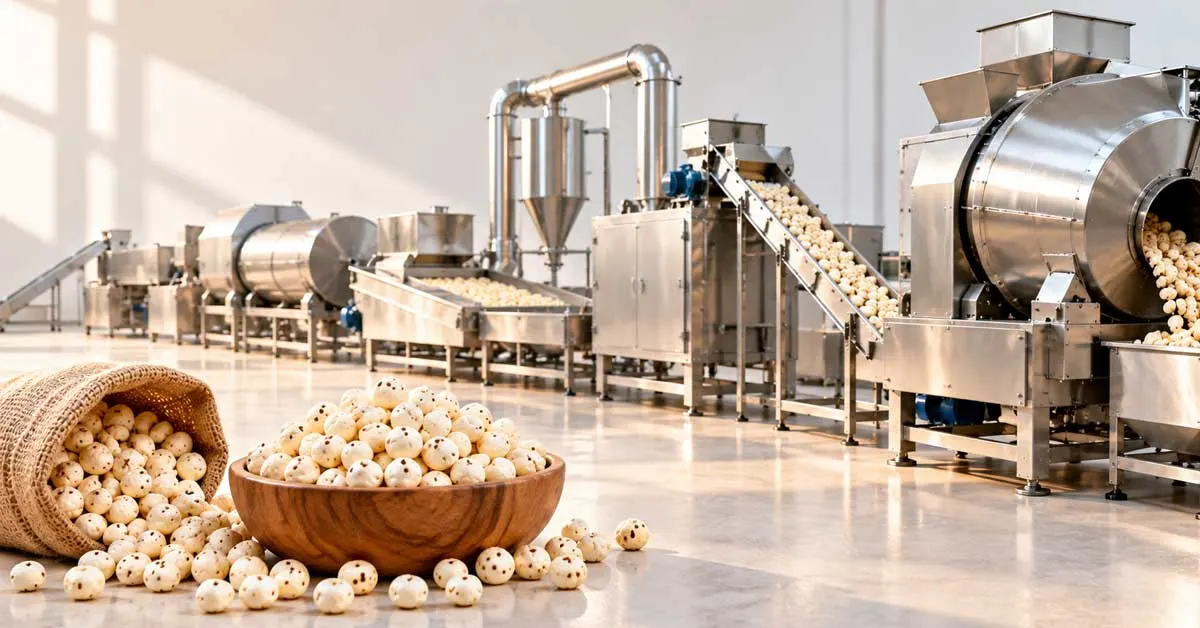
Machinery requirements depend on the scale and product range of the business.
Makhana Cleaning Machine
Cleaning machinery aids in removing dust and other contaminants before further processing.
Grading and Sorting Equipment
Grading equipment can separate makhana according to size or other quality requirements, helping create more consistent raw material for subsequent processing.
Roasting Machine
The commercial roasting machine helps control the heating and flow of the ingredients. This is especially relevant to firms that roast or flavour makhana commercially.
Cooling Equipment
After roasting, cooling helps bring the product to a suitable temperature before seasoning, handling, or packaging.
Flavouring Equipment
For flavoured products, dedicated flavouring equipment can help distribute seasoning more consistently.
Packaging Machine
Packaging equipment can be selected according to the required pouch size, packing speed, sealing method, and level of automation.
For larger facilities, an industrial makhana machine setup can combine multiple processing stages into a coordinated production line.
Manual vs Machine-Based Makhana Processing
| Factor | Manual Processing | Machine-Based Processing |
|---|---|---|
| Production capacity | Generally lower | Higher potential |
| Manual labour | Higher | Reduced |
| Process consistency | Can vary | More controlled |
| Production speed | Slower | More efficient |
| Scalability | Limited | Easier to expand |
| Process monitoring | More manual | Can be automated |
The use of machine operations does not make the role of skilled personnel, inspections, and maintenance any less important. On the contrary, it helps eliminate routine tasks and gain control over manufacturing operations.
How to Set Up a Makhana Udyog
Setting up a makhana udyog requires planning across several areas.
1. Define the Product
The first step is to figure out what product you want your business to make. Roasted makhana, flavored snacks, bulk products, or packaged products would each have their own requirements.
2. Determine Production Capacity
It is recommended to assess the production volume before selecting the equipment. It helps not to purchase equipment which differs from requirements either in size or capacity.
3. Plan the Processing Layout
Equipment should be arranged to allow smooth movement of raw materials and finished products. A logical layout can reduce unnecessary handling and improve workflow.
4. Select Suitable Machinery
Equipment must be chosen with regard to capacity, automation, construction, energy consumption, maintenance, and compatibility with other processes.
5. Establish Quality Controls
Inspection should run through the production process and must include inspections for raw materials, roasting, seasoning, packaging, and final product.
6. Plan Packaging and Distribution
Package design must not only guarantee the safety of the product but must also consider channels of distribution through which the products would be sold. There is also the need to decide on what kind of distribution channel to use.
Makhana Processing Machine Price
The makhana processing machine price can vary considerably depending on the number of machines required, production capacity, automation level, construction material, and overall plant configuration.
It should be noted that a small processing factory can use selected pieces of machinery, while large commercial factories can use different machines for cleaning, sorting, roasting, flavoring, and packing. In turn, companies should estimate the overall cost of machinery according to their own production line and not the cost of just one piece.
Other costs that should be considered include:
- Installation
- Electrical requirements
- Labour
- Maintenance
- Packaging materials
- Raw materials
- Facility costs
- Transportation
- Working capital
Quality and Hygiene in Makhana Manufacturing
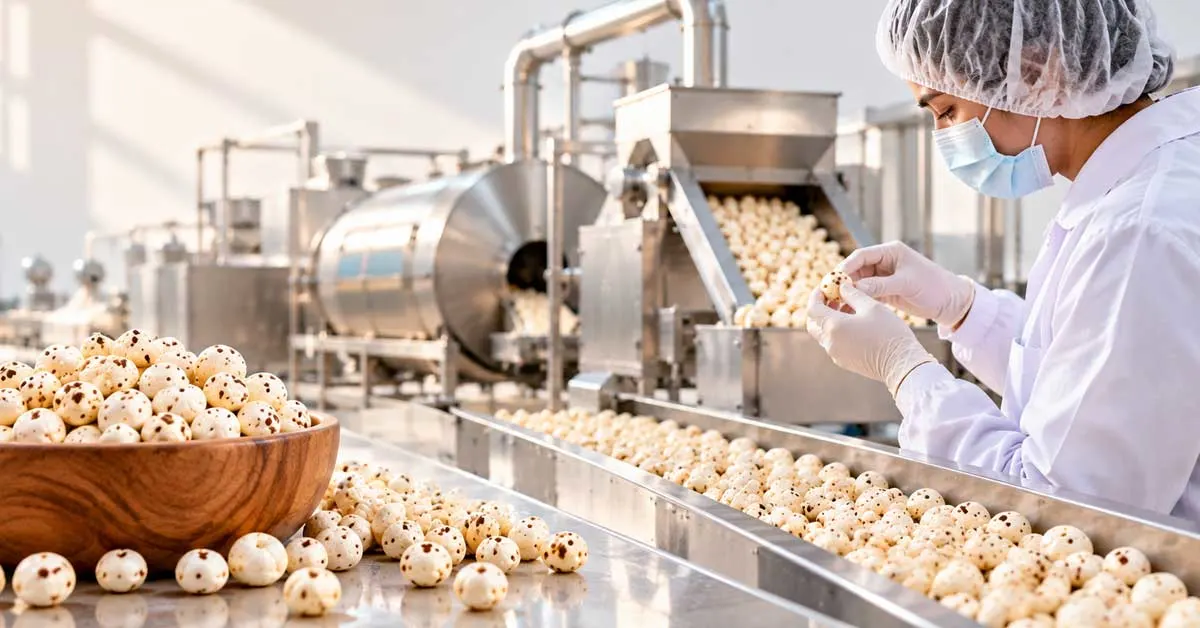
Quality management is important in all stages of production. Raw materials should be checked before being placed on the production line, while equipment should be cleaned and maintained using proper methods.
Materials used for food contact should be appropriate, and handlers should practice proper handling techniques.
In the case of roasted and flavored foods, roasting consistency, seasoning distribution, cooling, and packaging should be controlled.
Good hygiene and proper process control will ensure that the product maintains good quality levels and minimize unnecessary production problems.
Scaling a Makhana Business
A firm can scale up through increased production capacity, offering new flavors, improved packaging, enhanced distribution channels, or even producing private label brands.
But scaling up must be done in accordance with real demand and production capacity. Increasing machinery capacity without adequate raw material availability, manpower, packaging, or distribution channels can lead to inefficiencies.
Firms need to assess production constraints periodically and upgrade their respective production processes when necessary.
Factors to Consider Before Starting a Makhana Business
Before investing in a commercial setup, entrepreneurs should evaluate:
- Availability of makhana raw material
- Product line for target market
- Estimated production quantity
- Mechanical requirements
- Plant facilities
- Labor availability
- Packaging needs
- Quality control measures
- Sales channels
- Working capital
- Operating expenses
A detailed assessment of these factors can help create a more practical production plan.
Future Opportunities in the Makhana Industry
The makhana industry in India provides opportunities across both traditional and value-added product categories. Businesses can explore roasted products, flavoured snacks, premium packaging, bulk supply, private-label manufacturing, and other processed formats.
Technology can even contribute to enhancing consistency in the production process. This includes systems for automatic cleaning, sorting, roasting, flavoring, and packaging. The degree of automation will depend on the production needs, financial resources available, and the future business model of the manufacturer.
Conclusion
The makhana udyog includes a wide range of activities, from raw-material handling and processing to roasting, flavouring, packaging, branding, and distribution. This makes the sector relevant to businesses operating at different stages and scales.
For those entrepreneurs looking to establish a makhana business, it is imperative that proper planning be done in relation to selection of products, manufacturing capacity, machinery, quality control, packaging, and distribution. Proper planning will help develop a profitable makhana manufacturing business step-by-step.
Investment in machinery needs to be done based on the need for production rather than cost alone. With proper machinery, proper workflow, and quality standards, businesses can form a business structure in the emerging field of the makhana processing industry.
Have a Question? Let’s Connect
Need expert guidance on food processing machines, production setup, or process optimization? Our team is ready to help you choose the right solution for your business.
Frequently Asked Questions
What is makhana udyog?
Makhana udyog refers to the business and manufacturing ecosystem associated with makhana, including sourcing, processing, roasting, flavouring, packaging, marketing, and distribution.
What machines are required for a makhana business?
Depending on the product and production scale, businesses may require cleaning, grading, roasting, cooling, flavouring, and packaging machines.
Is makhana manufacturing suitable for small businesses?
Makhana production could be arranged at various levels. Small firms can start off with certain stages of processing and build up their equipment and production according to their needs.
What affects makhana processing machine price?
Capacity, automation level, machine configuration, construction material, number of processing stages, and additional features can influence machinery costs.
What products can be made through a makhana manufacturing business?
There are several kinds of products that businesses can make out of makhana, like plain roasted makhana, flavored makhana, packaged fox nuts, and bulk-roasted makhana, among others.




