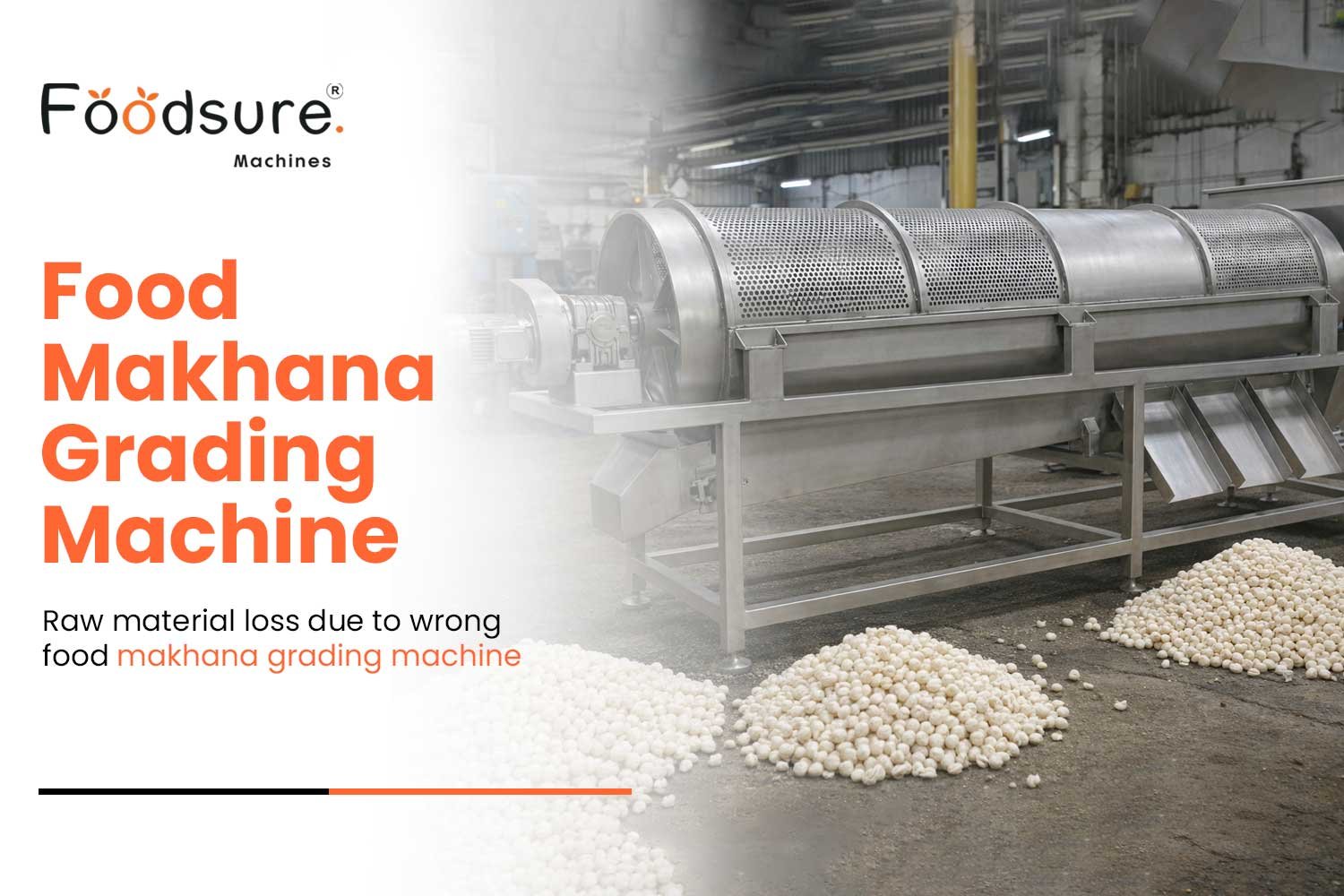
Loss of raw material due to the selection of a food makhana grading machine rarely starts on the farm; instead, it usually starts after harvest. By mixing sizes, crushing kernels, and inflating rejection, poor grading subtly destroys margins. This case study demonstrates how the appropriate food makhana grading machine found hidden losses and fixed them before profits continued to escape.
Why Makhana Grading Drives Profit and Ensures Product Superiority – Not Just Appearance or Size Uniformity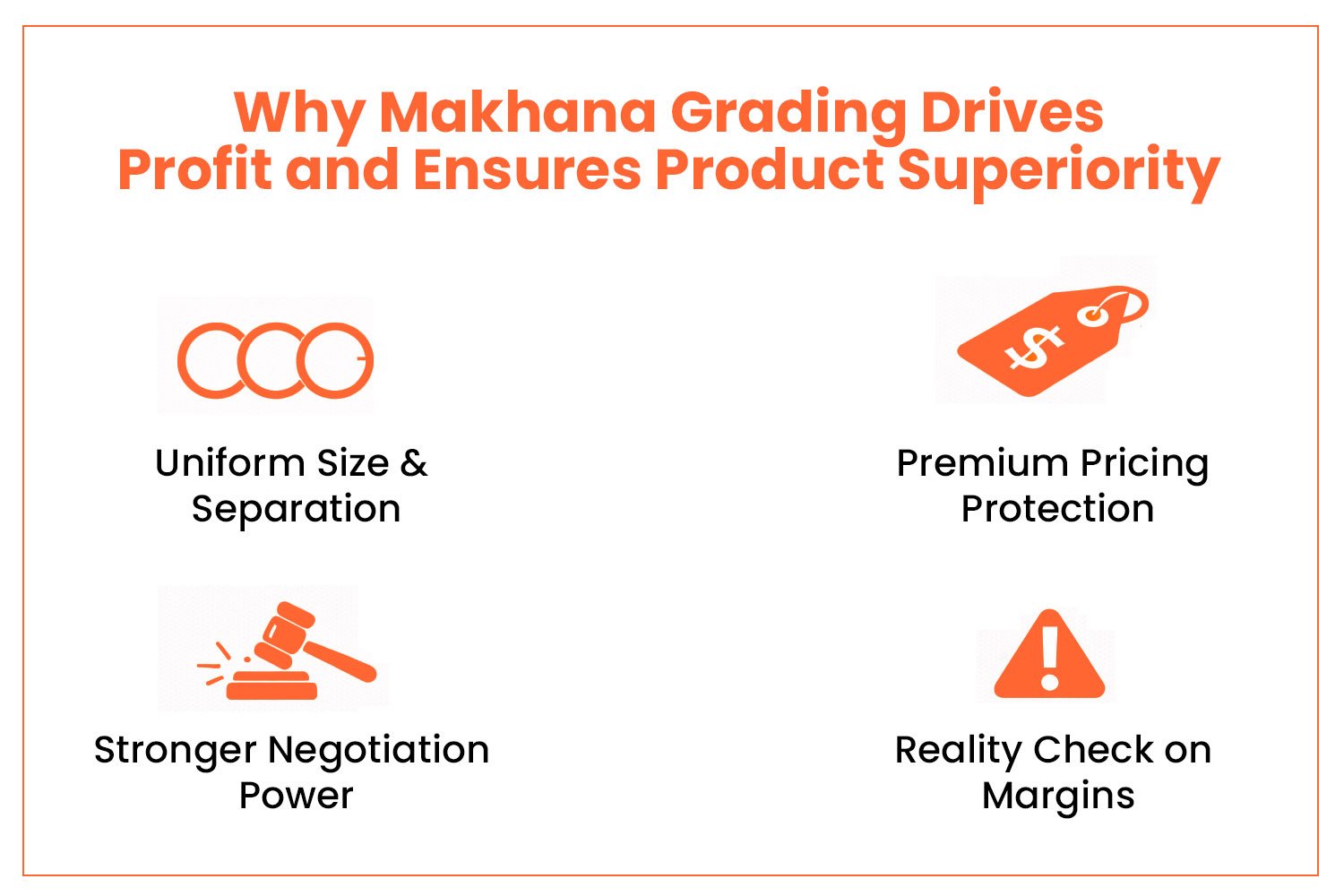
- Before packaging or branding processes have started, makhana grading has a big impact on profit. The reason is that consumers pay for uniform size, neat separation, and consistency in addition to the product’s overall weight.
- When premium, small, and broken kernels are combined, customers urge for a discount on the entire lot, not just the damaged part. As a result, even though the bulk of the batch is of high quality, the sellers are forced to offer the superiority fraction at the low price of the remainder.
- Negotiation power is also reduced by poor grading. In order to get rid of their product, processors are compelled to make bulk sales at discounted pricing rather than selling at premium rates by size.
- Reality Check: Even a small grading error, such as 5–7%, can destroy monthly margins because one mixed sack can lower the price of the entire dispatch, not just the faulty kernels.
Case Background: How a Small Makhana Processing Unit in Bihar Handled Grading Challenges
- A small makhana processing unit located in Bihar that has a daily capacity of 250-300 kg. The unit is not only marketed its products locally but also to bulk buyers, and the prices depended significantly on size consistency and visual quality.
- The makhana grading process was done with the help of an extremely simple, low-speed food makhana grading machine, along with manual sorting of the kernels. Although this arrangement had the appearance of being low-cost, it did not provide the desired level of accuracy in grading.
- The main problem was that the makhana making machine was unable to correctly separate the grades of kernels that were very close in size. As a result, some medium and small kernels ended up in premium grades, leading to repeated complaints from buyers and price cuts being enforced.
Where Raw Material Loss Was Really Happening: Inside the Makhana Grading Process
The loss of raw materials in this processing unit occurred during the grading stage rather than as a result of inadequate output or poor storage. Inconsistent sizes, which required repetitive handling and prevented precise size separation, were the main cause of the loss at the core of makhana processing.
Mixing of Sizes That Led to Buyer Rejections
- Due to an inefficient grading system, premium and medium makhana were frequently blended. Instead of consicutive superiority items from the bags, the purchasers evaluate the entire collection.
- True impact: The entire shipment may be labelled as non-premium based on a single discernible size difference. As a result, a shipment that was shipped for a higher price would eventually be sold for the average sale price. The per kg realisation has been directly impacted by this common inaccuracy in makhana size grading, which has lowered it.
Breakage of Makhana During Repeated Handling and Processing
- The employees manually regraded the rejected lot in response to consumer complaints. Pouring, sifting, moving, and breaking the fragile seeds are all part of each re-grading cycle.
- The increase in the number of unrecorded damaged seeds: The majority of the most fragile and partially opened seeds cracked, increasing the amount of fines and waste that could not be used, leading to a loss that was never apparent in the stock records.
Quality Product Sold at Low-Grade Price
- Top-quality kernels were combined with lesser grades and sold as a result of improper size separation.
- Pricing discrepancy: Even though the production quality was high, the maker of premium makhana was essentially failing to discount, which reduced the margin.
The Real Issue: How the Wrong Food Makhana Grading Machine Hurts Size Accuracy
The challenge was not about making efforts but rather using an unsuitable food makhana grading machine for the specific product and volume. The automated makhana grading machine applied fixed, improper mesh sizes, which were unable to distinctly separate very close makhana grades. Medium-sized kernels were often mistaken for premium ones, while the actual premium pieces fell to the bottom during the process of vibration.
- Vibration control was poor: vibration that was not constant produced uneven flow. Some kernels went through very quickly, while others bounced, which led to breakage being more than the separation of good and bad kernels.
- Dependence on humans: Operators had to manually adjust the speed of feeding and frequently stop the makhana machine. The grading results varied from one shift to another; the quality of grading was not determined by the control of the process, but rather by the judgment of the operator.
Hidden Monthly Losses: How Makhana Processing Cost Increased Without Notice
Monthly losses were not accounted for in a single large amount. Instead, they infiltrated the company’s operations through price reductions, rework, and unproductive labour. Errors in grading led to a reduction in the price of superiority makhana by ₹25–30 per kg, despite its good quality.
Loss Impact Box (Monthly):
| Metric | Value |
| Avg processing volume | 7,500 kg |
| Avg loss per kg (₹) | 25 |
| Avg loss/month (₹) | 1,87,500 |
| Material downgraded (%) | 12–15% |
| Rejected lots | 2–3 consignments |
| Extra labour & rework cost | ₹18,000–22,000 |
Also read: Start Your Profitable Makhana Processing Plant Setup In 90 Days
The Solution: How the Right Makhana Grading Machine Stopped Size Loss
The solution was not only simple but also very effective: the use of an automatic grading machine for makhana. The new machine had a grading logic based on the kernels’ size, which was completely different from the old setup; every kernel was classified correctly. 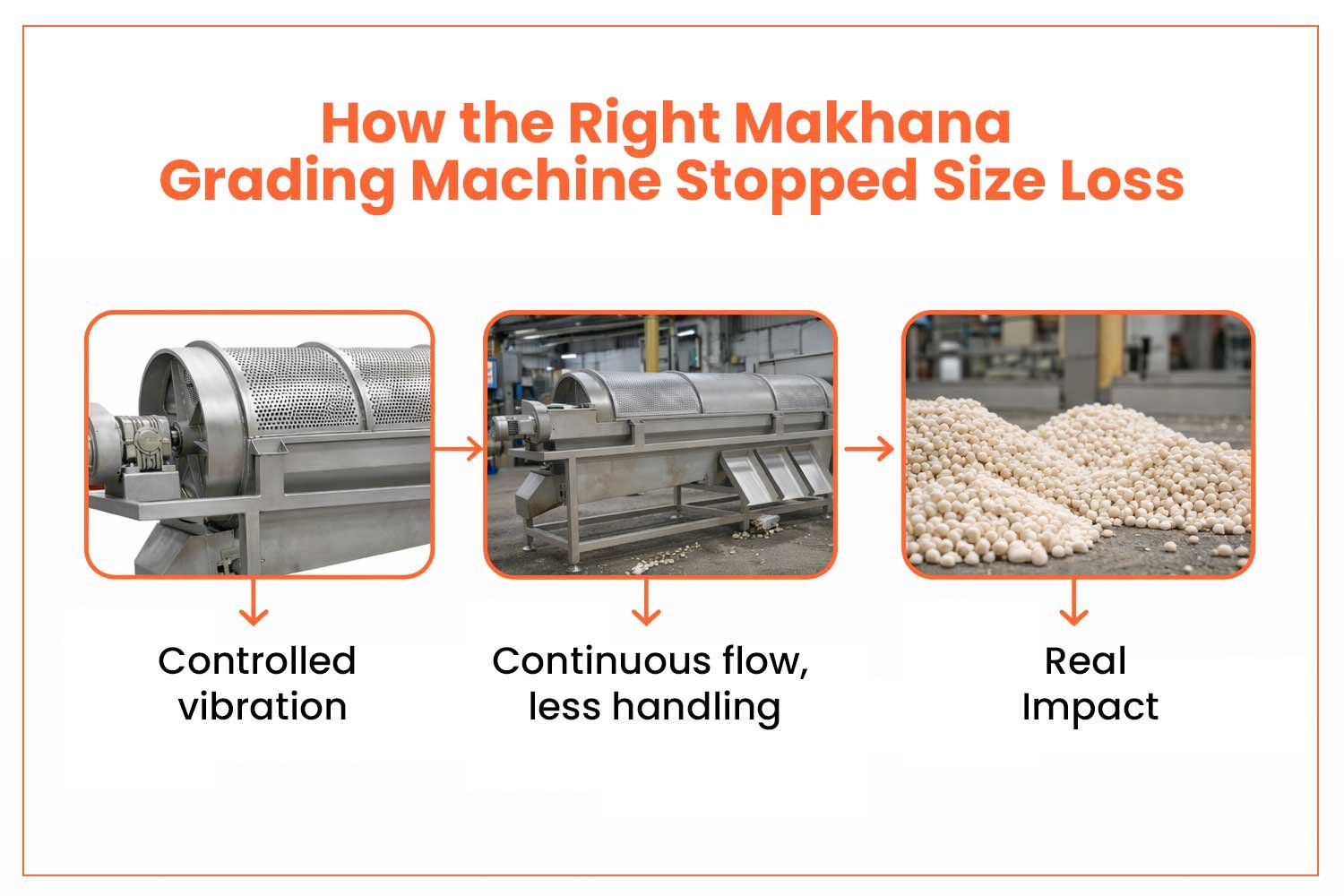
- Controlled vibration: The kernels didn’t bounce or crowd, and they moved steadily, resulting in very little breakage.
- Continuous flow, less handling: Manual intervention was significantly reduced, resulting in a significant decrease in repeated damage and quality loss.
- Real impact: With precise separation and very little human dependency, the unit quickly got back its lost premium grades, so the pricing was stable, and the monthly material loss was significantly reduced.
How We Help Makhana Manufacturers Prevent Grading Losses Effectively
We provide support to makhana producers to prevent grading losses through a meticulous examination of their processing capability. Every kernel’s handling precision is guaranteed through the analysis of batch sizes, peak loads, and product mix.
Our target: Actual makhana processing loss reduction, rather than pressing for unnecessary upgrades. With the correct arrangement, our clients are able to redeem premium grades, lessen the breakage rate, and increase the monthly profit margin, all while using the same labour force and not changing the handling process.
Conclusion
The proper grading solution upgrade halted the hidden losses of our customers. Foodsure Machines guarantees accurate separation, reduced breakage, and increased profits. We are dedicated to supporting the makhana manufacturers in defending their margins and simplifying their processing with trustworthy and productive machines.
Makhana Grading Machine – FAQ
What is a food makhana grading machine?
This machine not only sorts the makhana kernels into different sizes but also separates quality grades so every batch remains uniform and consistent.
Why is grading makhana important?
Buyers pay more for uniform-size products, and poor grading silently reduces margins through rejection and price cuts.
Can a grading machine reduce breakage?
Yes — a good grading machine handles kernels gently and minimises cracking during sorting.
Is it suitable for small-scale units?
Yes. Models are available for small units as well as large commercial processing lines.
What capacity do these machines have?
Capacity varies by model — from 50 kg per day in small units to several tons in industrial systems.
Are automatic and semi-automatic options available?
Yes. Semi-automatic units work with operator support, while fully automatic systems reduce labour dependency.
How accurate is size separation?
Premium-grade machines generally achieve 95–99% accuracy in size and grade separation.
Does it save labour costs?
Yes — reduced manual sorting means fewer workers, fewer errors, and lower rework costs.
Can it handle mixed-quality batches?
Yes — premium, medium, and small kernels are separated cleanly without cross-mixing.
Is maintenance difficult?
No — routine cleaning and periodic checks are usually enough to keep it running smoothly.
What is the typical ROI for small units?
Higher pricing and reduced wastage help most small units recover investment within 6–12 months.
Does it work for all types of makhana?
Yes — it effectively grades raw, semi-processed, and roasted makhana types.