The popularity of protein bars has now shifted from their presence in fitness bags to being part of day-to-day snacking, while the requirement for such bars in India has continued to increase over time. More manufacturers are now entering into the segment, and each one of them has a common production issue maintaining the consistency of size, weight, texture and hygiene in each product.
A suitable protein bar production machine helps automate the process of mixing, molding and cutting, thereby allowing you to reduce dependence on manual labor and expand operations without compromising quality. Hence, it becomes equally important for you to choose the right protein bar machine manufacturer.
Why Are Businesses in India Investing in Protein Bar Making Machines?
Because hand-made batches cannot keep up with demand, and buyers notice the difference quickly.
Quality consistency. The machine blends, forms and cuts each batch using the exact specifications. Bars will weigh and feel the same for the retailers and their clients.
Greater production rate. Even a small protein bar production line is capable of producing 50 to 80 kg of bars per hour. This amount exceeds anything a manual workforce can deliver in a single shift.
Process consistency. Time of mixing, pressure used to form bars and the size of cut pieces can be programmed. Consistency will reduce the number of rejections and amount of wasted protein powder.
Reduced manpower requirement. With machines doing blending, forming and cutting jobs, you will have fewer people on the floor. Your dependence on certain skillful people will be reduced as well.
Ability to scale. Begin with base units and add coating/packaging options as needed. As your orders increase, add more units to the line without rebuilding everything from scratch.
Key Features to Look for in a Protein Bar Making Machine
Not every machine is built the same, so check these points before you request a quote.
Accuracy and control. Seek adjustable cutting size and mixing parameters. Protein bars vary from soft date-based bars to hard whey blends, and the equipment needs to be adjustable according to your recipe.
Uniform formation. Your protein bar forming machine / protein bar extruder should form the mixture in uniform slabs or bars. Otherwise, there will be unevenness of the products, which leads to variations in their weights and losses.
Capacity that meets your needs. You need to determine your production capacity per hour first. Buying far beyond it is a waste of money, and buying below it will require replacement within a year.
Sanitization and materials. High-quality food grade stainless steel is a must. The construction should be easily cleaned in order to meet GMP and FSSAI requirements.
Ease of use. It will be easier for your personnel to work and to make fewer mistakes using a simple interface of the machine. You can inquire whether the manufacturer provides on-site training.
Scalability. Find out whether you can purchase a coating unit, cooling system or packaging equipment separately at some point.
How Does a Protein Bar Production Line Work?
The exact process varies by model and recipe, but most lines follow these stages.
Preparation. The protein powders, oats, nuts and syrup are weighed and fed. Proper weighing is important in this step for accurate nutritional value on the packaging.
Blending. The blender mixes the dry ingredients with syrup or binder such that the blend is consistent and sticky.
Extrusion/forming. The extruder forms the blend into a homogeneous slab or bar profile. This is the step that determines the consistency of the final product.
Cooling and Cutting. The formed mass is cooled to stiffen it after which it is cut into bars with identical weight.
Coating (if needed). The enrober coats the formed bar with chocolate or yogurt followed by cooling.
Packaging and quality assurance. The bars are packed hygienically. There is weighing and metal detection before distribution.
How to Pick the Right Protein Bar Machine Capacity
Choosing the right capacity tier saves money on both sides: you avoid paying for output you do not need, and you avoid outgrowing the machine too soon. Think about current demand, floor space, budget and how fast you expect to grow. Prices range from around ₹8 lakh to ₹35 lakh depending on capacity and automation.
| Production Scale | Suitable For | Key Consideration |
|---|---|---|
| Small (around 50–80 kg/hr) | Startups and health snack brands making their first in-house batches | Lowest investment, with entry-level setups starting around ₹8 lakh. Check that cutting and forming can be upgraded later. |
| Medium (semi-automatic line) | Growing nutrition brands and contract bar makers handling regular orders | Individual units such as a mixer, extruder and cutter cost roughly ₹1–4 lakh each, so you can build the line step by step. |
| Large (full automatic line) | Established factories supplying retail chains and export orders | A complete mixing, extruding, coating and packing line is around ₹30–40 lakh. Plan space, power and trained staff first. |
Biggest Challenges and Solutions for Protein Bar Production in India
Most problems come from sticky mixtures, uneven output and unreliable support. Here are the four we see most often.
Hard and difficult to process mix
High protein content and density make it very difficult to process, with chances of jamming in the extruder and sticking to cutting blades.
Solution–
Invest in machinery capable of handling high protein and binder content mix and have the manufacturer test it using your own recipe before purchasing.
Variation in size of bars
Manual cutting process or poor calibration of machinery produces bars of varied sizes causing customer dissatisfaction and quality tests failure.
Solution–
Purchase machinery which is equipped with controls for forming and cutting bars and equip it with weighing and testing stations.
Pressure on hygiene and compliance
Protein bars are food safety sensitive products and machinery which cannot be easily cleaned is more vulnerable to contamination.
Solution–
Purchase food grade stainless steel machinery which complies with GMP and FSSAI norms.
Machine breakdown without immediate support
A machine which breaks down for a week due to the absence of spare parts may cost you much more than the difference in price of the machine. Many customers realize this only when it is too late.
Solution–
Collaborate with manufacturers who provide installation, employee training and easy access to spare parts.
Benefits of Using Automated Protein Bar Machines
Automation pays back through quality, speed and lower running effort.
- Consistent output: all the bars are uniform in terms of weight, size and texture.
- Increased speed: machines produce bars faster compared to manually prepared batches.
- Decreased manpower: less workforce is required to blend, shape and cut the bars.
- Minimal wastage: accurate metering and cutting leads to minimal loss of material.
- Easy scalability: install systems for coating, cooling or packaging as you increase orders.
How to Choose the Best Protein Bar Machine in India?
The best machine is not the biggest or the most expensive one. It is the one that fits your needs.
- Output per day (Kg/Hour)
- Type and Size of Bar
- Type of Recipe & Stickiness
- Degree of Automation
- Food grade Stainless Steel Construction
- GMP/FSSAI Compliant
- Warranty and Reliability
- Installation/Training of Operator
- Availability of Spares
- Budget and Scope of Upgradation
Why Choose Foodsure Machines for Protein Bar Machines?
Foodsure Machines boasts 13+ years of expertise in assisting food companies grow with improved machines. Our food grade stainless steel protein bar machine includes mixing, cutting, coating and packaging (optional), with easy-to-use controls which your employees will easily be able to operate.
Our services don’t end there! The Foodsure Machines company also offers installation, training for staff members, and spare parts from our regional service centers located throughout India.
Start your protein bar production with Foodsure Machines — Enquire now!
FAQs
What is a protein bar making machine?
The most important machine which blends the materials into one single block from which protein bars can be cut out in uniform sizes and weights.
How much does a protein bar machine cost in India?
It costs anywhere from ₹8 lakh upwards depending on the quantity of production and extent of automation.
What is the protein bar machine capacity per hour?
Usually small machines have a capacity of 50 to 80 kg per hour. The larger machines far exceed the above capacities.
What equipment comes in the protein bar production line?
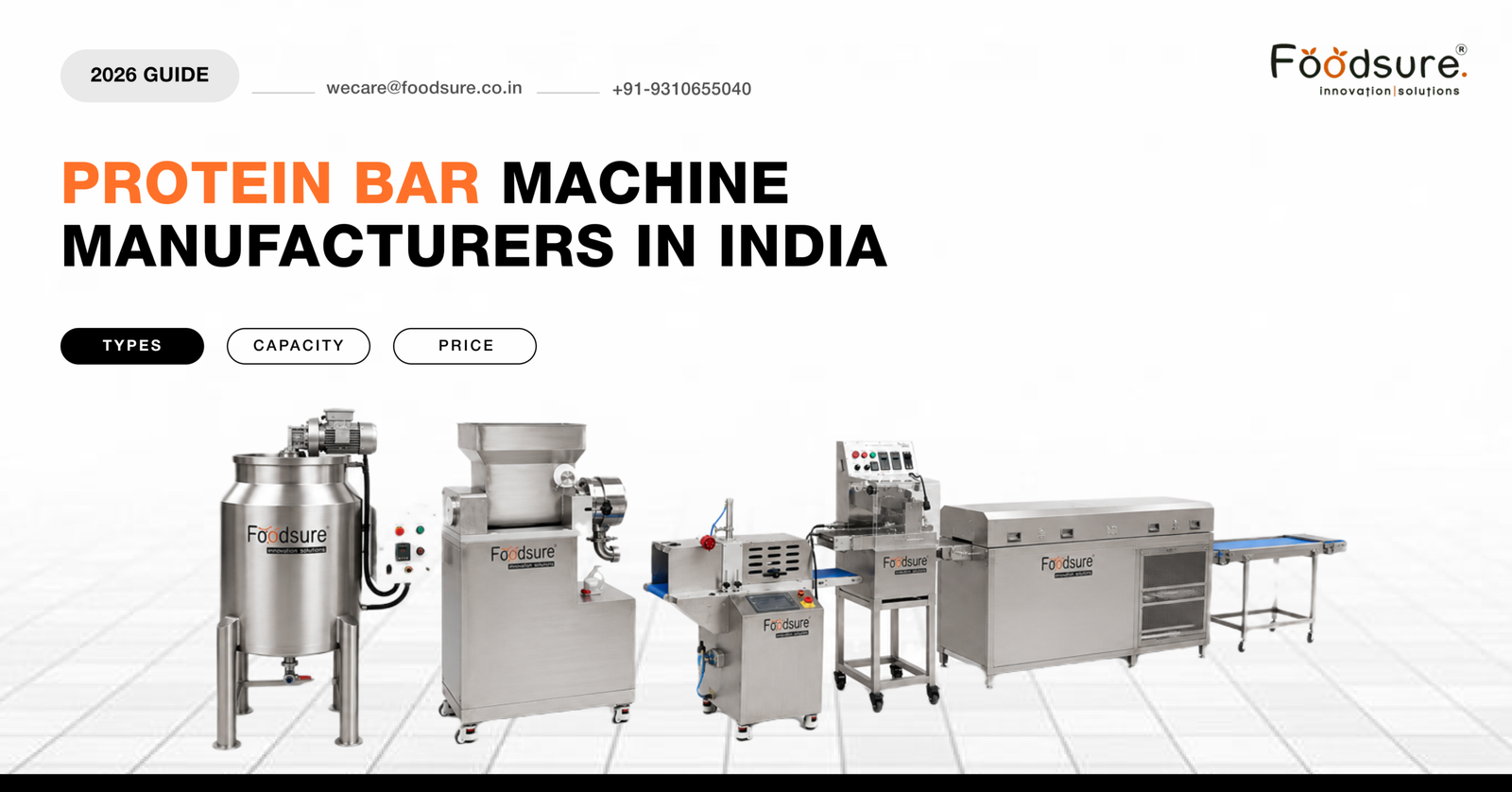
The complete production line consists of a mixer, slitter or extruder, cooler and cutter. The chocolate coated bars also need an enrobing and cooler.
Which is the best protein bar machine for startups?
For startup, a basic machine consisting of a mixer, slitter or extruder and cutter would suffice. It is better if they can install a coating and packing machine later.
What should I look for while choosing a protein bar machine manufacturer?
The one who offers you recipe development trial, warranty and after-sales support in addition to delivering the machine.