If you have been researching makhana processing machines for even one week, you must be aware of how many different players there are in this market, and not all of them deserve to be on your factory floor. There is an ever-increasing demand for roasted and flavored makhana across India and international markets. The traditional popping and roasting methods cannot cater to this increasing demand.
Selecting the right supplier goes beyond just picking a supplier who offers the most affordable machines. It involves machinery capability, machine build, after-sales support, and whether the company really knows how to handle makhana. It also means looking at how much the process depends on manual handling, because human errors in grading, roasting, flavouring, weighing, and packing can create batch-to-batch variation as production volumes increase. In this buyer’s guide, we’ve evaluated the top makhana machines companies in India on exactly these parameters, so you can compare them side by side before making a decision. We’ll also walk through what to expect from a genuine makhana machine manufacturer in India, how pricing typically works, and the questions worth asking before you sign a purchase order.
How We Selected the Top Makhana Machine Companies in India
A good makhana processing equipment company is one that offers a genuine machinery range (not just a single roaster relabelled for every product), uses food-grade construction, supports capacities from small batch to industrial scale, and stands behind the machine after installation with training and spare parts. Companies were shortlisted on these grounds, not on marketing claims alone.
Beyond that headline answer, here’s what actually went into the shortlist.

Range of Makhana Processing Machinery
The best vendors do not sell a single machine as a solution. They offer machinery for grading, cleaning, roasting, flavoring, dehusking when needed, weighing and packing and, increasingly, a whole line of machinery connecting all these processes. A one-machine vendor is good enough for a very small unit, but not for a business thinking about growth.
This also matters because every additional manual step creates another opportunity for human error. In a small batch, an operator may be able to identify and correct an issue. At commercial volumes, inconsistent grading, uneven roasting or incorrect seasoning can affect an entire batch before the problem is noticed.
Capacity and Level of Automation of Processors
Some processors require 30 kg per hour, others 200 kg per hour over several shifts. We considered if a company offered realistic capacity range and not just a machine that “fits all.” If their automation (semiautomatic or push button automatic) really fit medium sized and large processors’ needs was another criterion.
Automation is particularly relevant when the same process has to be repeated for several shifts. Manual operations can vary with operator experience, fatigue, attention, and workload. A well-designed automatic or push-button system can reduce these variations, although proper operator training and process monitoring are still necessary.
Quality of Machine and Food Grade Material Used
Contact material is important in makhana processing because of repeated exposure to heat and handling. Companies which manufacture using food grade stainless steel in contact parts and use robust construction material in other places were considered better than those which did not take care about construction quality.
Machine construction also affects how consistently operators can work with the equipment. Poorly designed equipment can increase manual intervention, make cleaning difficult, or make it easier for an operator to make mistakes during routine production.
Customisation and Plant Integration
Every plant does not have the same floor layout, power supply, and product portfolio. The more flexible the company is about providing customised size, capacity, and even multi-product capabilities (such as peanut and pumpkin seed machines) in their equipment than forcing one format on everyone.
Good integration can also reduce unnecessary manual transfers between machines. Every time product is manually moved from one stage to another, there is a possibility of spillage, contamination, incorrect batch handling, or simple operator error.
Installation, Training and After Sales Support
What is sold with the machine is more important than the machine itself. We took into consideration the support services like the installation of the machine, training for the operators and the time period offered for the warranty.
Operator training matters because automation does not eliminate human error completely. Incorrect settings, poor cleaning practices, improper loading, or failure to follow operating procedures can still affect product quality. Proper commissioning and training help reduce these avoidable mistakes.
Industry Experience and Customer Applications
Finally, we looked at how long each company has actually been building food processing machinery, and whether their client base reflects real, ongoing use in commercial makhana processing rather than a handful of one-off orders. Together, these six parameters are what separate serious makhana processing equipment companies from vendors selling a single generic roaster.
Top 5 Makhana Machines Companies in India
This is the part most buyers skip straight to, and fair enough. Below are five companies worth evaluating if you’re setting up or upgrading a makhana processing line in India. We’ve kept each profile in the same format so you can compare them without digging through five different websites.
1. Foodsure Machines
Company overview: Foodsure Machines is a Noida-based food processing equipment manufacturer that designs, builds, and installs machinery and turnkey plant solutions for snack, health food, sauce, and condiment producers across India, the GCC, and South Asia. Makhana processing is one of its core focus areas, alongside protein bar, energy bar, mayonnaise, and ketchup processing lines.
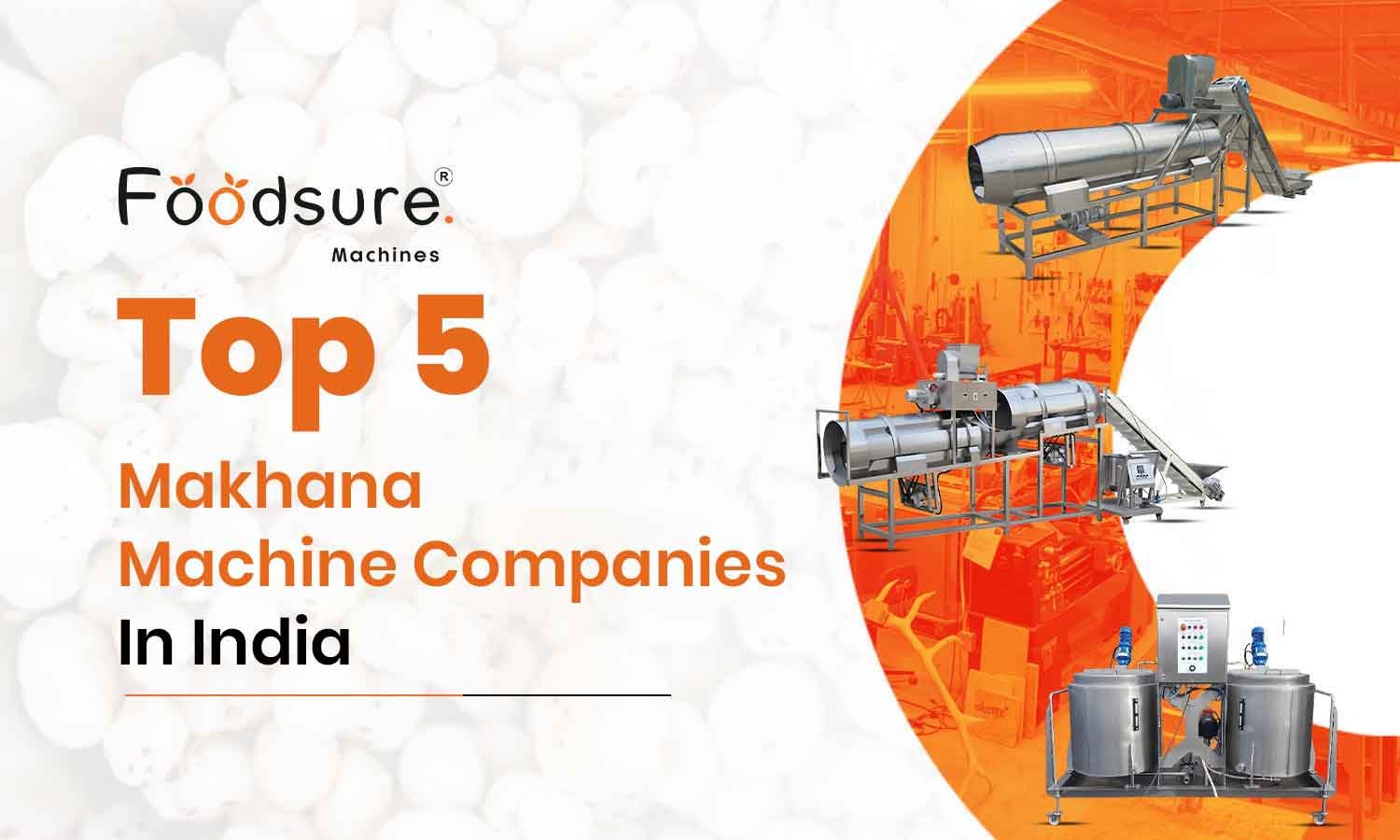
Makhana machinery offered: Foodsure Machines builds electric roasting and processing equipment engineered specifically for makhana, with the same platform also configured for peanuts and pumpkin seeds, useful for processors who want to diversify their dry snacks line without buying separate machines for each product.
Processing capacities: The company offers a genuinely wide capacity range instead of a single fixed output, which is where it stands apart from many smaller suppliers.
| Capacity per Hour | Power (kW) | Area Required (Sqft) | Size of Machine (L × W × H, ft) | MOC |
|---|---|---|---|---|
| 30 kg | 15–18 kW | 2,000 | 45 × 12 × 15 | SS 304 |
| 50 kg | 20–25 kW | 5,000 | 55 × 12 × 15 | SS 304 |
| 100 kg | 30–35 kW | 10,000 | 100 × 12 × 15 | SS 304 |
| 200 kg | 55–60 kW | 15,000 | 150 × 12 × 15 | SS 304 |
Automation options: Push-button controlled operation, built for high productivity with minimal manual intervention once loaded. Reducing manual intervention can also help limit common operator mistakes such as inconsistent loading, timing variations, and uneven process handling during repetitive production runs.
Key strengths: Food-grade SS304 for all product-contact parts and SS302 for non-contact structural components, electric heat source (no open-flame dependency), large-capacity design, and a machine footprint (approximately 2375 × 690 × 1630 mm on the base unit) built for continuous commercial runs rather than intermittent use. It runs on a standard 415 V, 3 Phase, 50 Hz industrial connection, which keeps installation straightforward for most Indian factory setups.
Best suited for: Processors who want one manufacturer to handle the full range, from a 30 kg/hour starter setup to a 200 kg/hour industrial line, without switching suppliers as they scale, and who value food-grade construction over the cheapest possible quote.
Service and support: 1-year warranty, along with installation, operator training, and after-sales technical support as part of the standard onboarding, so new lines aren’t left to figure things out alone. Training is also important for reducing human errors during machine operation and ensuring that operators follow the intended process settings.
2. Blacknut Agrifood Machinery
Company overview: An Ambala, Haryana-based agri-food processing machinery manufacturer with a broad catalogue spanning mango, onion, potato, tomato, spice, and fruit processing plants, alongside a dedicated makhana equipment line, giving them real cross-category engineering depth.
Makhana machinery offered: A Makhana Popping Machine, a Makhana Processing Plant, a Makhana Roaster, and a Makhana Grading Machine, covering most of the early-stage processing steps under one supplier.
Processing capacities: The popping machine runs at 20–25 kg/hour, while the processing plant is rated at 40 kg/hour, extendable up to 80 kg/hour, with higher custom capacities available on order.
Automation options: The popping machine is fully automatic; the larger processing plant is offered in a semi-automatic configuration.
Key strengths: Construction options across stainless steel, mild steel, and cast iron depending on the model, plus flexibility on single-phase and three-phase power, which suits smaller or budget-conscious setups.
Best suited for: Processors wanting a dedicated, purpose-built makhana line from a company that also understands broader agri-processing, rather than a generic multi-snack platform.
Service and support: Sold and serviced through an IndiaMART TrustSEAL-verified storefront, with direct factory contact in Ambala for enquiries and after-sales queries.
3. Kalyan Machines
Company overview: A Noida-based trader and distributor of snack processing machinery, active since 2011, with a catalogue that spans kurkure extruders, corn puff lines, packing machines, and a dedicated makhana processing machine range.
Makhana machinery offered: An automatic foxnut snacks processing plant, a semi-automatic foxnut snacks processing plant, a makhana roaster machine with food-grade coating, an automatic foxnut packing machine, and a makhana packing machine.
Processing capacities: The semi-automatic plant runs at 50 kg/hour, the automatic plant and roaster machine at 100 kg/hour, with packing machines rated by pouches per minute rather than weight.
Automation options: Both semi-automatic and fully automatic options are listed across the makhana range, so buyers can pick based on budget and shift pattern.
Key strengths: A wide adjoining catalogue (packing, corn puff, kurkure machinery) that makes them a convenient single point of contact if you’re running a multi-product snack unit alongside makhana.
Best suited for: Processors who want makhana roasting and packing equipment from the same source as their other snack-line machinery.
Service and support: As a trading and distribution company rather than an in-house manufacturer, service and spare-part turnaround depend on their supplier network, which is worth confirming directly before ordering.
4. Kanchan Metals Pvt. Ltd. (Snack Food Machines)
Company overview: A Greater Noida-based, large-scale food processing equipment manufacturer with an in-house R&D centre and a client roster that includes major snack and FMCG brands, reflecting serious manufacturing scale.
Makhana machinery offered: Roasted nut processing machinery falls under their snack food machinery segment, alongside potato, extruded snacks, namkeen automation, and packaging equipment, making them more of a full-plant engineering partner than a makhana-only specialist.
Processing capacities: Built around industrial-scale, contract-manufacturing-grade output rather than small-batch setups, in line with their work for large branded snack manufacturers.
Automation options: Custom-engineered automation levels depending on project scope, since much of their work is bespoke plant design rather than off-the-shelf units.
Key strengths: Genuine large-enterprise credibility, an R&D centre, and experience contract-manufacturing for a major national snack brand, which signals engineering depth beyond a standard catalogue seller.
Best suited for: Large processors or brands planning a full-scale, heavily customised makhana or dry-snack plant rather than a single standalone machine.
Service and support: Dedicated B2B support team for equipment evaluation and spare parts, though their scale and bespoke approach generally suit larger project budgets rather than small first-time buyers.
5. Jackson Machine
Company overview: An Ahmedabad-based snack machinery manufacturer with over 20 years of experience, built primarily around Gujarati and Indian snack formats like samosa, papad, khakhra, chapati, and farshan.
Makhana machinery offered: Not a dedicated makhana line; their core strength is roasting and forming equipment for khakhra, papad, and farshan-style snacks, which shares some underlying roasting technology with makhana processing but isn’t purpose-built for it.
Processing capacities: Varies by machine type, generally sized for small to mid-scale regional snack manufacturers.
Automation options: Both semi-automatic and automatic machines across their catalogue, including a dedicated khakhra roasting machine.
Key strengths: Long-standing experience and cost-effective pricing within their core snack categories.
Best suited for: Processors primarily looking at khakhra, papad, or farshan machinery who might explore makhana roasting as an add-on conversation rather than their main use case.
Service and support: Over two decades in the market with an established customer base, though makhana-specific support should be confirmed directly given it isn’t their primary product line.
Comparison of the Top Makhana Machine Companies in India
Reading five separate profiles is useful, but sometimes you just want the numbers next to each other. Here’s how these makhana machines companies in india stack up on the factors that actually affect a buying decision.
| Company | Machinery Range | Capacity Options | Automation | Customisation | After-Sales Support |
|---|---|---|---|---|---|
| Foodsure Machines | Roasting, processing lines, multi-product (makhana, peanuts, pumpkin seeds) | 30 kg/hr to 200 kg/hr | Push-button automatic | Capacity, dimension, and multi-product configuration | Installation, training, 1-year warranty |
| Blacknut Agrifood Machinery | Popping machine, processing plant, roaster, grading machine | 20 kg/hr to 80 kg/hr (custom higher capacities on order) | Automatic and semi-automatic variants | MOC and power configuration options | Direct factory support, TrustSEAL-verified |
| Kalyan Machines | Roaster, processing plants, packing machines | 50 kg/hr to 100 kg/hr | Semi-automatic and automatic | Limited, catalogue-based | Distributor-network dependent |
| Kanchan Metals (Snack Food Machines) | Roasted nut machinery within a full snack/plant engineering catalogue | Industrial, project-based | Custom-engineered automation | High, bespoke plant design | Dedicated B2B support, spare parts team |
| Jackson Machine | Khakhra, papad, farshan roasting equipment (not makhana-dedicated) | Small to mid scale | Semi-automatic and automatic | Standard, within their core snack range | 20+ years in market, direct support |
What Types of Makhana Processing Machines Do These Companies Offer?
Before you commit to one makhana machine manufacturers in India shortlist, it helps to understand the individual machines that make up a full processing line. Most buyers don’t need all of these on day one, but knowing what exists helps you plan for where the business is headed.
Makhana Cleaning Machines
These remove dust, husk fragments, and foreign material from raw makhana before it enters the roasting stage. Clean input directly affects the final product’s shelf life and appearance.
Manual cleaning can also introduce inconsistency because operators may miss smaller foreign particles or process different quantities at different speeds. Mechanical cleaning helps make this stage more consistent when production volumes increase.
Makhana Grading Machines
Grading sorts makhana by size, which matters because uniform-sized kernels roast more evenly and command better pricing in premium retail and export channels.
Manual grading depends heavily on operator judgement and attention. Differences in visual assessment can result in mixed sizes entering the same roasting batch, which can then contribute to uneven roasting.
Makhana Roasting Machines
The core of any processing line. Roasting machines apply controlled, even heat to pop and crisp the kernels without scorching them, which is where machine quality genuinely shows.
Manual roasting can be particularly sensitive to human error. Variations in temperature monitoring, roasting time, batch loading, or operator attention can lead to under-roasted or over-roasted kernels. At larger production volumes, even a small process variation can affect a significant quantity of product.
Makhana Flavouring Machines
Used for coating roasted makhana with salt, spice blends, or other flavour profiles. Even coating without excess oil or masala wastage is the mark of a well-built flavouring unit.
Manual flavouring can lead to differences in seasoning quantity from one batch to another. An operator may also add seasoning too quickly, too slowly, or unevenly, affecting taste consistency and increasing material wastage.
Makhana Dehusking Machines
Where applicable, dehusking machines remove any remaining outer shell before or after roasting, depending on the processing method used.
The level of manual intervention required at this stage can influence both processing speed and consistency. Repetitive manual handling also increases the possibility of missed shells or unnecessary product handling.
Makhana Weighing and Packaging Machines
These handle portion control and sealing for retail packs, bulk cartons, or export-ready packaging, an increasingly important step as more processors move into branded, shelf-ready products.
Manual weighing creates another common source of human error. Small differences in every pack can add up to significant product giveaway or underweight-pack compliance issues across thousands of packs. Automated weighing and packing can help improve portion consistency while reducing repetitive operator work.
Complete Makhana Processing Lines
For larger operations, individual machines are connected into a single line, cleaning through packaging, cutting down manual handling and labour cost significantly compared to running standalone machines.
Reducing unnecessary manual transfers also reduces opportunities for human error, product spillage, inconsistent batch handling, and delays between processing stages.
How to Choose the Right Makhana Machine Manufacturer in India
Once you know the machine types, the next step is narrowing down the right partner. Here’s what actually matters when you’re comparing quotes.
Define Your Required Processing Capacity
Work backward from your monthly production target, not the other way around. Buying a 200 kg/hour line for a 50 kg/hour business ties up capital you don’t need to spend yet.
Also consider how much of the current process depends on manual labour. A machine that matches your nominal capacity but still requires extensive manual intervention may not deliver the consistency or labour savings you expect.
Decide Between Semi-Automatic and Automatic Machinery
Semi-automatic machines cost less upfront and suit smaller teams, while push-button automatic systems reduce labour dependency and are better suited to businesses running multiple shifts.
Automation can also reduce human errors caused by repetitive tasks, operator fatigue, inconsistent timing, and variations in manual handling. However, operators still need to monitor the machine and follow the correct operating procedures.
Check Product-Contact Materials and Machine Construction
Anything touching the makhana during processing should be food-grade stainless steel. Non-contact structural parts can use a slightly different grade, but the parts handling your product shouldn’t be a place to cut costs.
Evaluate Power and Space Requirements
Larger capacity machines need more power and floor space. Confirm your electrical connection (most industrial lines run on 415 V, 3-phase supply) and factory layout can actually support the machine before ordering.
A poorly planned layout can also force unnecessary manual movement of material between stages, increasing handling time and the chances of operator mistakes.
Check Customisation Options
Ask whether the manufacturer can adjust dimensions, capacity, or add multi-product functionality. A rigid, non-customisable machine can become a limitation as your business grows.
Ask About Installation and Operator Training
Confirm whether installation and training are included in the price or billed separately. A machine that arrives without proper commissioning support often sits idle longer than it should.
Training should cover not just machine operation but also loading, cleaning, settings, safety, troubleshooting, and what operators should do when something looks abnormal. Many avoidable production errors happen when operators are unsure whether to stop the machine or continue running it.
Evaluate Spare Parts and After-Sales Support
Ask how quickly spare parts are available and whether the company offers ongoing technical support after the warranty period ends. This is often the difference between a two-day downtime and a two-week one.
Good technical support can also help identify whether a recurring problem is caused by a machine component, incorrect settings, maintenance issues, or operator error.
Consider Complete Plant Integration
If you’re planning to scale, check whether the manufacturer can integrate additional machines into your existing line later, rather than requiring a full new setup. This is also a useful test when you’re shortlisting makhana machine suppliers in india, since not every reseller can support a full plant build-out down the line.
How Much Does Makhana Processing Machinery Cost in India?
There’s no single honest number here, and any company giving you one figure without asking about your capacity needs is skipping a step. Cost depends heavily on scale and automation level.
Small-Scale Makhana Processing Setup
Entry-level setups, typically around 30 kg/hour, are the most affordable starting point for new processors testing the market before committing to a larger investment.
At this level, businesses may also tolerate more manual intervention, but they should still consider how human errors affect product consistency as volumes increase.
Semi-Automatic Makhana Processing Setup
Mid-range setups (roughly 50–100 kg/hour) balance investment against output and suit growing regional brands that have outgrown manual processing but aren’t yet running multiple shifts.
Automatic Makhana Processing Line
Full automatic lines at 200 kg/hour and above involve a larger upfront investment but bring down per-kg processing cost significantly at scale, which matters for export-focused businesses.
The reduction in manual intervention can also make production more repeatable across shifts, reducing variations caused by different operators following the same process slightly differently.
Factors That Affect Makhana Machine Cost
- Capacity requirement
- Number of machines in the line
- Automation level
- Material specification (SS304 vs other grades)
- Packaging requirements
- Customisation needs
- Installation and commissioning charges
If you want a detailed breakdown by capacity tier, our dedicated guide on makhana machine price in india covers real cost ranges and what typically drives them up or down.
Questions to Ask Before Buying Makhana Processing Equipment
Whichever of the makhana machines companies in india you’re leaning toward, run these questions past them before signing anything. A confident, specific answer to each one tells you a lot about how the relationship will go after the sale.
What Production Capacity Does the Machine Handle?
Get this in kg per hour, not vague terms like “high capacity.” Ask for it in writing.
Can the Machine Be Customised for My Product?
If you’re planning to process peanuts or pumpkin seeds alongside makhana, confirm the machine supports that before, not after, purchase.
What Is Included in the Machine Price?
Confirm whether installation, training, and initial spare parts are part of the quoted price or added separately.
Does the Company Provide Installation and Training?
On-site commissioning and operator training materially affect how fast your line becomes productive.
Ask whether the training also covers common operating mistakes, machine settings, cleaning procedures, loading practices, and basic troubleshooting. The goal isn’t just to teach an operator how to start the machine, but how to operate it consistently.
What After-Sales Support Is Available?
Ask specifically about response time for service requests, not just whether support “exists.”
Are Spare Parts Easily Available?
Confirm lead time for spare parts, especially for components that see the most wear, like heating elements and moving parts.
Can Multiple Machines Be Integrated Into One Processing Line?
If scaling is on your roadmap, ask this upfront rather than discovering the limitation later.
Choose the Right Makhana Machinery Company for Your Business
Comparing makhana machine companies eventually comes down to a handful of factors that actually matter: machinery range, capacity flexibility, food-grade construction, customisation, and whether the company sticks around after the invoice is paid. Price matters too, but it shouldn’t be the only line item on your checklist.
Human error is another factor worth considering, particularly as production moves from a small operation to multiple shifts. Manual grading, roasting, flavouring, weighing, transferring, and packing each introduce opportunities for inconsistency. The right level of automation can reduce these repetitive errors while still keeping trained operators in control of the process.
Foodsure Machines was built around exactly that checklist, offering electric, push-button automatic makhana processing machines across a 30 kg to 200 kg per hour range, built in food-grade SS304 for all product-contact parts, with a 1-year warranty and full installation, training, and after-sales support included. It’s also worth a look if you’re processing or planning to expand into a roasted makhana manufacturer in india setup, since the same processing line adapts well for peanuts and pumpkin seeds too.
If you’re evaluating makhana processing equipment companies for a new setup or an upgrade, it’s worth getting a capacity-specific quote before deciding. Reach out to Foodsure Machines for a consultation, and get a machine recommendation based on your actual production targets, not a generic catalogue price.
Have a Question? Let’s Connect
Need expert guidance on food processing machines, production setup, or process optimization? Our team is ready to help you choose the right solution for your business.
Frequently Asked Questions
Which is the best makhana machine company in India?
There’s no single universal answer, since the right choice depends on your required capacity and budget. Among the makhana machines companies in india, Foodsure Machines stands out for offering a genuine capacity range from 30 kg to 200 kg per hour with food-grade SS304 construction and full after-sales support.
Who are the leading makhana machine manufacturers in India?
Leading manufacturers typically offer a full machinery range covering cleaning, roasting, flavouring, and packaging, along with food-grade construction and installation support, rather than a single standalone machine.
How much does a makhana processing machine cost in India?
Cost varies by capacity and automation level, ranging from more affordable small-scale setups around 30 kg/hour to larger automatic lines at 200 kg/hour and above. Material grade and customisation also influence final pricing.
Which machines are required for makhana processing?
A complete line typically includes cleaning, grading, roasting, flavouring, and weighing/packaging machines, though smaller processors often start with just a roasting unit and add stages as they grow.
What capacity makhana machines are available in India?
Capacities generally range from 30 kg/hour for small units up to 200 kg/hour or more for industrial lines, with several manufacturers offering intermediate options at 50 kg and 100 kg per hour.
How do I choose a makhana machine supplier in India?
Evaluate machinery range, food-grade construction, capacity options, customisation flexibility, and after-sales support together, rather than comparing on price alone. Also consider how much manual intervention each machine requires and whether the manufacturer provides operator training to minimise human errors during production.
Can makhana processing machines be customised?
Yes, most established manufacturers offer customisation around dimensions, capacity, and multi-product functionality, though the extent varies by company, which is worth confirming before ordering.