
Makhana processing is gaining attention as Indian producers expand cultivation, processing and value-added snack manufacturing. According to the Press Information Bureau (PIB), India’s makhana production reached 63,910 metric tonnes in 2024–25, while the second advance estimate for 2025–26 projects production at 80,590 metric tonnes. These figures indicate an expanding production base, although the 2025–26 figure is an estimate rather than a final production total.
For food processing businesses in Chandigarh, this growth creates opportunities to explore makhana roasting, flavouring and packaged snack manufacturing. However, commercial production requires more than access to raw materials. Manufacturers must maintain consistent roasting quality, manage energy consumption and choose equipment that matches their production requirements.
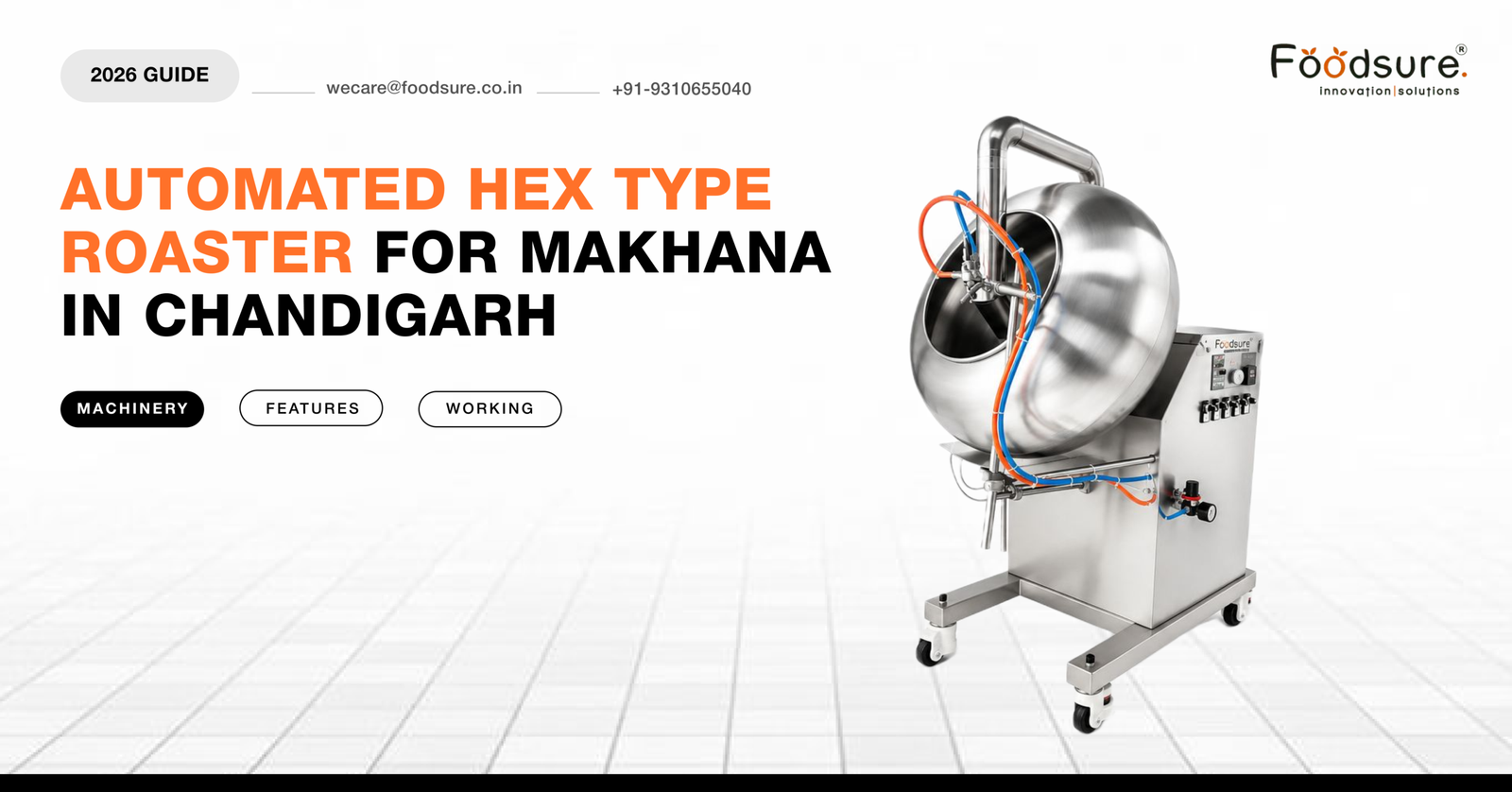
An automated hex type roaster for makhana uses a rotating hexagonal drum and a controlled heating system to roast makhana under defined operating conditions. Depending on the selected configuration, it can help standardise product movement, reduce repetitive manual operations and prepare roasted makhana for subsequent seasoning, cooling and packaging.
Whether you are starting a new makhana business or upgrading an existing facility, the right machine depends on your expected output, raw material quality, heating requirements, available floor space and future production plans.
Why Are Businesses in Chandigarh Investing in Automated Hex-Type Roasters?
The commercial opportunity extends beyond India’s domestic snack market. An APEDA Market Intelligence Cell dashboard, citing CRISIL Intelligence, reported that Indian makhana exports increased from 7,260 metric tonnes in 2020 to 25,130 metric tonnes in 2024, representing nearly four times the 2020 volume. The report also highlighted the importance of premium product grades and value-added makhana products in export markets.
For manufacturers, these developments make consistent roasting, product grading and efficient processing important considerations. Moving from manual roasting to a hexagonal makhana roaster can help address several operational challenges.
- More consistent roasting: A rotating hexagonal drum moves makhana through the heated chamber, helping distribute heat across the batch. Actual consistency depends on drum design, heating arrangement, batch size and operating settings.
- Improved process efficiency: Controlled heating and repeatable operating conditions can reduce unnecessary interruptions and make production easier to manage.
- Better temperature control: Digital temperature controls allow operators to monitor and adjust heating more precisely than methods relying entirely on manual observation.
- Reduced repetitive labour: Depending on the automation level, the machine can reduce frequent manual temperature adjustments and other repetitive tasks. Operators must still oversee loading, quality checks, discharge and safe operation.
- Scope for production expansion: Businesses can select a machine according to current requirements and expand their processing line as demand grows. Grading, seasoning, cooling and packaging equipment must also be capable of handling the planned output.
Key Features to Look for in an Automated Hex-Type Roaster
A suitable automatic hex type roasting machine should match the product, production volume and operating conditions of your facility. Before purchasing, evaluate the following features.
1. Temperature Regulation
Accurate temperature control helps operators maintain repeatable roasting conditions. When combined with suitable operating settings and appropriate raw material preparation, it can reduce the risk of burning and inconsistent texture.
Foodsure’s published roasting machine specifications list a digital temperature range of 50°C to 290°C, a PID temperature controller, a digital display and safety cut-offs. The page also lists optional heating configurations. The appropriate operating temperature depends on the product, the desired result and the selected machine configuration.
2. Uniform Heat Distribution
The hexagonal drum is a key feature of a hexagonal roasting machine. Its shape and rotation help move makhana through the heated chamber instead of allowing the product to remain stationary in one position.
However, drum geometry alone does not guarantee uniform roasting. The heating arrangement, rotation speed, batch loading and heat retention also influence the finished product. Ask the supplier how these features are configured for the makhana grade you intend to process.
3. Appropriate Processing Capacity
Choose the machine according to the quantity you expect to process per hour or per batch. A smaller unit may suit a new business testing market demand, while a larger processor supplying distributors may require higher throughput.
Foodsure lists capacity options of approximately 20–25 kg/hr, 50–60 kg/hr, 100–120 kg/hr and 200 kg/hr on its roasting machine page. Confirm the capacity available for the specific hexagonal model and whether the quoted figure refers to raw input or finished roasted output.
4. Energy-Efficient Design
Heating method, insulation, batch size and operating duration affect energy consumption. Compare machines using actual consumption data wherever available rather than relying only on general claims about fuel savings.
A useful comparison is the energy cost per kilogram of acceptable finished product. This allows businesses to assess operating expenses while accounting for product losses and differences in roasting performance.
5. User-Friendly Controls
Digital controls, accessible operating panels and clear temperature settings can simplify day-to-day operation. The required automation level should match your operators’ experience and the consistency needed across batches.
For example, Foodsure’s published specifications mention a PID temperature controller, digital display and safety cut-offs. Buyers should confirm the controls included in their selected model and whether additional automation is available.
6. After-Sales Service
Spare parts, installation assistance, operator training and maintenance support matter when the roaster becomes part of a commercial production line.
Before placing an order, clarify the warranty, installation requirements, service arrangements and availability of replacement components. These details can affect maintenance planning and production continuity.
How Does an Automated Hex-Type Roaster Work?
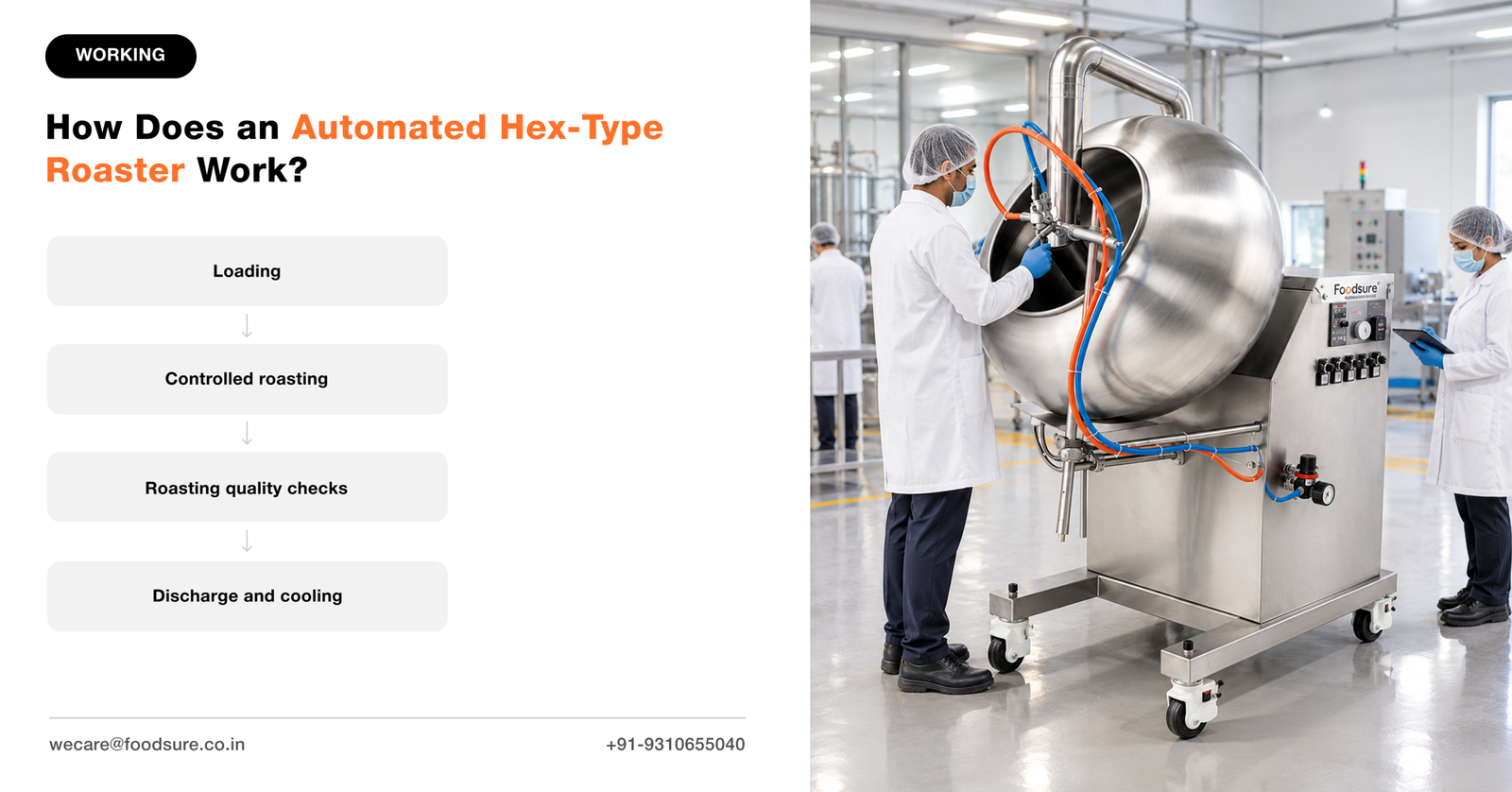
An automated hex-type roaster uses a rotating hexagonal drum and a heating system to roast makhana under controlled conditions. The exact operating sequence varies by model and heating configuration, but the process generally includes four stages.
1. Loading
Clean and appropriately sorted makhana is loaded into the roasting drum. The batch size should remain within the manufacturer’s recommended operating limits to support consistent processing.
2. Controlled Roasting
The drum rotates while the heating system raises the product temperature. Operators follow suitable temperature and rotation settings according to the makhana grade and desired product characteristics.
3. Roasting Quality Checks
Operators assess colour, texture, crispness and the proportion of damaged or inadequately roasted pieces. Recording operating settings and product quality helps establish repeatable production conditions.
4. Discharge and Cooling
Once roasting is complete, the product is discharged and cooled as required before further handling. Depending on the product and production setup, the makhana can then move to seasoning and packaging.
For businesses planning a larger facility, the roaster can form part of an integrated processing line. Foodsure’s food processing machinery range provides a starting point for exploring equipment options beyond roasting. The availability and compatibility of material transfer, seasoning, cooling and packaging equipment should be confirmed for the proposed configuration.
Capacity and Selection Guide for a Hex-Type Roaster Setup
Choosing the right roaster depends on expected production volume, available floor space, budget and expansion plans. An undersized machine may restrict output, while an oversized unit can increase initial investment and operating costs before demand justifies the additional capacity.
|
Production scale |
Suitable for |
Key consideration |
|
Small-batch roasting |
Startups and businesses testing market demand |
Lower initial investment and manageable operation |
|
Mid-volume roasting |
Growing units supplying regional retailers and multiple flavour variants |
Balance between throughput, labour and energy requirements |
|
High-volume roasting |
Established processors and distributors handling regular bulk orders |
Sustained output, process consistency and downstream integration |
These categories are planning guidelines, not fixed machine specifications. Select the machine after reviewing actual hourly throughput, batch size and product requirements.
Before finalising a model, ask the supplier to clarify:
- Whether capacity refers to raw makhana input or finished roasted output.
- Whether the machine operates in batch or continuous mode.
- The recommended batch size and roasting cycle.
- Power or fuel requirements under normal operating conditions.
- Space needed for installation, loading, discharge and maintenance.
- Compatibility with downstream seasoning, cooling and packaging equipment.
A well-sized roasting machine should support the intended production rate without creating unnecessary bottlenecks elsewhere in the processing line.
Biggest Challenges and Solutions for Automated Hex-Type Roasting in Chandigarh
Businesses processing makhana may encounter several production challenges when they depend on manual roasting or equipment with limited process controls.
1. Inconsistent Roasting Quality Between Batches
Manual roasting depends heavily on operator experience, temperature monitoring and product movement. Differences in raw material size, moisture and heating conditions can result in inconsistent texture or colour.
Solution: A properly configured hexagonal makhana roaster can help standardise product movement and heating conditions. Operators should establish suitable settings through production trials and record the results for repeatable operation.
2. High Dependence on Skilled Labour
Manual operations may require continuous attention to heating, stirring and product inspection. This can limit the time operators have available for other production tasks.
Solution: Temperature controls and a rotating drum can reduce repetitive manual work. The operator remains responsible for loading, monitoring, quality checks and safe operation, depending on the machine’s automation level.
3. Excessive Fuel or Energy Consumption
Energy use can increase when batches are poorly loaded, heating is inefficient or the machine requires long operating periods to achieve the desired product quality.
Solution: Evaluate the heating system, insulation, operating cycle and actual energy consumption. Compare machines using the cost per kilogram of acceptable finished product rather than relying on rated power or broad fuel-efficiency claims.
4. Yield Losses from Burnt or Inadequately Roasted Makhana
Overheating, unsuitable temperature settings and inconsistent raw material can result in damaged product and additional sorting.
Solution: Use controlled heating, suitable batch sizes and documented quality checks. Track rejected product and usable yield during trials to determine whether the new machine improves production performance.
Benefits of Using an Automated Hex-Type Roaster for Makhana
Automated roasting can improve process control, but its benefits should be assessed through measurable production results rather than assumed percentage improvements.
- Production efficiency: Controlled operating cycles can reduce unnecessary manual interventions and improve production planning.
- Quality consistency: Repeatable heating conditions and drum rotation can help produce more consistent batches.
- Labour management: Automation can reduce repetitive handling and allow operators to supervise related production activities.
- Energy management: Monitoring consumption per kilogram helps identify economical operating conditions.
- Improved usable yield: Better process control can help reduce losses caused by overheating or inconsistent roasting, subject to actual trial results.
- Production scalability: A suitably sized roaster can form part of a larger makhana processing line as order volumes increase.
For an accurate assessment, compare the existing process with the proposed machine using the same raw material grade and similar production conditions. Record throughput, energy consumption, labour requirements and the quantity of acceptable finished product.
How to Choose the Best Automated Hex-Type Roaster in Chandigarh
The best machine is not necessarily the largest or most expensive one. It is the equipment that meets your production requirements, product specifications and operating budget.
Before buying an automated hex type roaster for makhana, evaluate the following:
- Expected kilograms of raw makhana processed per hour.
- Batch size and required roasting cycle.
- Temperature control accuracy and adjustment range.
- Hexagonal drum construction, rotation and cleaning access.
- Heating method, power supply and energy consumption.
- Automation level and operator requirements.
- Available floor space and installation conditions.
- Spare parts, maintenance and operator training.
- Warranty terms and after-sales support.
- The supplier’s experience with relevant food processing applications.
For businesses comparing a roasted makhana machine in Chandigarh, ask for a product trial using the makhana grade you intend to process. This helps assess output quality, throughput and usable yield before committing to a commercial installation.
Buyers should also compare the complete production process rather than the roasting machine alone. If seasoning, cooling or packaging cannot keep pace with the roaster, the entire line may struggle to meet production targets.
Why Choose Foodsure Machines for an Automated Hex-Type Roaster?
Foodsure Machines offers food processing machinery for businesses that need equipment suited to their product, production volume and operating requirements. Its published roasting machine specifications include customisable hexagonal or circular drums, digital temperature controls, different capacity configurations and multiple heating options.
When evaluating Foodsure for your makhana roasting setup, discuss the following requirements with the team.
Capacity selection: Identify a model suited to your expected production volume and future growth. Confirm the rated and tested capacity of the specific configuration.
Heating and process control: Review the available heating options, temperature controls and operating settings for your makhana grade.
Machine configuration: Discuss drum design, food-contact materials, loading arrangements, discharge requirements and cleaning access.
Production line integration: Determine whether you also need grading, seasoning, cooling, conveyors or packaging equipment. An integrated setup can help coordinate the different stages of production.
Installation and support: Confirm installation arrangements, operator training, warranty coverage and spare parts availability for the selected configuration.
Upgrade Your Makhana Roasting Process
Choosing the right roasting equipment can help businesses improve process consistency, manage production requirements and prepare for future expansion. Before making a decision, compare capacity, operating costs, product quality and support arrangements.
Contact Foodsure Machines to discuss the right hexagonal roasting equipment for your makhana processing requirements in Chandigarh. Request a technical consultation and model-specific quotation to evaluate your options.
Looking for an automated hex type roaster for makhana in Chandigarh?
Contact Foodsure Machines to discuss your production capacity, raw material, heating preferences and machinery requirements. Request the relevant technical specifications and a quotation to compare the available options.
Frequently Asked Questions
1. What Is an Automated Hex-Type Roaster for Makhana?
An automated hex-type roaster is a food processing machine that uses a rotating hexagonal drum and a controlled heating system to roast makhana. It helps standardise product movement and heating, reducing dependence on continuous manual intervention.
2. How Does a Hexagonal Makhana Roaster Improve Roasting Consistency?
The rotating drum moves makhana through the heated chamber, helping expose the batch more evenly to heat. Consistency also depends on temperature settings, drum speed, batch size and raw material quality.
3. Is an Automatic Hex Type Roasting Machine Suitable for Small Businesses?
Yes, a suitably sized model may be appropriate for a startup or small processor. Buyers should confirm the minimum practical batch size, hourly capacity, operating costs and automation level before selecting a machine.
4. Can an Automated Roaster Reduce Labour Costs?
It can reduce repetitive manual tasks, including continuous stirring and frequent manual temperature adjustment. Actual labour savings depend on the existing process, selected automation level and staffing requirements for the complete production line.
5. Is a Hexagonal Makhana Roaster Energy-Efficient?
Energy efficiency depends on the heating system, insulation, batch loading and operating cycle. Request energy-consumption data and compare the cost per kilogram of acceptable finished product before purchasing.
6. What Is the Difference Between a Hexagonal Makhana Roaster and a General Makhana Roasting Machine?
A hexagonal makhana roaster uses a drum with six sides, whereas general roasting machines may use circular drums or other designs. The best choice depends on product movement, heating arrangement, capacity and required roasting quality.
7. What Capacity Should I Choose for a Makhana Roasting Machine in Chandigarh?
Start with your expected daily production, operating hours and planned order volumes. Compare these figures with the manufacturer’s tested hourly capacity and account for loading, unloading, cleaning and other production stages.
8. What Should I Check Before Buying a Roasted Makhana Machine in Chandigarh?
Check the machine’s capacity, temperature controls, heating method, construction materials, power requirements, cleaning access, warranty, installation arrangements and service support. A trial with your intended raw material can help evaluate product quality and usable yield.
9. Can a Hex-Type Roaster Be Integrated into a Complete Makhana Processing Line?
Yes. Depending on the selected configuration, roasting equipment can be combined with grading, seasoning, cooling, conveying and packaging machinery. Each stage should be sized to support the intended production rate.
10. How Can I Get a Quotation for an Automated Hex-Type Roaster from Foodsure Machines?
Contact Foodsure Machines with your expected production capacity, preferred heating method, raw material details and installation location. Ask for model-specific technical specifications, a quotation, delivery terms and applicable after-sales support.




