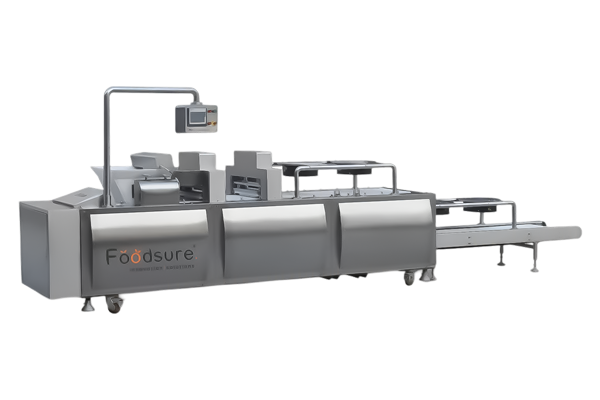
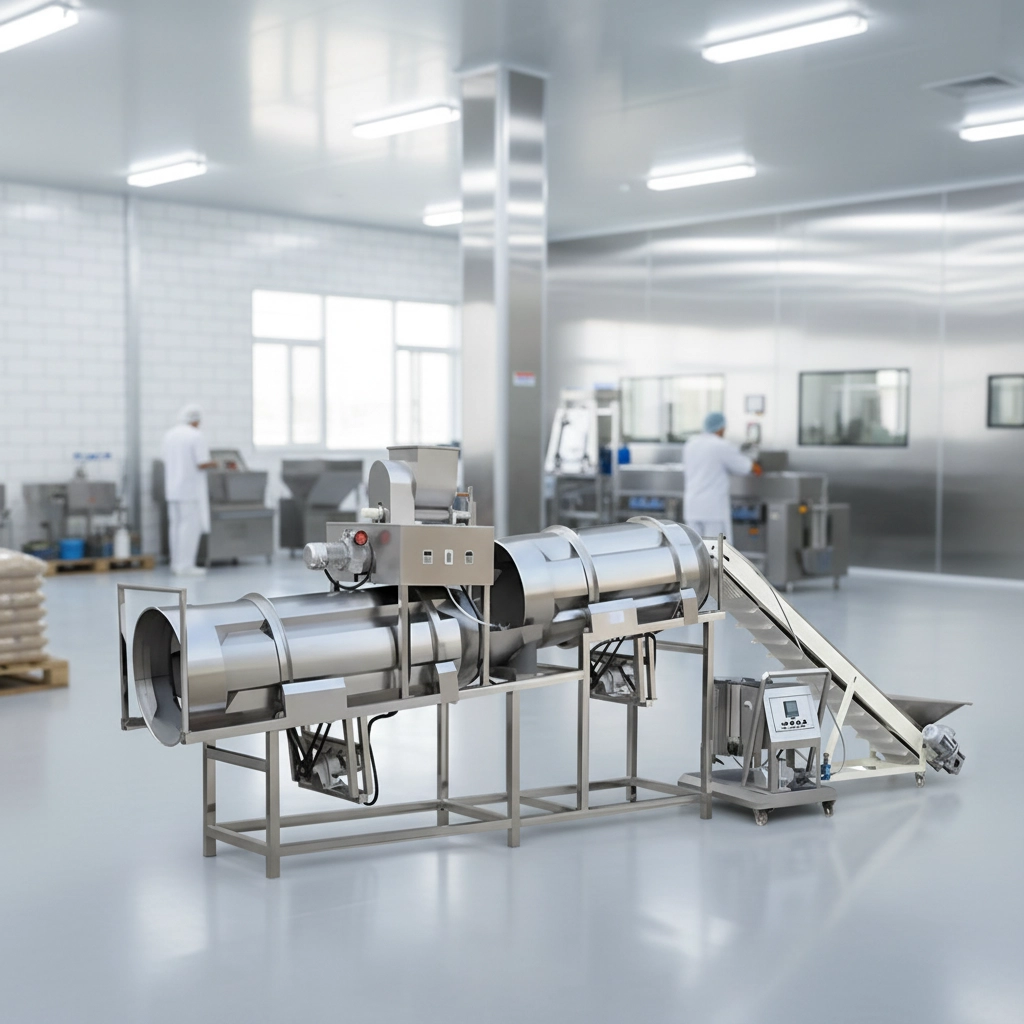
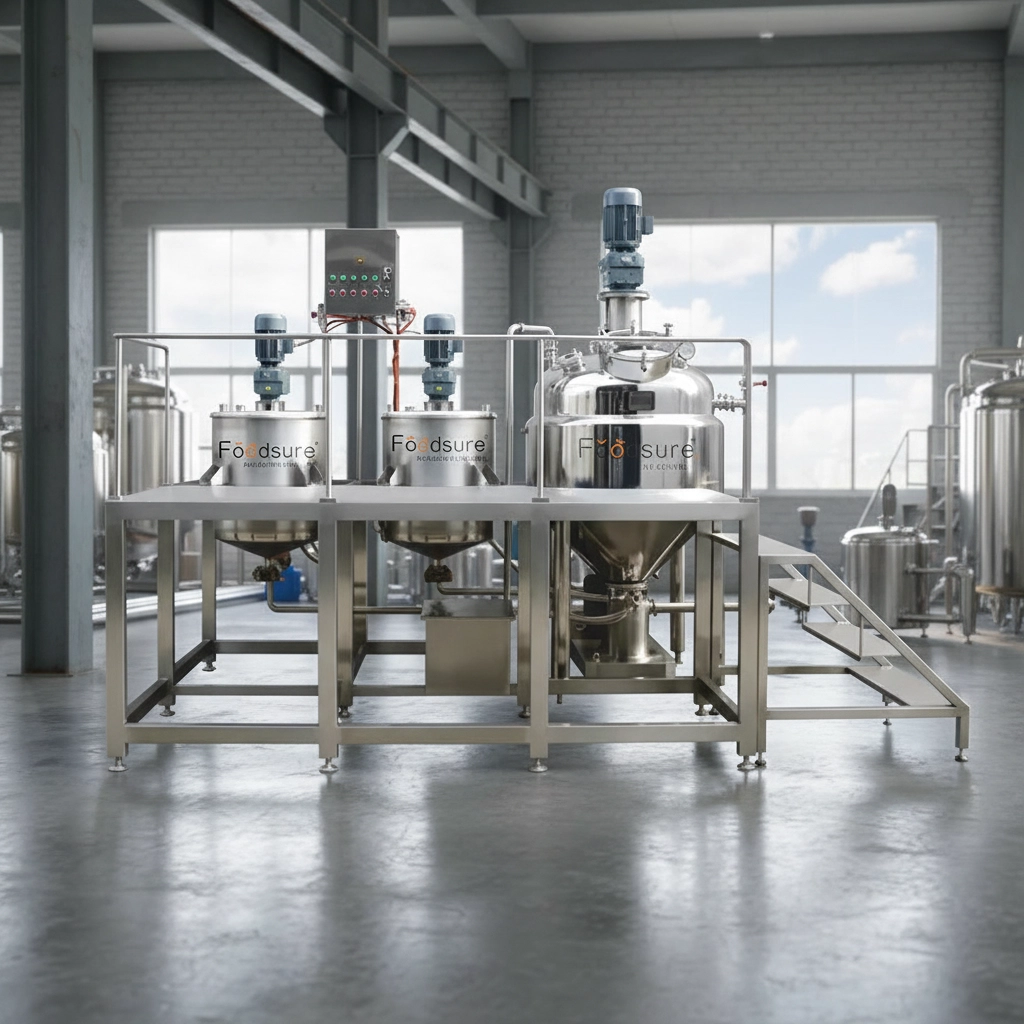
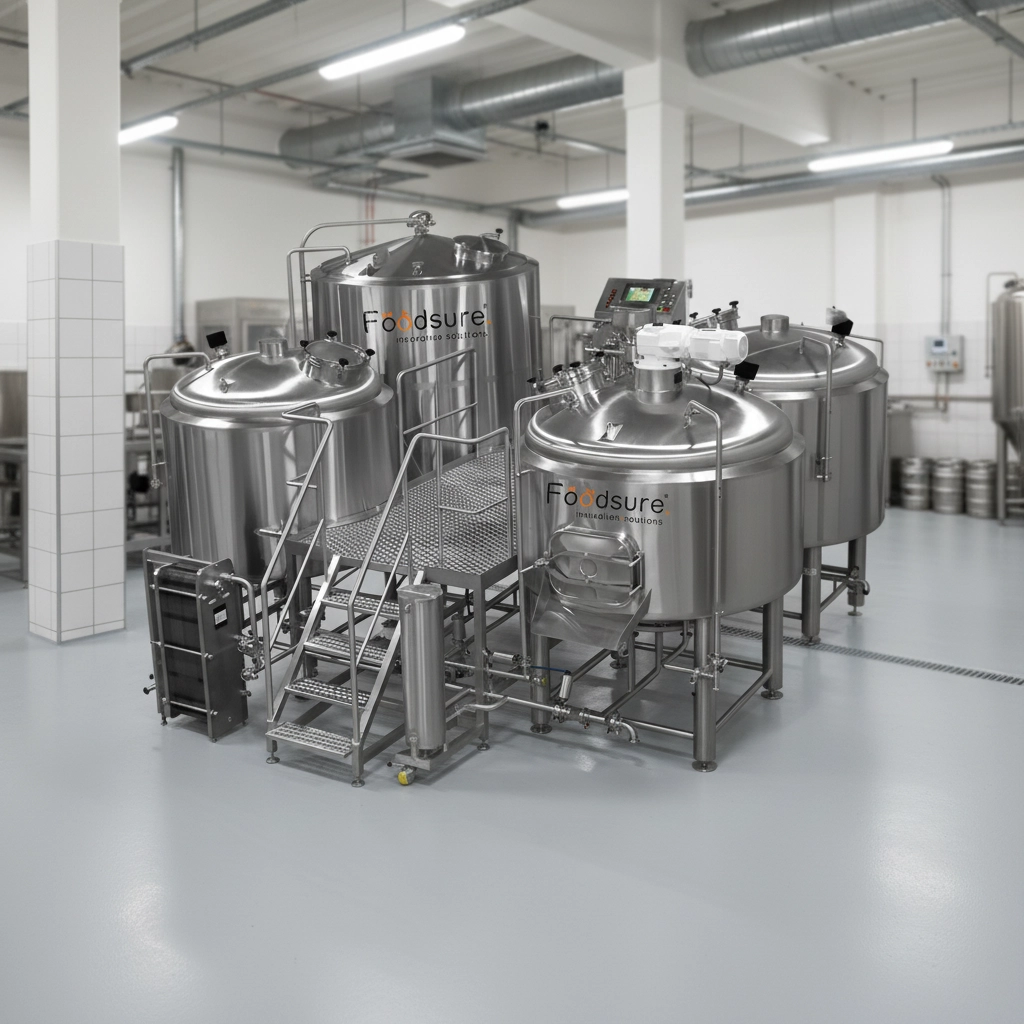
Are you aware of this that over 80% of India’s makhana is grown in Bihar, yet First-Time Buyers Overinvest in Makhana Machine and stall profits? This case study explores a Bihar-based startup’s ambitious setup, where money went wrong, and production outcomes. It also shows how Foodsure Machines helped optimise investment and scale efficiently.
Business Performance & Production Issues Before Switching to Right-Sized Makhana Machines
Food startups were operating high-capacity machines at only around half capacity. This resulted in poor cash flow management and production downtime. These regular troubles mounted month after month due to outdated machinery and unqualified personnel. Food production became unpredictable with high waste and worsening during seasonal changes. Plants were operating far from actual capacity.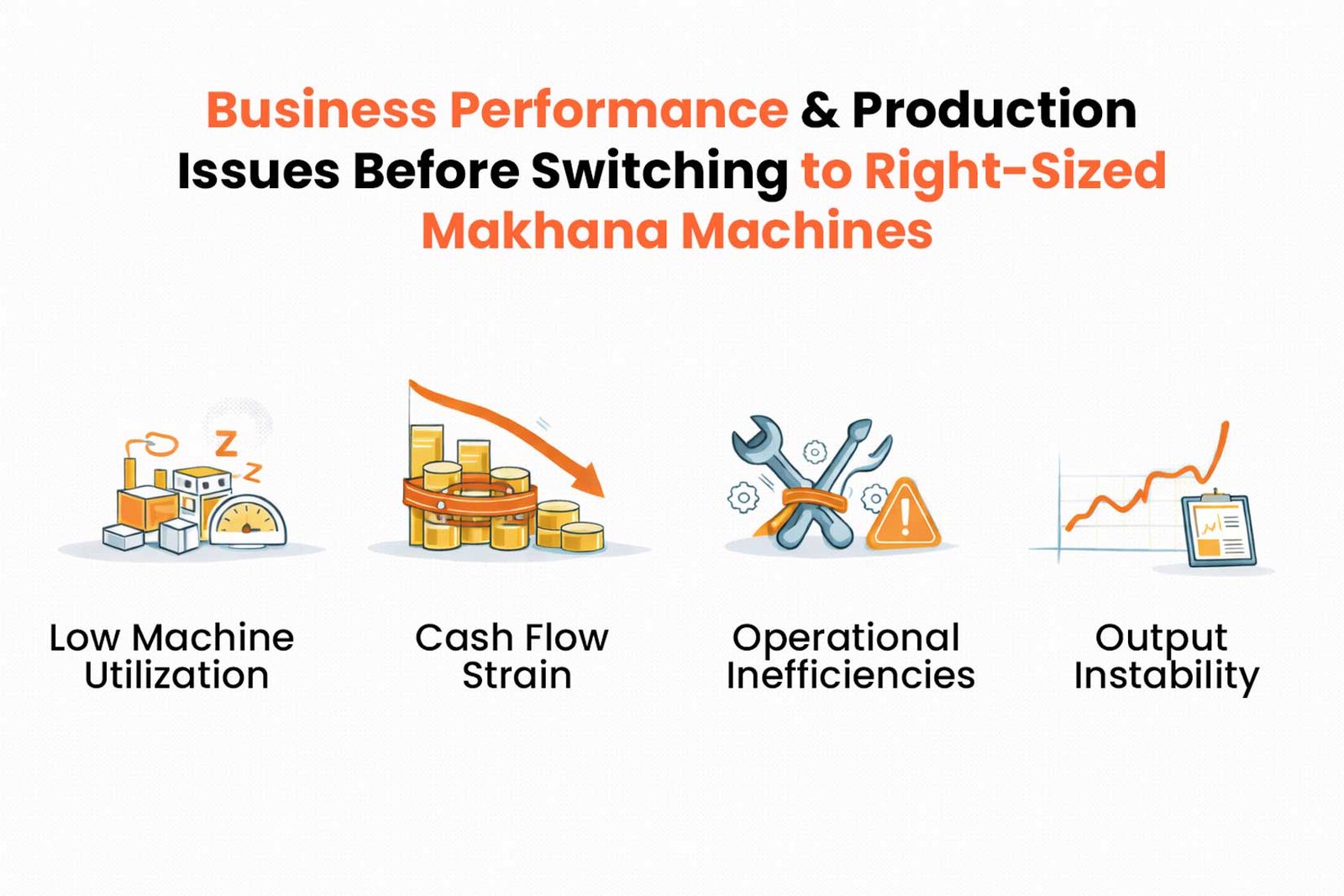
- Low Machine Utilisation: Machines that were designed for high volume production were operating between 40 to 60% capacity, and semi-automatic equipment slowed mixing and packaging processes due to minimal automation.
- Cash Flow Strain: Raw materials perish quickly. Add the effects of seasonality and a lack of credit extension, and liquidity becomes a rare commodity. Businesses were surviving on high-interest loans.
- Operational Inefficiencies: Many breakdowns are the norm. Inexperienced operation, poor maintenance, and energy-guzzling equipment are the causes.
- Output Instability: In the makhana production lines, imprecise emulsification and operating errors resulted in defective production, increased waste, and quality variability.
Also read: Efficient Makhana Making Machine For 3× Higher Yield
Investment Decisions of First-Time Buyers in Makhana Processing Machines
The makhana production unit, a first-time purchase, has overlapping large capacity machines (45- 50 Lakhs) due to future proofing, replacement risks, and government incentives under India’s food processing schemes. Their plans for the demand in a month, which included the real need of 20 tonnes based on the consumption level of 80% from the very first month, were not justified based on the extrapolated demand of 50 tonnes.
Key Errors Made by Risk Managers
- Oversized Capacity: Choose machines that have the oversized capacity of 1,000 L/h, but because of low demand, the machines are only 60-70% full.
- Fear of Loss Decisions: Small pilots are being avoided owing to replacement hassles, which adds to the capex growth of 40% over and above the need.
- Subsidy Factor: Attracted to 20-30% subsidies, and ignored ROI payoffs of over 3 years.
- Demand Mismatch: Basis of rapid growth based on unproven markets, resulting in inventory buildup and capital outlays.
Where First-Time Buyers Overinvest in Makhana Making Machines
Many first-time producers believe that bigger is better. They will go out and end up with high-capacity equipment, commercial-grade dryers, and complicated infrastructure systems because that’s how they think they can hasten their own rate of success.
| Area | What Was Bought | Why It Led to Overinvestment |
| Core Processing Machine | Oversized capacity | Demand mismatch, low utilisation |
| Dryer / Roaster | Industrial scale | Batch flow imbalance |
| Power & Electrical Load | High load | Fixed monthly cost inflated |
| Civil / Foundation | Overbuilt | Non-recoverable cost |
It is very clear from this table that the company had overinvested in some areas without any resulting gains. This occurred due to overscaled equipment and infrastructure, which led to an increase in fixed costs, having destructive implications for the company’s cash and flexibility.
Overinvested Makhana Roasting Machines: Output vs What the Startup Really Needed
| Metric | Planned | Actual Reality | Needed |
| Machine Capacity | High | 35–40% utilised | Moderate (based on monthly demand) |
| Monthly Output | Maximum | Underused | Targeted production for the market |
| Cost per Kg | Expected low | Increased | Optimised per kg cost |
Key Insights:
- It was observed that the makhana roasting machines were operating at a capacity utilisation level of just 35-40%, leaving the investment unused.
- There was a level of production that was lower than potential, given the use of equipment with a high capacity level, which resulted in per kg production costs that were higher than expected because of lower utilisation and higher energy consumption.
Foodsure Machines Review: Finding Gaps and Fixes
Foodsure Machines didn’t act without assessing the true condition the startup found itself in. We didn’t research the machines on paper. We looked into the way the plant operated, the areas where the money was being lost, and what we could change for the ultimate effect on the startup. Here is what we concentrated on: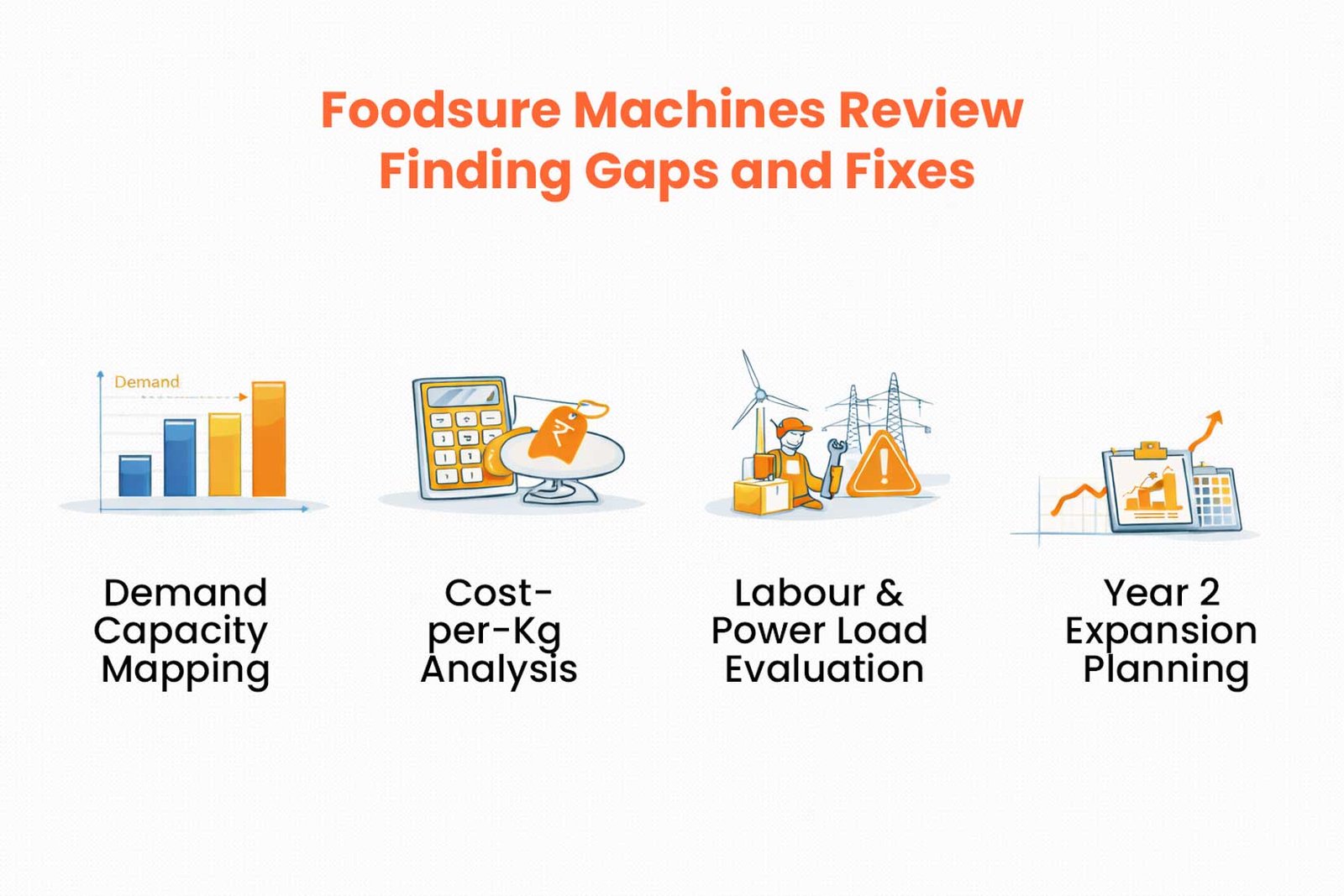
- Demand-Capacity Mapping: The actual market demand was compared to the capacity of the machines installed to determine the equipment with low capacity utilisation.
- Cost-per-Kg Analysis: Real production cost calculation based on energy, material wastage, and labour inefficiencies, thereby identifying areas that are driving the overall unit cost up.
- Labour & Power Load Evaluation: Also evaluated the workforce allocation and power consumption for maximum optimisation of shifts, least idling, and minimum fixed costs.
- Year 2 Expansion Planning: Create a plan that would expand only when there was a reason to expand due to increased demand.
Equipment Strategy Recommended by Foodsure Machines
Having examined the structure that existed within the startup, we functioned within a framework that provided effective and value-for-money solutions. The aim was to ensure that there existed a corresponding machine size that provided effective responses to the challenge while preventing wastage and creating room for expansion. This is depicted below:
| Recommendation | Reasoning |
| Right-sized core machine | Runs at 70–80% capacity → efficient cost/kg |
| Modular dryer/roaster | Matches batch flow → reduces idle time |
| Minimal grading system initially | Ensures saleable output without excess spend |
| Expansion-ready layout | Allows phased growth when demand rises |
| Optimised electrical load | Avoids fixed cost inflation |
Cost Investment Strategy Made Simple: Where, Why, How, and When
| Timeline | Where to Invest | Why | How | Indicative ₹ Range |
| Within 1 Week | Demand & capacity assessment | Prevent wrong machine size | Validate monthly sales & daily throughput | ₹0–₹50,000 |
| Within 1 Week | Layout & power planning | Avoid civil/electrical rework | Map machine footprint & power load | ₹0–₹30,000 |
| Within 1 Month | Core processing machine | Controls cost/kg | Select a machine for 70–80% utilisation | ₹12–18 lakh |
| Within 1 Month | Dryer/roaster | Prevent bottlenecks | Match batch output | ₹4–6 lakh |
| Within 1 Month | Grading system | Market-ready sizes | Install essentials only | ₹3–5 lakh |
| Within 3 Months | Operator training & stabilisation | Reduce losses | Focus on yield consistency | ₹50k–₹1 lakh |
| Within 6 Months | Working capital buffer | Cash flow safety | Maintain a 2–3 months reserve | ₹3–5 lakh |
| Within 1 Year | Expansion modules | Demand-backed growth | Add modules after utilisation >80% | ₹6–12 lakh |
The Makhana Startup Strategy That Delivered Results
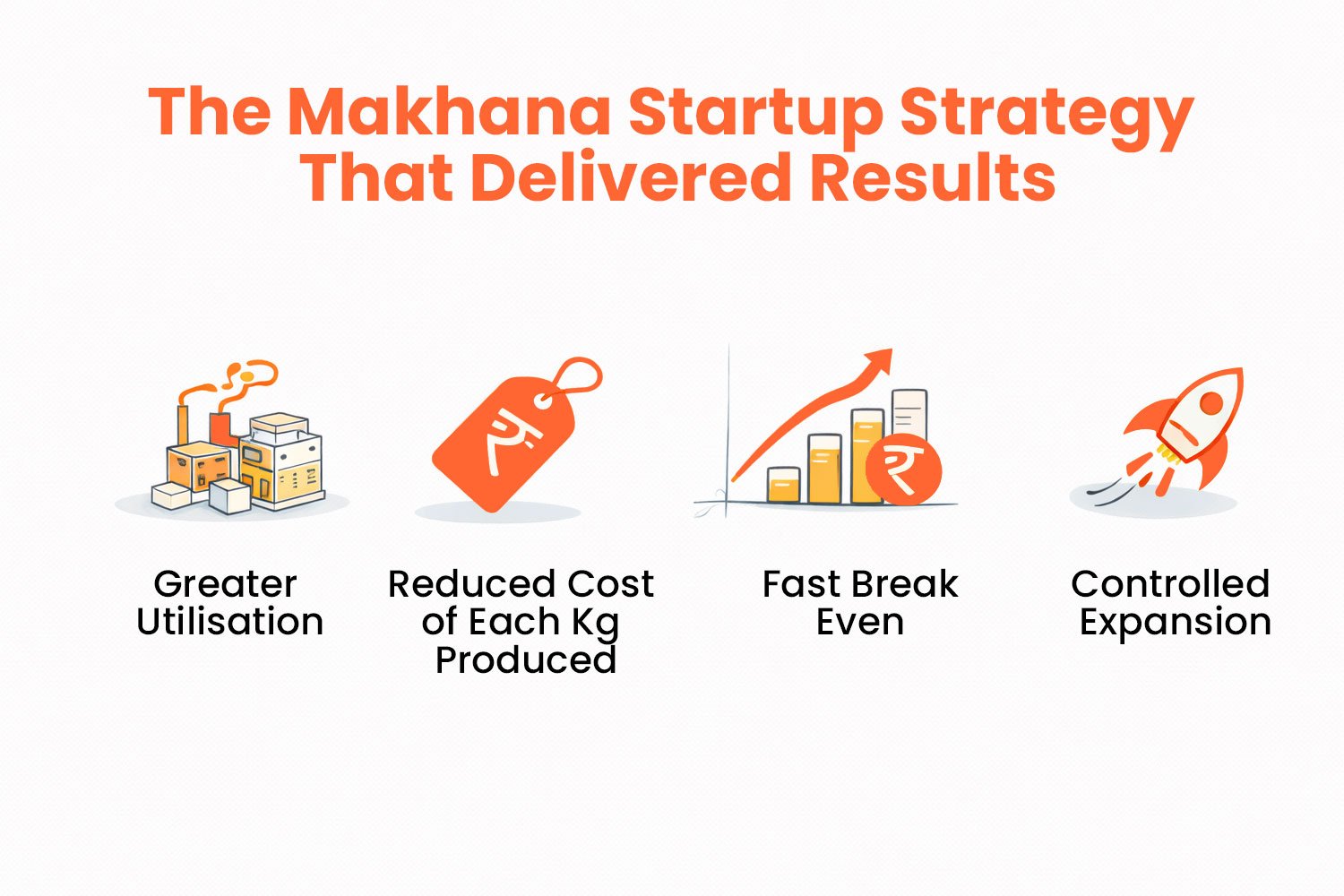
- Greater Utilisation: The machines were optimised to work at an optimal level of 70%-80% capacity.
- Reduced Cost of Each Kg Produced: The optimised use of machines, energy, and labour resulted in fixed costs of each unit being reduced.
- Fast Break-Even: Through the avoidance of overinvestment, it took the company 12 to 18 months to break even, rather than years.
- Controlled Expansion: Modularity in equipment enabled a controlled scale-up that was feasible only if there was a corresponding increase in demand, thus containing risk costs.
Essential Checklist for First-Time Makhana Machine Buyers
- Actual monthly demand validation.
- Calculate the required daily throughput.
- Target machine utilisation of 70–80%.
- Calculate the power and cost of labour per kg.
- Planning of expansion in Phase 2 will avoid overinvestment and ensure growth at a steady pace.
Conclusion
At Foodsure Machines, we ensure that first-time makhana buyers invest wisely. This case study on Why First-Time Buyers Overinvest in Makhana Machine reflects our approach, which has utilisation, cost efficiency, and scalable growth to ensure that our clients avoid over-investment in achieving profitable and continuous operations from day one.