
Most spice manufacturers pursue consistency through formulation improvements, including adjusting ratios, sourcing higher-quality raw materials, and strengthening supplier controls. Yet batch deviation persists. The problem exists because consistency requires process solutions instead of recipe solutions. Your mixing system fails to provide stable results because it cannot achieve three essential requirements, which include uniform particle distribution, controlled shear energy, and repeatable cycles.
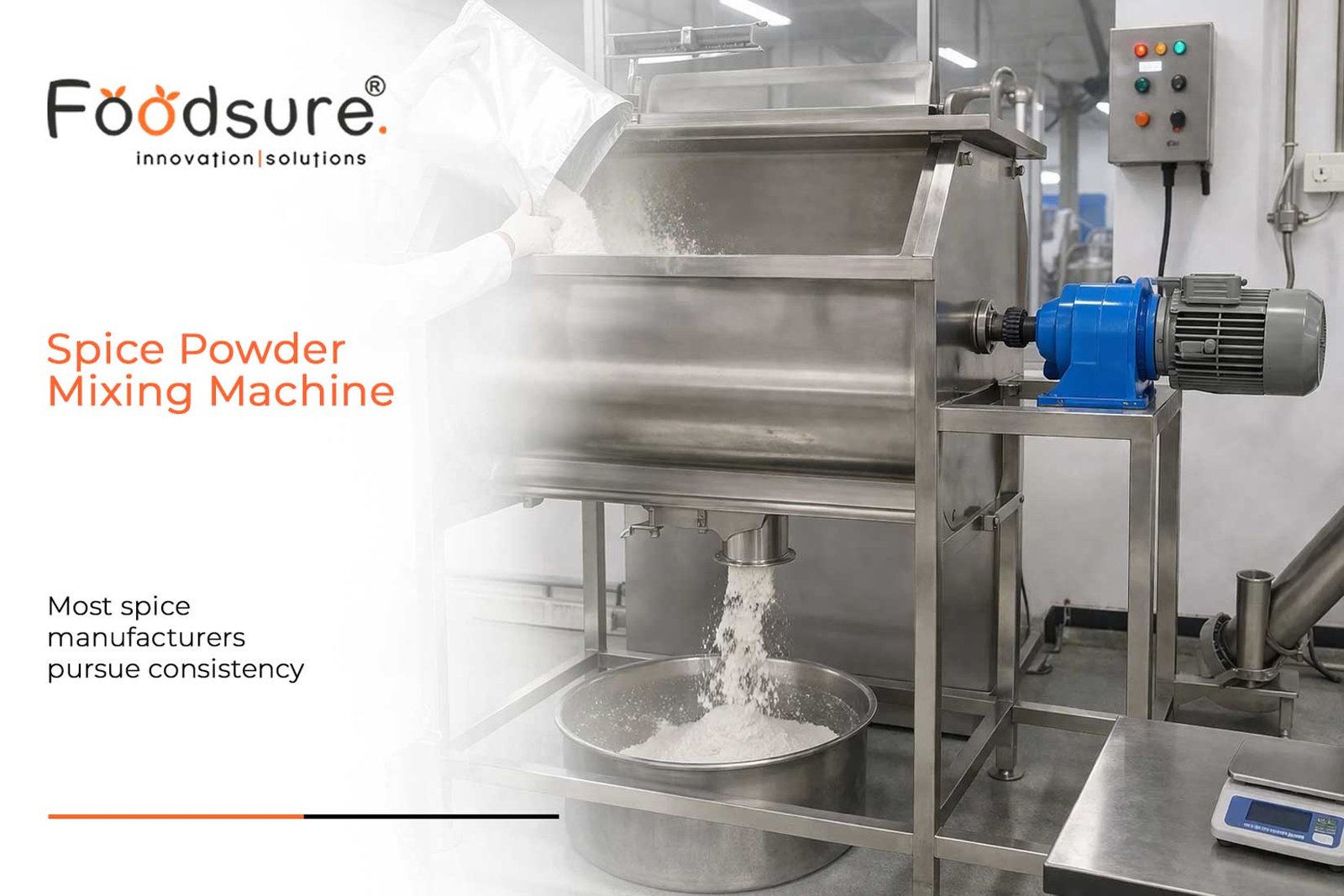
The Spice Powder Mixing Machine combines mechanical precision with recipe-based functionality to deliver results beyond the capabilities of standard recipes. The system guarantees that all seasoning blends maintain consistent flavor strength, aroma delivery, and texture characteristics throughout all production runs.
The blog presents information about mixing science and the comparison between ribbon and paddle mixing systems, CV benchmarks, and the financial benefits of ROI and compliance factors, and the process of choosing a suitable seasoning powder mixer that enables production that meets both scalability and quality requirements.
Why Your Production Needs a Spice Powder Mixing Machine to Eliminate Flavor Inconsistency
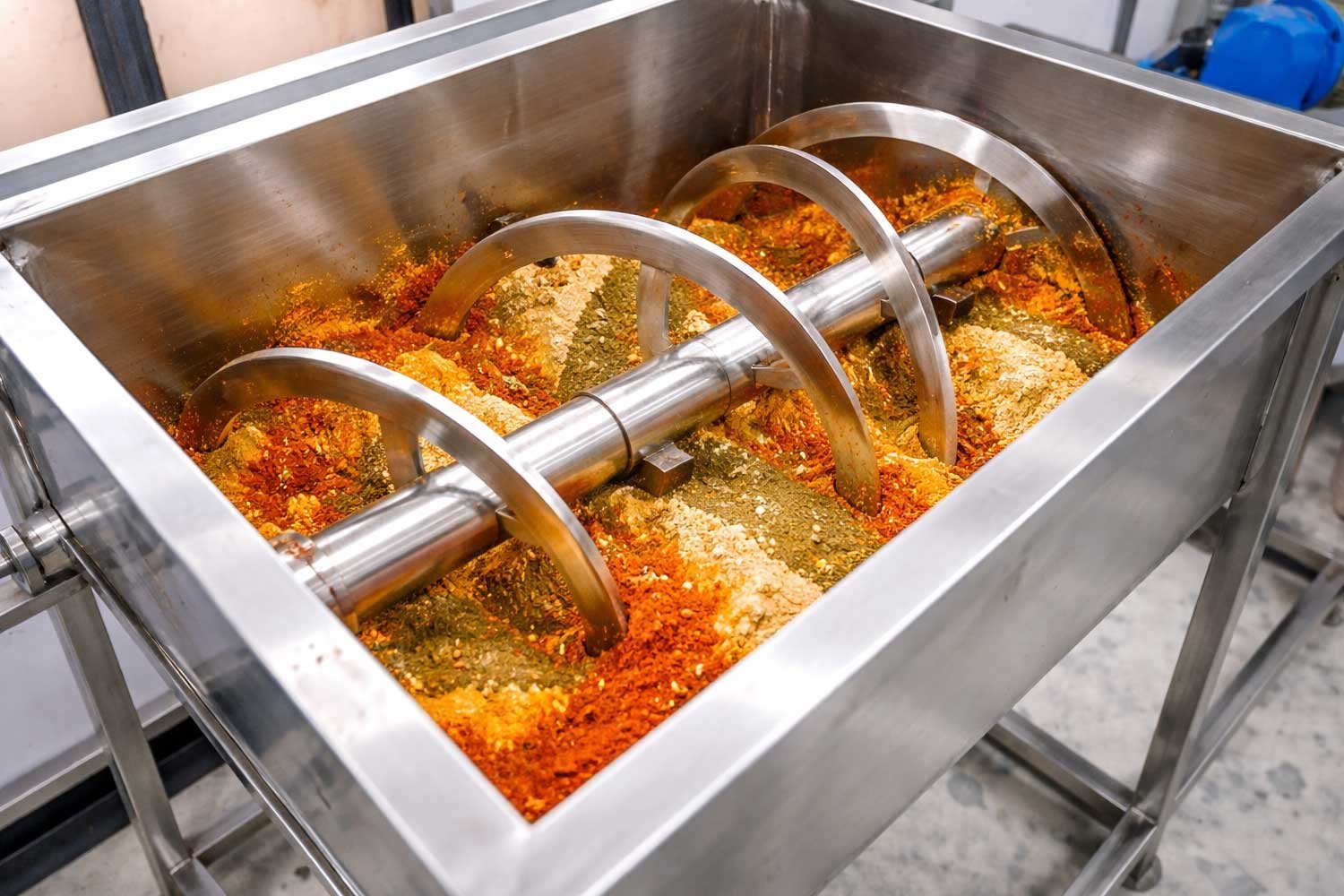
The Physics of Stratification & Pocketing
The main obstacle to achieving constant flavor throughout industrial spice production arises from the process of particle segregation. The majority of commercial seasonings exist as complex heterogeneous mixtures that contain ingredients that show extreme differences in their physical characteristics.
- Density Differentials: Salt (high density) sinks while dried herbs like oregano or mint (low density) float at the surface during movement or vibration.
- Particle Size Variance: Fine powders like turmeric or garlic powder (10-50mu) become trapped inside the tiny spaces between larger chili flakes or cracked peppercorns, which measure (500-1000mu) in diameter.
- Surface Tension & Oil Content: High-oil spices like clove or cardamom show a tendency to agglomerate because of their elevated oil content.
Manual mixing leads to different results, which create a stratification effect that produces:
- Hot Spots: Show where chili or salt concentration reaches dangerous levels, which creates an unpalatable product.
- Dead Zones: The locations in a container where materials remain totally unmixed at both corner areas and the center-bottom points.
The Spice Powder Mixing Machine uses shear force and convective mixing to achieve its mixing function. The machine uses mechanical forces to push particles upward, which results in continuous particle movement and mixing through gravity-based operations.
Coefficient of Variation (CV): The True Measure of Mixing Quality
Food engineering professionals use mathematical models to evaluate flavor consistency through Coefficient of Variation (CV) measurements. The calculation requires taking the standard deviation of ingredient concentration from various samples and dividing that value by the average ingredient concentration.
- CV < 5%: The industry gold standard requires CV values to remain below 5%. The seasoning sachet system ensures complete uniformity because every 10g sachet contains identical proportions of salt, spice, and aromatics.
- CV 5–10%: Acceptable for low-cost bulk commodities but risky for premium brands where a too salty batch can destroy consumer trust.
- CV > 10%: High rejection risk. The result shows that homogenization failed because of insufficient mixing time and defective machine design.
The high-performance seasoning powder mixer operates with a design target of achieving a 3-5% CV during a standard 10-15 min operation, which delivers consistent sensory results for all production runs.
Ribbon vs. Paddle Mechanisms: Selecting the Right Mixing Physics
The internal mechanism selection will decide if your masala powder mixer maintains product quality or causes ingredient loss.
- Ribbon Blenders (High-Efficiency Standard)
The Ribbon Blender serves as the primary equipment used in the spice industry because it operates using a U-shaped horizontal trough and a specially designed ribbon mixer.
- Mechanism: The double-helical ribbon mechanism moves materials because its outer ribbon transports ingredients to the center while its inner ribbon moves them to the outer edges.
- Best Suited For: The system works best with free-flowing dry masalas and fine powders that require high-volume processing.
- The Advantage: It achieves rapid 99% uniformity because it delivers high radial and axial mixing capabilities.
- Paddle Mixers (Low-Shear Precision)
The Paddle Mixer provides better performance when mixing premium blends or chunky seasonings.
- Mechanism: It operates through large flat paddles, which execute a scoop lift and fold motion to handle material movement instead of using a continuous ribbon system.
- Best Suited For: Seasonings with high oil content, fragile whole spices (like coriander seeds), or blends where you want to avoid over-grinding.
- The Advantage: The system produces much lower friction heat, which enables important spice volatile oils to maintain their aromatic and medicinal characteristics.
How a Spice Powder Mixing Machine Improves Performance and Delivers Fast ROI
Waste Reduction: The Hidden Profit Leak
The manual spice blending process results in a hidden profit leak because manufacturers who work without established standards fail to measure their financial losses. The batch fails both sensory and laboratory tests because its ingredients have not been blended into a uniform mix.
- The Cost of Off-Spec Batches: The manual process results in a 5-10% loss of product during production because of incorrect salt measurements and insufficient color distribution, which leads to defective products.
- The Financial Toll: Indian manufacturing units that process 500kg of premium masala face a 5% rejection rate, which results in monthly losses between ₹50,000-₹2,00,000 because of raw material waste and re-processing costs.
A professional seasoning powder mixing equipment setup ensures first-pass accuracy. The machine operates without human error during agitation because it uses its complete raw material inventory, including Kashmiri Mirch and Pure Saffron, to achieve proper operational results, which avoids financial losses from waste.
Labor Efficiency: Manual vs Automated Mixing
The Spice Powder Mixing Machine provides the most effective solution to reduce operational expenditure costs, which need to be spent on manual labor. Workers who handle manual mixing work face physical exhaustion, which causes their mixing performance to decrease throughout the entire work period.
| Parameter | Manual Mixing | Spice Powder Mixer Machine |
|---|---|---|
| Time (per 500kg) | 3–4 Hours | 10–20 Minutes |
| Labor Requirement | High (4–6 workers) | Low (1 operator) |
| Physical Effort | Extreme (Risk of fatigue) | Minimal (Automated) |
| Output Quality | Variable (Human error) | Consistent (Mechanical precision) |
The commercial spice powder mixer machine enables facilities to produce 3 times their normal output because it reduces mixing time from hours to minutes, which eliminates the need for extra employees.
Brand Consistency = Market Scalability
The competitive food industry requires customers to receive the same flavor experience when they open a food package. Customers will stop trusting a seasoning brand when its products change from excessive heat to insufficient flavor during different weeks of the month.
- Standardized Taste: The masala powder mixer establishes sensory profile control. The production process maintains its mechanical components and timing operations at all times throughout the year, from January to June.
- Repeatable Batches: Automated systems enable you to create permanent storage for your blending recipes. The system lets you achieve precise results by setting the blend to mix at 45 RPM for 12 minutes, which can be done repeatedly throughout the entire process.
- Stronger Brand Trust: Market scalability depends on businesses maintaining consistent operations. The local brand can expand into global markets because it maintains proper flavor standards, which enable the product to pass all export quality requirements.
5-Year ROI Outlook
The acquisition of a high-grade spice blender functions as a capital investment because its payback period remains fully determined. Most startups and FPOs can expect to achieve their ROI within 12-24 months after their operations begin.
- Year 1-2: The machine provides a complete financial return through its ability to minimize raw material waste and its significant decrease in required labor expenditures.
- Year 3-5: The unit reaches a period of maximum profitability. The business can now handle bigger B2B contracts and export orders, which were previously unachievable through manual mixing, because it has reached its initial investment point and gained extra production capacity from faster batch processing times.
Manufacturers achieve machine longevity of 15 years through their practice of using SS304 or SS316 food-grade stainless steel to build seasoning powder mixing equipment, which results in a decade of profit after they recover their initial investment.
How a Spice Powder Mixing Machine Ensures Quality and Regulatory Compliance
Cross-Contamination Control
The multi-product facility needs to achieve flavor transition from using peri-peri blend to turmeric latte mix because this process requires complete flavor purity. The high-spec seasoning powder mixer uses sanitary design elements to build equipment that successfully prevents cross-contamination.
- CIP (Clean-In-Place) Systems: The advanced units provide automatic washing and sanitization capabilities through their built-in spray balls, which operate without needing to remove the complete agitator system.
- Smooth Interiors: Industrial spice powder mixing machines utilize mirror-polished internal surfaces (Ra < 0.8 µm). The design prevents micro-pockets, which would allow spice dust to remain hidden and create conditions for bacterial and mold development.
- Fast Cleaning: The modular system allows for quick cleaning because its easy-remove seals and gaskets enable operators to complete cleaning processes in less than two minutes, which results in comprehensive cleaning rather than hurried cleaning.
Microbial & Thermal Control
Spices lose their flavor when heated. The mixing process creates high friction, which results in two problems. The first problem occurs when moisture breeds microorganisms in specific areas, while the second problem leads to the loss of vital oils through the evaporation process.
- Controlled RPM: Modern seasoning powder mixing equipment operates at optimal speeds between 30-60 RPM to achieve uniform mixing results while minimizing thermal energy production.
- Heat Management: The machine achieves its purpose of maintaining low temperature during the mixing process, which prevents powder materials from sticking to ribbon blades and creating burnt particles in finished products.
- Preserved Volatile Oils: Low-heat mixing preserves aromatic compounds, which include piperine from pepper and curcumin from turmeric, by keeping them inside the powder instead of letting them escape into the air as waste.
Standard Operating Procedures (SOPs)
The machine and the method work together to create consistent results. The masala powder mixer needs to follow strict industrial standard operating procedures for its correct operation.
Loading Sequence: The Gravity Logic:
To achieve a CV value below 5% The order of loading materials needs to be followed.
- Heavy Ingredients: Start with base fillers like salt or dextrose.
- Middle Layer: Add primary spices (chili, coriander).
- Light/Micro Ingredients: Add herbs, colors, or expensive extracts in the sweet spot of the agitator for immediate dispersion.
Blending Time: The Bell Curve of Mixing
- Under-mixing: Results in pocketing and flavor spikes.
- Over-mixing: Can cause particle degradation or de-mixing (segregation), where ingredients start to separate again due to excessive vibration. A standard spice blender usually hits peak homogeneity between 8 and 12 minutes.
Discharge Hygiene: Complete Evacuation
The process of mixing will continue until the trough achieves complete emptying. Seasoning powder mixing equipment should feature a bottom-discharge bomb bay door or a precision butterfly valve to ensure zero material remains for the next batch to contaminate.
Material Grades: SS304 vs SS316
The chemical composition of the machine establishes both its operational duration and its ability to maintain food safety standards.
| Feature | Grade SS304 | Grade SS316 |
|---|---|---|
| Chromium % | 18% | 16% |
| Nickel % | 8% | 10% |
| Molybdenum % | 0% | 2.0–3.0% |
| Pitting Resistance | Moderate | High |
| Salt Tolerance | Low (Corrodes) | Excellent |
| Application | Dry Base Spices | High-Salt / Wet Rubs |
The commercial use of a spice powder mixer machine made from SS316 allows for safe operation because the equipment prevents high salt content in seasonings from causing metal pitting, which creates micro-holes that can trap harmful Salmonella bacteria.
How a Spice Powder Mixing Machine Enables Scalable Spice Production
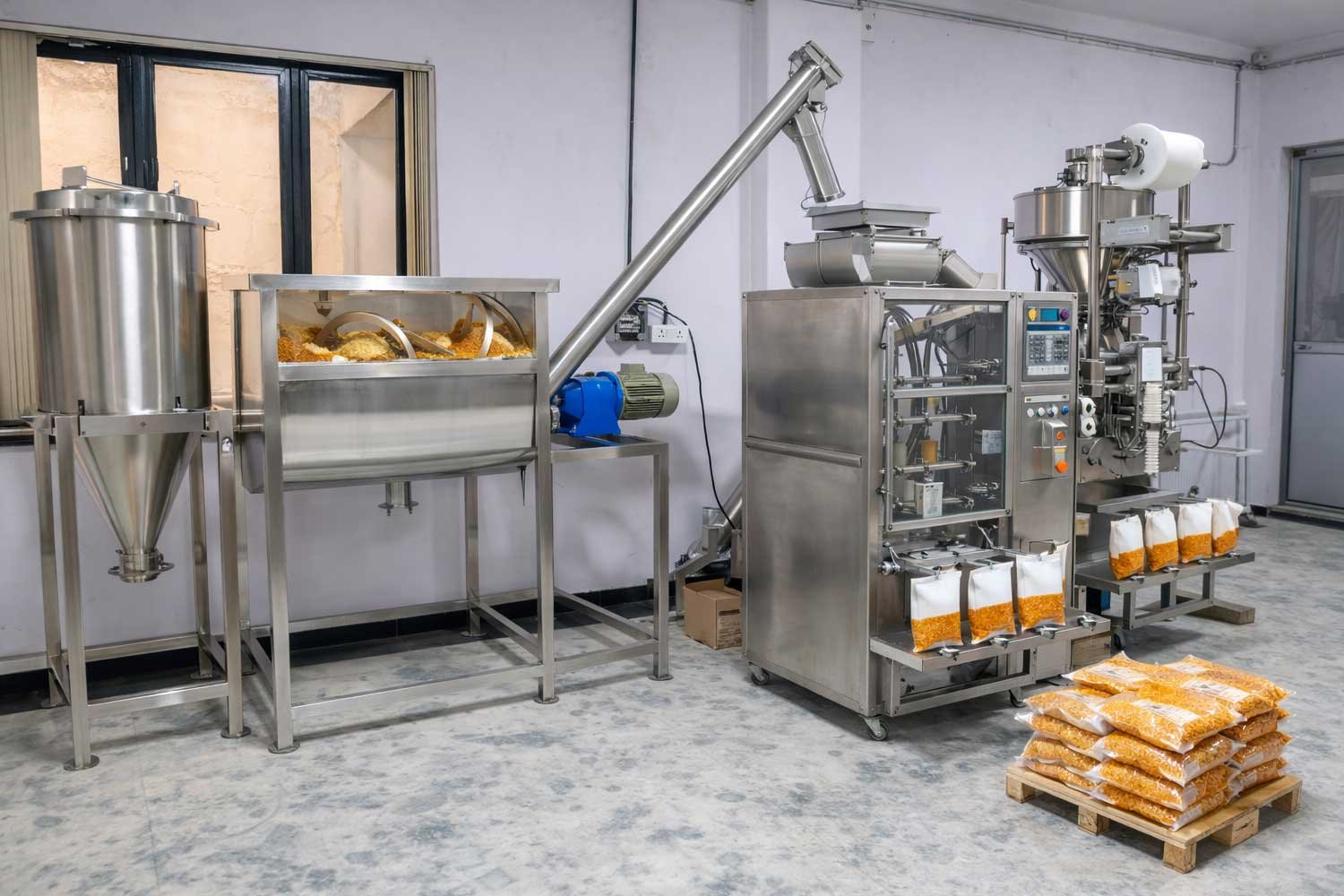
Why Manual Mixing Fails Beyond 100 kg/day
Production expansion reveals that manual blending operations reach their maximum capacity when operators attempt to handle increasingly larger production volumes.
- Inconsistent Output: Human operators experience fatigue, which results in their failure to maintain consistent agitation patterns. This leads to the separation of materials based on their density because salt settles at the bottom.
- High Labor Dependency: The process of handling 100+ kilogram production requires companies to assign multiple employees, which causes financial expenses to rise while increasing the chances of different flavors appearing in each production batch.
Liquid & Oil Integration
Modern seasoning powder mixing equipment features specialized liquid injection manifolds.
- Spray Nozzles: The pressurized nozzles of spray nozzles use their power to create a fine mist from oils and oleoresins.
- Uniform Coating: The system guarantees that all particles receive equal flavor distribution, which prevents any particle from reaching full saturation.
- No Clumping: The process of high-shear mixing creates a state that prevents balling (lumping) from occurring when operators add liquids through manual methods.
Power & Infrastructure Requirements
Selecting a Spice Powder Mixing Machine requires matching your facility’s electrical load to the motor’s torque needs.
| Capacity | Power | Phase |
|---|---|---|
| 50–100 kg | 2–5 HP | Single / 3 Phase |
| 200–500 kg | 5–15 HP | 3 Phase |
Packaging Line Integration
The mixing process produces packaged products with stronger efficiency when its consistency remains unchanged throughout the production process.
- Prevents Hopper Bridging: The packing machine hopper operates without any blocking problems because a consistent mix enables smooth flow through the system.
- Ensures Accurate Filling: The standardized powder distribution permits accurate measurement of 10g pouches, which maintain identical volume and weight specifications to meet legal metrology requirements while minimizing product waste.
Conclusion
Consistency in flavor is not attained through recipe adjustments; it is achieved through tightly controlled methods/processes. A Spice Powder Mixing Machine will give a consistent distribution of particle size, provide uniform shear force, and provide a controlled mixing cycle, resulting in the same taste, aroma, and texture from batch to batch.
The equipment we manufacture at Foodsure Machines is designed specifically for production environments that have real production obstacles of reducing waste, improving efficiency, and achieving regulatory food safety. Our goal is to assist manufacturers in rapidly scaling their operations with dependable and high-quality systems.
Struggling with Uneven Flavor in Every Batch?
Get the right seasoning & spice mixing solution for consistent taste, uniform coating, and better product quality.
FAQ
What does a seasoning powder mixer do?
Uniform distribution of spices in the seasoning powder mixer allows consumers to get the same taste in every serving.
How is a masala powder mixer different from manual mixing?
The masala powder mixer machine provides repeatable blending to ensure less variation from batch to batch and minimizes the chance of human error.
What is a spice blender used for in food processing?
Using a spice blender for spices will enable the bulk-to-bulk mixing of spoon-sized dry materials and will result in no damage to the natural scent or structure of the particles.
Why choose a spice powder mixer machine for commercial use?
The use of spice powder mixer machines for commercial purposes will increase efficiency, reduce waste, and provide scalable production capabilities.
How does seasoning powder mixing equipment improve product quality?
Seasoning powder mixing machines can help to provide a consistent taste and texture of materials and should help to reduce separations between batches of seasoning.