The global textured soy protein market is projected to cross INR ₹2,300–₹2,350 crore (approx.) by 2027, with Africa, Bangladesh, and Nepal driving the fastest growth. Yet, over 60% of first-time exporters replace their machines within 18 months, not because demand failed, but because the machine did. The soya nugget machine for exporter serves as a key piece of equipment, which they see as the main tool for future business development. The wrong choice, whether in capacity, power compatibility, or after-sales support, can erase margins before your second shipment. This 2026 blog provides users with instructions on selecting machines that will demonstrate actual performance during export operations.
Soya Nugget Machine for Exporter: Export Market Demand & Buyer Behavior Insights
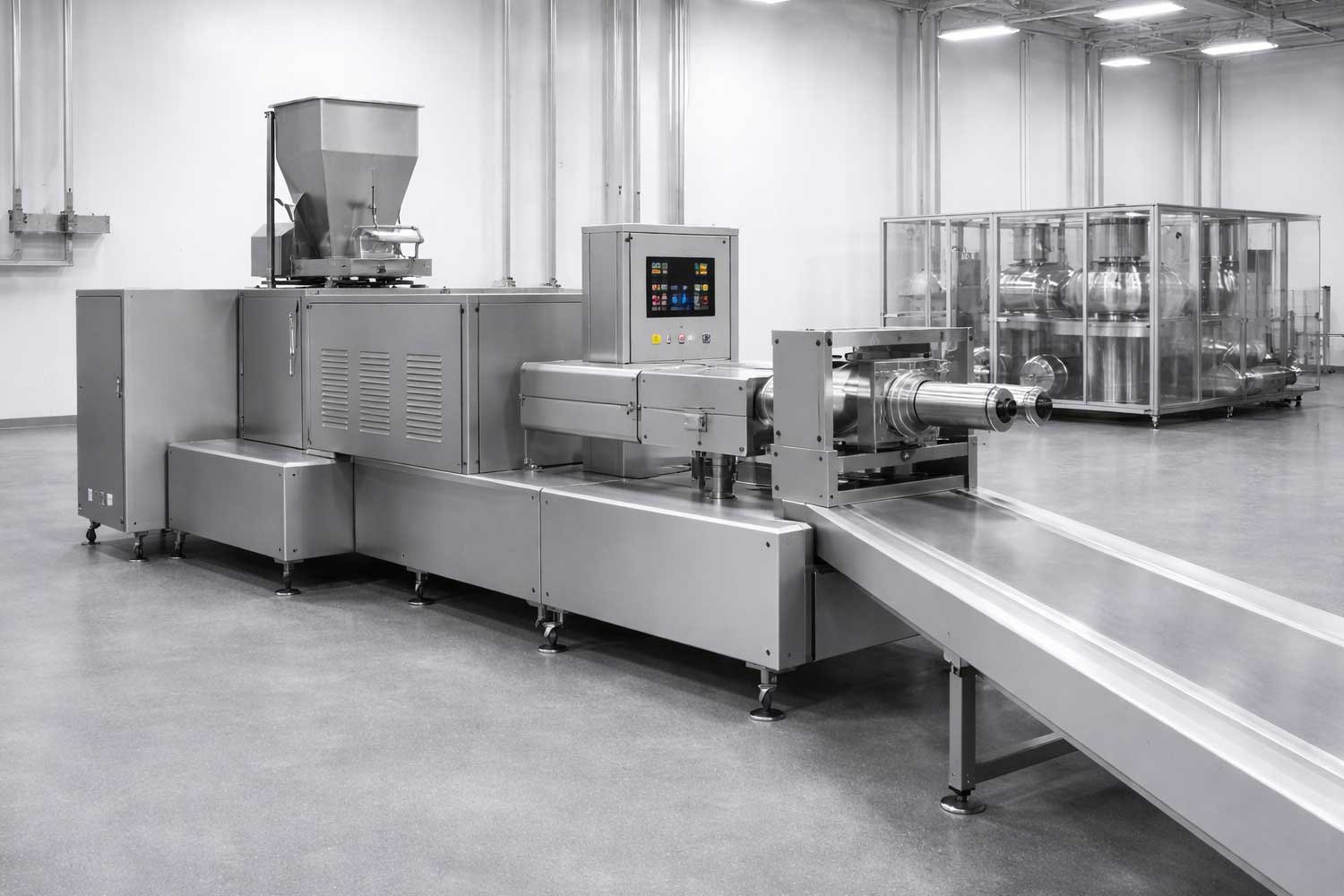
The 2026 business environment needs exporters to match their mechanical capacities with the economic conditions of their target regions when choosing soya nugget machines.
Africa: The Resilience Model
Demand has transformed into a fundamental requirement that extends beyond retail boundaries. The national feeding programs of Nigeria, NHGSFP, serve as the main bulk purchasers because protein deficiency affects more than 32% of Sub-Saharan Africa. Machines must include field-serviceable features that require heavy-duty mechanical components as their main parts because micro-electronics will fail under high-heat or dusty conditions.
- Buying Behavior: Customers show a strong preference for SS304 stainless steel products, which include manual overrides in their buying decisions.
- Intelligence: Local soybean production (e.g., Ethiopia, Nigeria) is rising, so machines that can process varied local flour grades are winning. The intelligent local soybean production in Ethiopia and Nigeria enables machines to process different local flour types, which results in increased success.
Bangladesh: The Quality-Speed Model
Branded TVP has become the dominant product in Bangladesh because it is now available in urban areas through supermarket distribution. Texture is the most important factor in determining product quality. Urban consumers now expect a specific chicken-like fibrous texture, which buyers achieve through their request for Twin-Screw machine that maintains 95% protein denaturation during production.
- Buying Behavior: The system uses automatic packaging, which operates at high speed to meet continuous retail needs throughout the day.
- Intelligence: The soya nugget processing machine works efficiently because energy-recovering dryers have become standard equipment, which helps businesses control their electricity expenses during the current period of rising industrial electricity costs.
Nepal: The Localization Model
Nepal has begun an aggressive import replacement program. Local businesses that depended on Indian soya products are now establishing compact production facilities. The region needs modular systems because its mountainous terrain creates difficult logistical challenges.
- Buying Behavior: Compact footprints that fit in small industrial buildings, which contain surge-protected motors.
- Intelligence: Buyers search for turnkey support that provides a complete soya nugget plant setup that contains miniature packaging solutions for local distribution.
How to Identify an Export-Ready Soya Nugget Machine for Exporter (Buying Criteria)
The Export-Ready soya nugget machine for exporter success in 2026 export markets needs to achieve FSSC 22000 Version 7 and ISO 22002:2025 hygiene standards as its essential requirement. The updated global benchmarks now require food safety governance and traceability systems to be demonstrable, together with machine performance. The system works as an essential requirement for both customs clearance in Bangladesh and government tender success in Africa.
Critical Technical Parameters
- Precision Extrusion (95% Denaturation): The twin-screw system operates as an essential component that delivers meat-like fibrous texture to international markets. The twin-screw system enables separate control over shear and temperature, which results in an expansion ratio that maintains a range between 2.5x and 3x throughout the process.
- Thermal Efficiency & Moisture Control: The moisture content for long-distance export to humid areas such as Chittagong and Lagos needs to stay below 10%. The dryers of 2026 now use heat recovery systems, which enable a fuel reduction between 15-22% that decreases cost-per-kg expenses for users.
Decision Matrix for 2026
| Feature | Single Screw (Entry) | Twin Screw (Growth) | Industrial PLC (Scale) |
|---|---|---|---|
| Primary Market | Rural Nepal / Local Startups | Bangladesh B2B / SME Africa | Large-Scale Export / NGOs |
| Material | SS202 / Partial SS304 | Full SS304 (Food Grade) | SS316 (Pharma Grade Optional) |
| Reliability | Relies on friction; high wear | Positive transport; low wear | Smart diagnostics; 24/7 run |
| Compliance | Basic FSSAI / Local | HACCP / ISO 22000 | FSSC 22000 V7 / GFSI |
Understanding the ROI of Soya Nugget Machine for Exporter: Cost vs Profit Analysis
To evaluate the financial sustainability of a Soya Nugget Machine for Exporter project, there should be a Total Cost of Ownership (TCO) rather than just the initial purchase price. The amount of operational costs saved from using high-efficiency motor drives (IE3/IE4 grades) will also be the most significant factor in determining the return on investment for various sizes of plants. The annual operational cost savings from these types of motors are from INR ₹1.5L to approximately ₹3L.
Capital Expenditure (CAPEX)
| Investment Item | Estimated Cost (INR) | Notes |
|---|---|---|
| Main Extrusion Line | ₹28,00,000 | PLC-controlled, SS304 |
| Auxiliary Equipment | ₹7,00,000 | Mixer, Multi-layer Dryer |
| Packing & Sealing | ₹5,00,000 | Nitrogen-flush band sealer |
| Installation & Training | ₹2,00,000 | Electrical setup and technician training |
| Total Initial Investment | ₹42,00,000 | Ready-to-run setup |
2. Operational Expenditure (OPEX) – Monthly
| Expense Category | Cost per kg (INR) | Monthly Total (INR) |
|---|---|---|
| Raw Material | ₹48.00 | ₹2,40,000 |
| Electricity | ₹4.50 | ₹22,500 |
| Labor | ₹3.00 | ₹15,000 |
| Packaging Material | ₹2.50 | ₹12,500 |
| Maintenance & Spares | ₹1.50 | ₹7,500 |
| Consumables | ₹0.50 | ₹2,500 |
| Total Production Cost | ₹60.00 / kg | ₹3,00,000 |
The Decision Matrix: Payback Period
- Scenario A (Standard Market): Your payback period reaches 24 months when you perform at 60% capacity with regular profit margins.
- Scenario B (High-Demand Export): Your payback period decreases to 14 to 16 months when you use the Soya Nugget Machine for Exporter to serve government tenders in Africa and premium retail markets in Bangladesh at 85% capacity.
Export Compliance for Soya Nugget Machine for Exporter: Certifications You Must Have
The regulatory landscape needs digital-first compliance to achieve successful customs clearance across Africa, Bangladesh, and Nepal. The Soya Nugget Machine for Exporter operation requires high-quality hardware to meet its regulatory needs.
- FSSC 22000 (V7): The FSSC 22000 is in its 7th thriving edition and will be the most Distinguished benchmark standard set to launch in 2026. This system exhibits the ability to implement a deep-clean sanitization, which is a critical requirement for all Governmental and NGO procurement systems for Africa.
- BSTI Compliance (Bangladesh): The Bangladesh Standards and Testing Institution will now require that all food processing machinery entering the country comply with BDS Standards. Not complying results in fines of over BDT 200,000.00 at the Port of Chittagong.
- CE & IEC 60204-1: This certification is required for the African market to ensure that the electrical systems on the machine are surge-ready and will provide a safe working environment for industrial operators, thus eliminating liability issues.
- Digital IEC & HS Code 8438: Ensure your import export code is digitally linked to HS Code 8438 (Machinery for preparation of Food and Beverages). Any discrepancies will be identified through the digital trade corridor from India to Nepal and will require an immediate review in 2026.
- Material Grade Certification (XRF Verified): Customs officers in Bangladesh and Nigeria are now using handheld scanners. Therefore, you must provide a mill test certification that verifies the machinery is genuine SS304/316 food-grade material, not polished mild steel.
Optimal Configuration of Soya Nugget Machine for Exporter for High-Volume Production
The system needs to achieve its target through two main operational methods, which both enhance texturization and energy recovery capabilities and achieve costs that remain competitive in African and Nepali markets.
- Twin-Screw Extruder (High-Shear System): The 2026 Twin-Screw System utilizes co-rotating screws, unlike traditional single-screw systems, which produce 40-60 Bar of pressure due to their operational differences. This allows for the conversion of globular protein to meat-like fibers, which are in demand by urban Bangladeshi consumers and Nigerian consumers.
- Industry 4.0 – PLC Integrated Control: The current units utilize VFD-driven electric motors and touchscreen PLCs to provide the control functions. The system allows the operator to develop shape recipes that allow for 100% consistency of output, independent of the operator’s skill level.
- Multi-stage continuous drying (meat nuggets): The drying process must achieve a moisture content of less than 10% when producing nuggets, as this allows for a shelf-stable product for a period of 12 to 18 months in humid conditions. The 2026 models use air-recirculation technology, allowing for an energy saving of 15 to 20%.
- FSSC 22000 Version 7 SS304 Sanitary Design: The requirements for FSSC 22000 version 7 require that food-grade stainless steel be used on every contact element to achieve International Food Safety Certification, ensuring compliance with audit requirements.
Growth Strategy for Exporters Using Commercial Soya Nugget Equipment for Higher Output
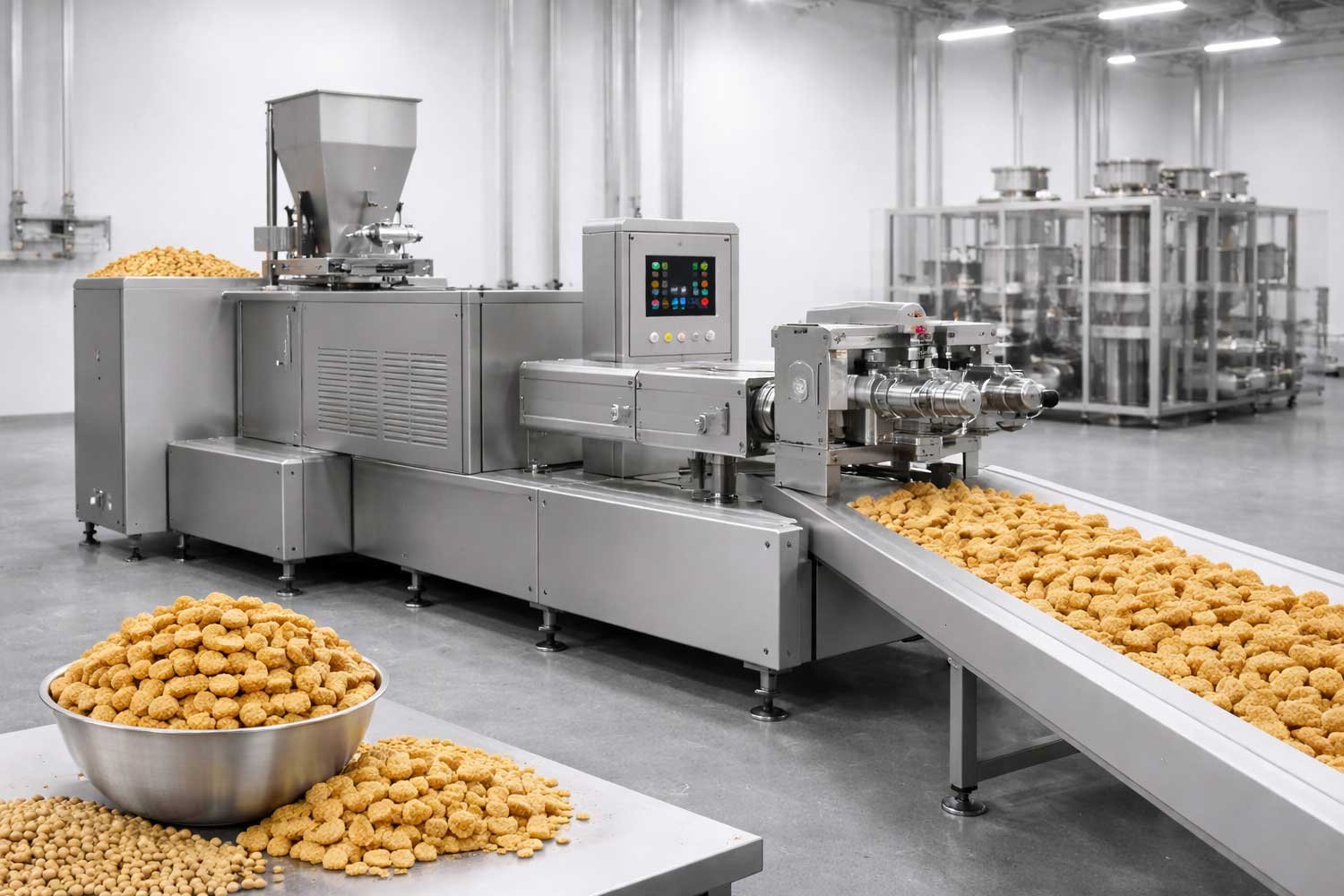
The Soya Nugget Machine for Exporter in 2026 requires successful scaling through Equipment investment, which must match established demand in African markets, Bangladesh, and Nepal markets.
Phase 1: Market Validation (100–150 kg/hr):
It requires a basic design that produces trial batches through its semi-automatic soya nugget machine. The system needs to perform Texture Analysis, which lets you assess whether your nuggets meet the local market demand for fibrous bite appearance.
Phase 2: Regional Specialization (200–300 kg/hr):
A shift to the Twin-Screw PLC system. The Energy Recovery Dryers validate their investment value by reducing utility expenses for Bangladesh and Nigeria. The company needs to achieve preferred vendor status with 1–2 reliable distributors through its local spare-parts buffer, which guarantees 99% uptime.
Phase 3: Industrial Dominance (500+ kg/hr):
Industry 4.0 technology to operate automated production systems. The project needs Fortification (adding vitamins/minerals) to secure high-volume Government/NGO nutrition contracts that operate through remote diagnostics to manage your fleet across multiple borders from a single dashboard.
Conclusion
An Exporter’s selection of an appropriate soya nugget making machine determines the growth opportunity of their export business. Foodsure Machines offers an export solution that operates under true export conditions of power loss, higher demand, and stringent quality control standards. Our machines provide consistent performance and improve operational efficiency and yield sustainable financial gain to our clients. We make sure that our customer makes the right investment in their overall facility and the products they use, not just their soya nugget equipment.
Looking for Export-Ready Soya Nugget Machines?
Get complete guidance on machine capacity, export specifications, pricing, and installation support for Africa, Bangladesh, and Nepal markets.
FAQ
Why does soya nugget machine selection fail in export markets?
Margins can be significantly reduced by the mismatch in voltage and by missing or oversized spare parts due to the time that it takes for the second container (the first container) to arrive after they have passed through customs.
Which soya nugget machine works best for African exporters?
Extruders with an output of less than 45kW are performing better than standard machines across all of Africa when supporting after sales have been at a local level.
How fast is ROI on a soya nugget machine for exporters?
The average payback period of machine users in Bangladesh operating 150kg/hour machines at 70% utilization is between 14 and 22 months.
What certifications does a soya nugget machine for export need?
Management without either CE marking or ISO 9001 for machines could face demands on the customs clearance process of African, Bangladeshi or Nepali ports.
Who should invest in a soya nugget machine for export business?
B2B sourcing agents, agricultural machinery exporters, and food trading equipment traders.