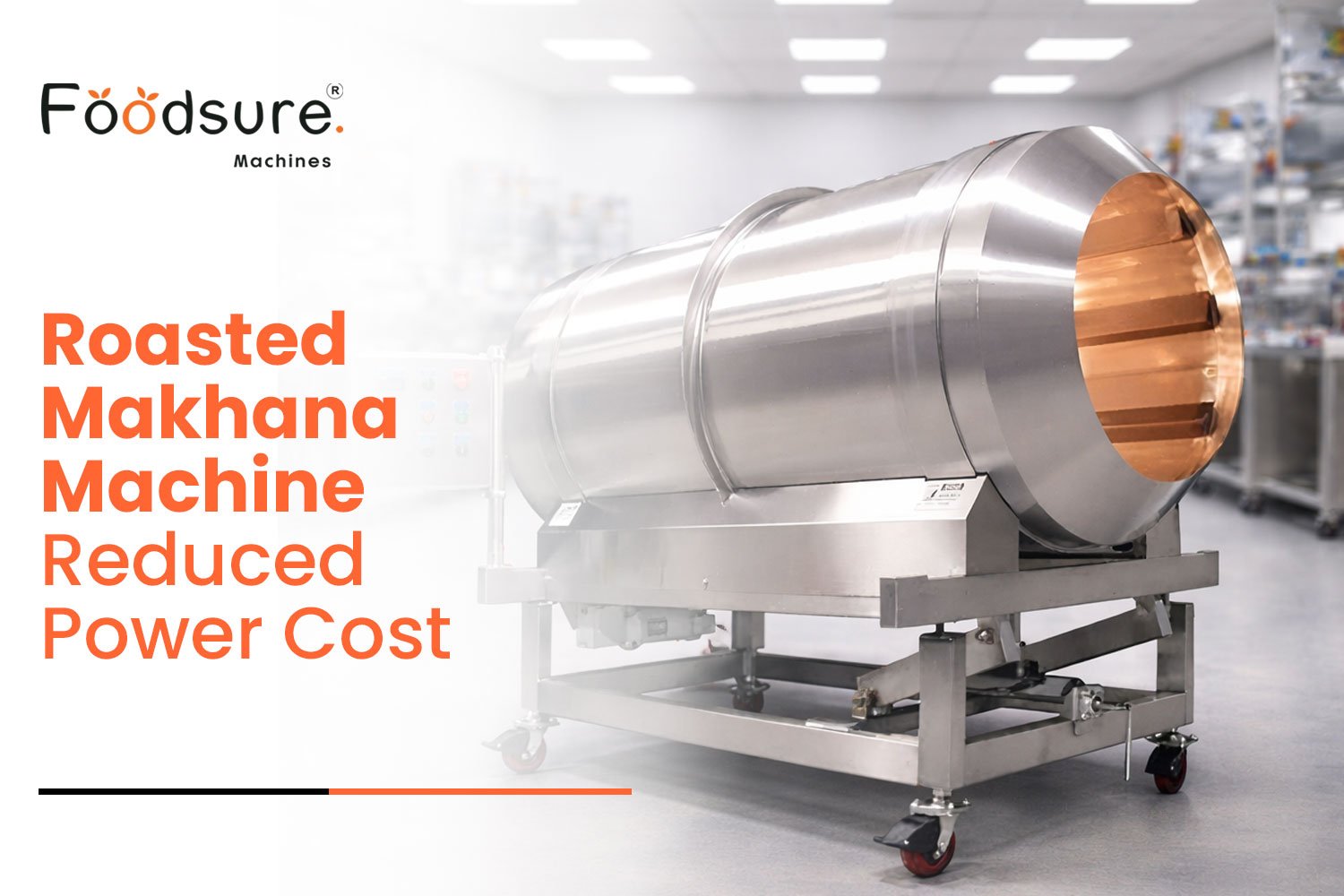
Electricity has become one of the vital cost pressures in makhana processing, particularly during roasting, where most of that power is consumed. Many processors assume that low fuel use means efficiency, but that’s rarely the case.
This blog highlights how an energy-efficient roasted makhana machine reduced power costs by 32%, measured over time.
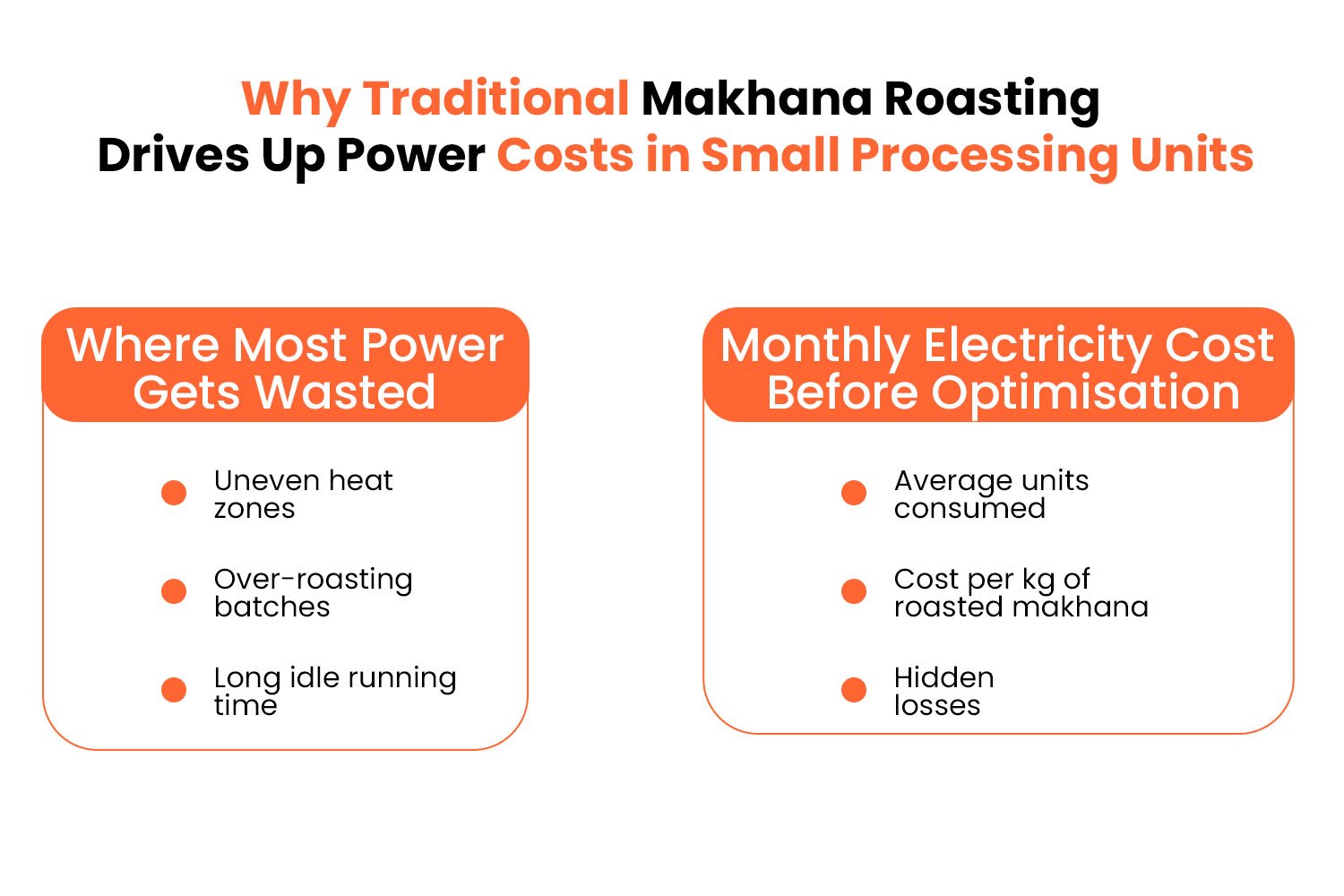
Why Traditional Makhana Roasting Drives Up Power Costs in Small Processing Units
Initially, the traditional makhana roasting setups have never been energy efficient by design. The majority of them rely on open heating, manual control, and long run cycles, all of which are gradually pushing electricity bills higher month by month. The actual problem is not only the type of fuel used or the size of the makhana making machine, but also the way power is reduced during the daily operation. If heat distribution is uneven and batch control is manual, the processors are losing money on energy, inconsistent product quality, and repeated work.
Where Most Power Gets Wasted
- Uneven heat zones: Hot spots burn some kernels while cold zones prolong roasting cycles.
- Over-roasting batches: To circumvent undercooking, operators are pushing time and temperature higher than necessary.
- Long idle running time: Machines are kept on between batches, consuming electricity without producing anything.
Monthly Electricity Cost Before Optimisation
- Average units consumed: High kWh usage resulting from extended roasting and reheating cycles.
- Cost per kg of roasted makhana: Increases continuously with the growing output inconsistency.
- Hidden losses: Re-roasting of rejected batches and the disposal of burnt makhana involve invisible power costs.
Real Reasons the Processor Needed a More Energy-Efficient Roaster
On a small scale, increasing power costs are not a big deal. However, when the production volume increases, the same roasting setup starts to be a disadvantage for the business anyway. The processor was not only doing it for optics but also helping with survival and growth.
- Scale limitations: Each increase in batch size required more roasting hours; consequently, the machines for food business were pushed beyond their optimal load, leading to a slowdown in daily throughput.
- Margin pressure: Electricity prices increased at a quicker rate than selling prices, thereby gradually eroding margins with every production cycle.
- Unpredictable power bills: Manual roasting and variable heat control resulted in monthly bills that varied a lot, hence making cost planning unreliable.
- Expansion plans blocked: Increased capacity would mean an energy spend proportionately higher, thus turning the growth into a financial risk instead of an opportunity.
What Changed with the Energy-Efficient Roasted Makhana Machine
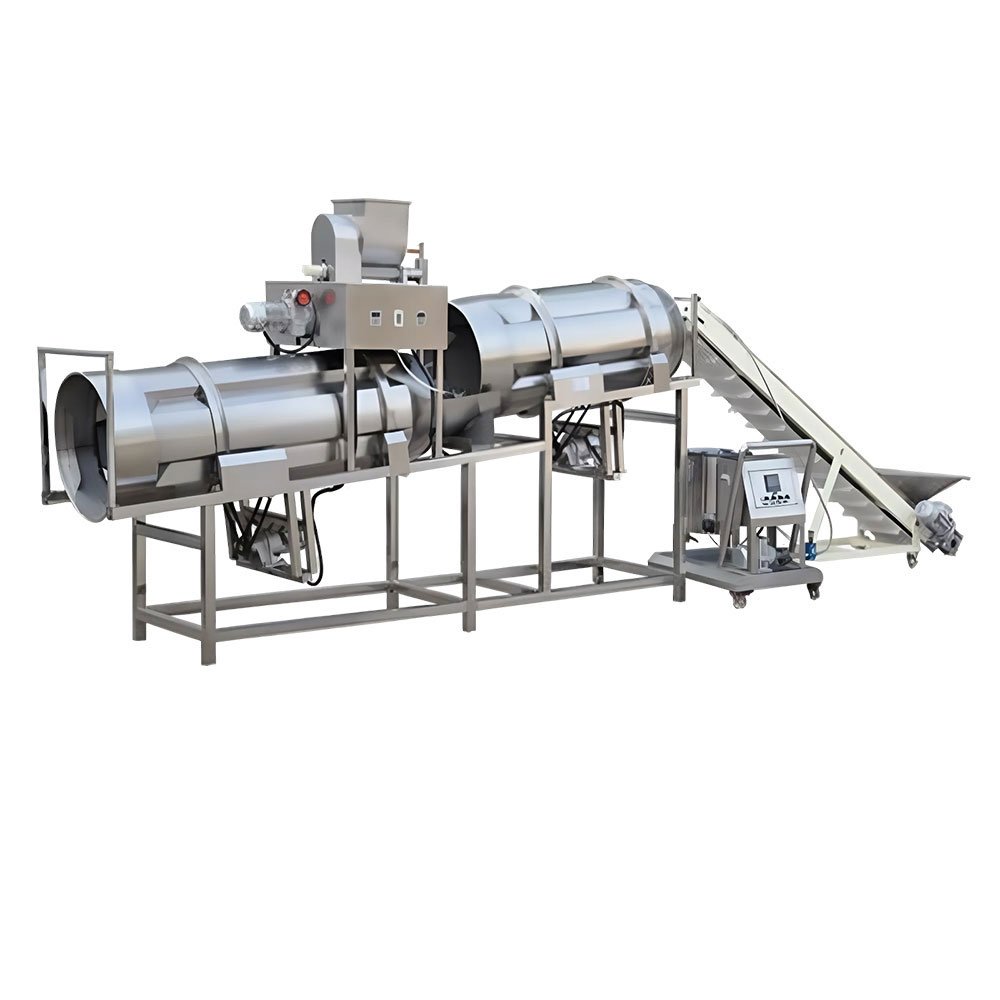
The change was not related to introducing elements of complexity; rather, it was a matter of eliminating the waste that is related to roasting. The control of heat, time, and output consistency was given to the processor when the roasted makhana machine reduced power costs. The differentiating factors between the low power consumption and low fuel claims were not the former, but the latter, that the food making machine stopped doing the unnecessary work.
Key Design Changes
- Controlled heating zones: Heat is distributed evenly across the roasting chamber, eliminating hot spots and cold patches.
- Improved insulation: Less heat escapes during operation, so the system doesn’t keep compensating with extra power.
- Optimised batch loading: Each batch is sized for uniform exposure, reducing over-roasting and repeat cycles.
Automation That Actually Saves Power
- No overheating cycles: Temperature stays within a defined range.
- No manual guesswork: Sensors replace constant human adjustment.
- Consistent roast in one pass: No re-roasting, no energy duplication.
| Parameter | Before (Traditional Roasting) | After (Energy-Efficient Machine) |
|---|---|---|
| Heat distribution | Un-even | Uniform, zone-controlled |
| Power usage | High and variable | Stable and predictable |
| Re-roasting | Frequent | Eliminated |
| Cost per kg | Rising | Controlled and lower |
Measured Power Savings After 60 Days Using a Roasted Makhana Machine Reduced Power Cost
The statistics indicated a noticeable change after two months, regardless of the fact that it was a continuous use of the system, not only in power but also in cost predictability. The measurements were taken from the electricity meter readings and the daily production logs instead of estimates.
| Metric | Before Optimisation (Traditional Roasting) | After Optimisation (Energy-Efficient Machine) |
|---|---|---|
| Units consumed per batch | 18–19 units | 12–13 units |
| Average batches per day | 10 | 10 |
| Total units per day | 180 units | 122 units |
| Monthly operating days | 26 days | 26 days |
| Monthly electricity units | 4,680 units | 3,170 units |
| Avg. electricity cost / unit | ₹8–9 | ₹8–9 |
| Monthly electricity bill | ₹37,000–₹42,000 | ₹25,000–₹28,000 |
| Power reduction | — | 32% lower consumption |
| Re-roasting / rejects | Frequent | Nearly eliminated |
How an Energy-Efficient Makhana Roasting Machine Improved Profitability and Daily Operations
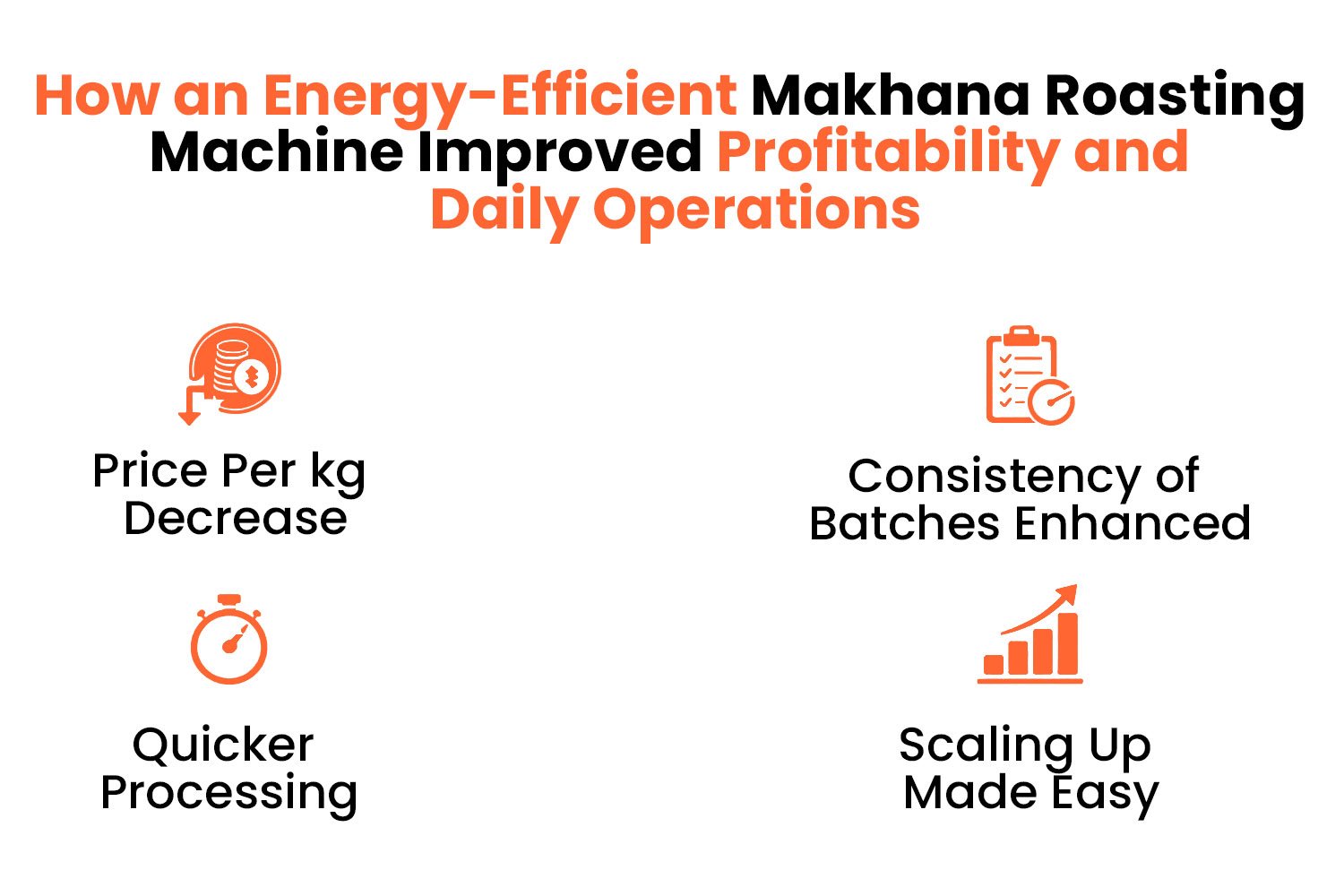
Reduction of energy usage has not only led to a minimum electricity bill but also significantly altered the daily performance of the whole roasting process.
- Price per kg decrease: The steady power consumption and fewer repeat cycles resulted in the effective price per kg of roasted makhana being down. Energy outlay was related to production, not a concealed overhead.
- Consistency of batches enhanced: Heat control and automation ensured even roasting throughout the batches, leading to fewer rejects as well as no re-roasting.
- Quicker processing: The single-pass roasting method reduced cycle time greatly; hence, more batches could be done in the same working hours.
- Scaling up made easy: Since power consumption per batch remained constant, it was no longer a matter of runaway operating costs when the capacity was increased. Expansion planning turned into a numbers decision instead of a risky guess.
Is Energy-Efficient Makhana Roaster Right for Your Operation?
Specialised energy-saving machine for roasting makhana is most beneficial to operators who are already experiencing power cost pressure, quality problems, or growth limitations, particularly in the important makhana production areas of Bihar, Madhya Pradesh, and Uttar Pradesh.
FPOs & SHGs
- Perfect for FPOs and SHGs in Bihar and MP that are operating their own processing units.
- Reducing and fixing electricity consumption allows for financially viable joint operations.
- It becomes simpler to set prices, make payouts, and estimate seasonal volumes without surprises in the electricity bills.
Rural Entrepreneurs Scaling from Manual Roasting
- Perfect for small business owners in UP and Bihar who are transitioning from pan or drum roasting.
- With automation, less skilled labour is needed while roast quality is improved.
- Daily production can be raised without a corresponding increase in power consumption.
Private Processors Facing High Power Bills
- Ideal for processors located in semi-urban areas of MP and UP with high electricity costs.
- It lowers the cost per kilogram, makes the monthly bills stable, and allows the safe capacity expansion to be released.
Conclusion
At Foodsure Machines, we take great pride in our roasted makhana machine reduced power costs without quality decline. Our devices facilitate FPOs and processors to grow sustainably, improve profit margins, and deliver consistent results. Smart investment proves to be favourable in the long run.
FAQ
How does a roasted makhana machine reduce power cost?
It uses intelligent heat control and minimizes heat loss, reducing electricity consumption by up to one-third.
Is this machine suitable for FPOs?
Yes. It is ideal for small and medium processors and runs smoothly without adding complexity or extra manpower.
Can it maintain consistent roasting quality?
Every batch is roasted uniformly, preventing overheating and avoiding unnecessary energy waste.
What kind of savings can I expect?
Monthly electricity bills can drop by around 30%, delivering significant long-term savings.
How long does it take to pay for itself?
Most units recover the investment within six to twelve months, depending on production volume.