
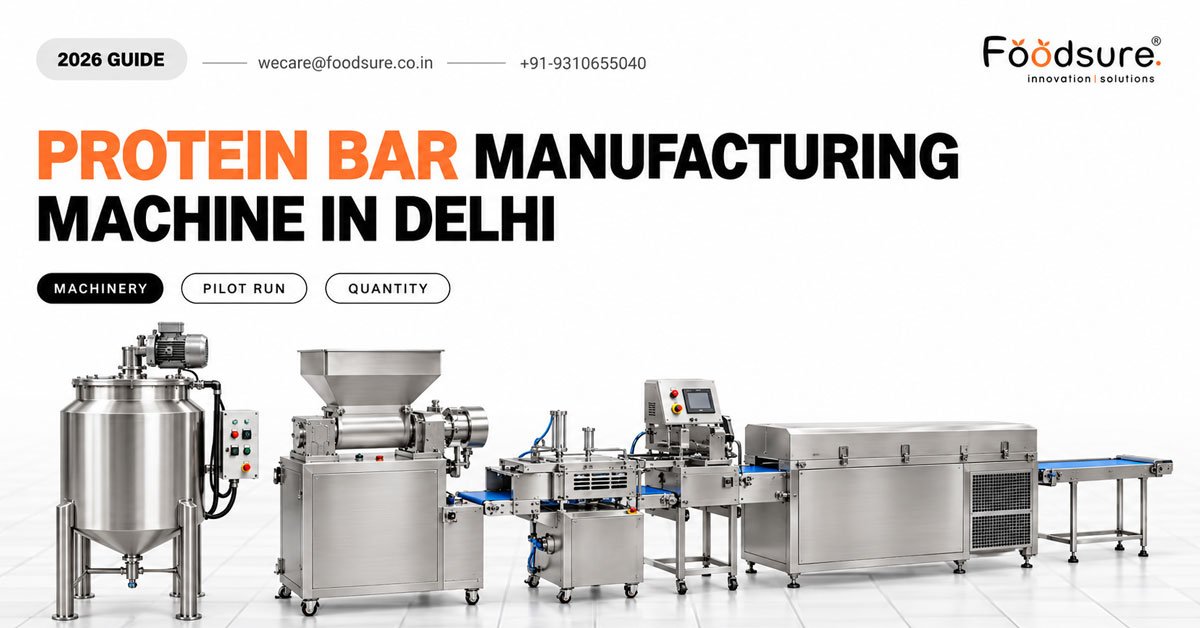
Protein bars form some of the fastest growing segments of the health food industry, with Delhi having transformed into a hotspot for emerging and existing brands in recent times. The need for uniformity in terms of appearance, weight and even flavor for each batch of bars is increasing; however, achieving this manually is a difficult task.
A protein bar making machine enables you to achieve all these functions without manual intervention and with great ease. The kind of machine that works best for you depends upon your requirements in terms of capacity and automation.
Why Are Businesses in Delhi Investing in Protein Bar Manufacturing Machines?
Here is what is pushing both startups and established brands to move away from manual production.
Quality control in each bar.
The machines maintain the size, weight and shape of the bars, so that even the first piece produced and the thousandth will be exactly the same. This creates trust among customers and wholesalers, and helps to minimize wastage due to different sizes of pieces.
Increased capacity.
The output can vary from a few hundred bars per hour to 500 kg per hour for the more powerful lines. This allows taking bigger orders and not having to hire a large staff to cover it.
Improved process control.
Flexible speed and settings will help you properly deal with sticky and high-protein mixtures. After finding the right recipe setting, you will be able to use it for all batches.
Decreased reliance on manual labor.
Less manual interventions into the process lead to less chance for human mistakes and contamination. Now your staff is free for quality checking and packaging.
Easy scalability.
It is possible to start with a small piece of equipment and increase the power of the line as sales increase. It is also easier when the supplier offers upgrade options.
Key Features to Look for in a Protein Bar Machine
Check these points before you compare quotes.
Precision and control adjustability.
It should be equipped with adjustable speeds and settings to cater to various recipes ranging from nut-filled to high-protein blends without experimenting all the time.
Uniformity of bar shapes and sizes.
Adjustable moulding and cutting systems ensure uniform shapes and sizes of bars which will help in perfect fit for packaging as well as accurate labeling weight.
Right size for right output.
A machine smaller than your requirement will slow you down while a larger machine means locking of capital. For beginners, 100-300 bars per hour capacity should work fine.
Sanitary conditions and quality of materials used.
Food grade stainless steel like SS304 are easily washable and durable as well. It ensures a smooth surface and easy disassemblability for an easier cleaning process.
Ease of operation.
If a machine is easy to operate, then learning how to use it becomes easy too. Find out whether training is included by the vendor or not.
Room for expansion.
Choose a supplier or a machine that allows you to increase capacity or shift to a more powerful production line in the future.
How Does a Protein Bar Machine Work?
The exact process varies by model and recipe, but most lines follow this sequence.
Preparation.
Dry ingredients such as nuts, seeds, grains and protein powder are weighed and readied. A binding syrup or paste is prepared separately.
Mixing.
The dry mix and binder are combined until the blend is even. Good mixing prevents loose crumbs and weak bars.
Forming.
The mixture is pressed or extruded into a continuous slab or rope. Moulds and settings decide the thickness and width.
Cutting.
The formed slab is cut to the required length and weight. Accurate cutting keeps every bar the same size.
Cooling.
Bars set on a cooling stage so they hold their shape and are firm enough to handle.
Secondary treatment.
Some products get a chocolate or compound coating, or a topping, depending on the recipe.
Packaging.
Finished bars are wrapped in moisture-resistant packs to protect texture and shelf life.
How to Choose the Right Machine Capacity
Picking the right tier saves money and avoids early upgrades. Your daily demand, available factory space, budget and growth plans should all shape the decision. Prices below are indicative and vary by model, speed and level of automation. Delhi machines broadly range from ₹5 lakh to ₹50 lakh for commercial setups.
| Production Scale | Suitable For | Key Consideration |
|---|---|---|
| Entry-level (50–300 bars/hour, approx. ₹1.5–2 lakh) | Startups testing recipes and selling locally | Low upfront cost and simple controls, but limited output as orders grow |
| Semi-automatic (300–500 bars/hour, approx. ₹5–10 lakh) | Growing brands needing steady daily output | Good balance of price and capacity; check how easily it can be upgraded |
| Fully automatic (500+ bars/hour, approx. ₹25–50 lakh+) | Factories and contract manufacturers with high-volume orders | Highest investment, but lowest labour dependency and best consistency |
Biggest Challenges and Solutions for Protein Bar Production in Delhi
These are the problems new manufacturers run into most often.
Between price and quality
When new brands are just starting out, they may have trouble balancing price and machine quality. The former could lead to machine breakdowns, while the latter could be too expensive at an early stage.
Solution
Use a machine that is cost-effective and has the necessary features, and then gradually upgrade as production grows. Compare capacity, quality, and serviceability apart from price.
Bar sizes not the same
Bars that are not uniform in size and weight will result in wastage, complaints and difficulties in packaging if production is manual.
Solution
Use a machine that will ensure consistent formation and cutting, and calibration will ensure that all bars meet the standard.
Cleanliness of the machine
Protein mixes are sticky in nature, and they tend to make residues that are difficult to clean, and this can lead to hygiene issues.
Solution–
Use machines made of stainless steel with accessible parts. Establish a cleaning schedule for after every batch and abide by the instructions of lubrication and maintenance.
Low after-sales service
With the lack of spares and trained personnel, even the best machine will be lying idle for days once there is a problem.
Solution–
Ensure that your supplier provides you with installation, training, warranty and spares.
Benefits of Using Automated Protein Bar Machines
Automation pays off in several practical ways.
- Uniform Quality: every bar is identical in dimensions, weight, and finishing.
- Increased Production: capable of manufacturing more bars than hand operations do hourly.
- Reduced Labor Costs: use of less manpower because of automation.
- Improved Hygiene: reduced handling and stainless steel parts that can be easily cleaned.
- Rapid Expansion: can increase production capacity without changing the setup.
How to Choose the Best Protein Bar Machine in Delhi?
The best machine is not the biggest or the most expensive one. It is the one that fits your needs.
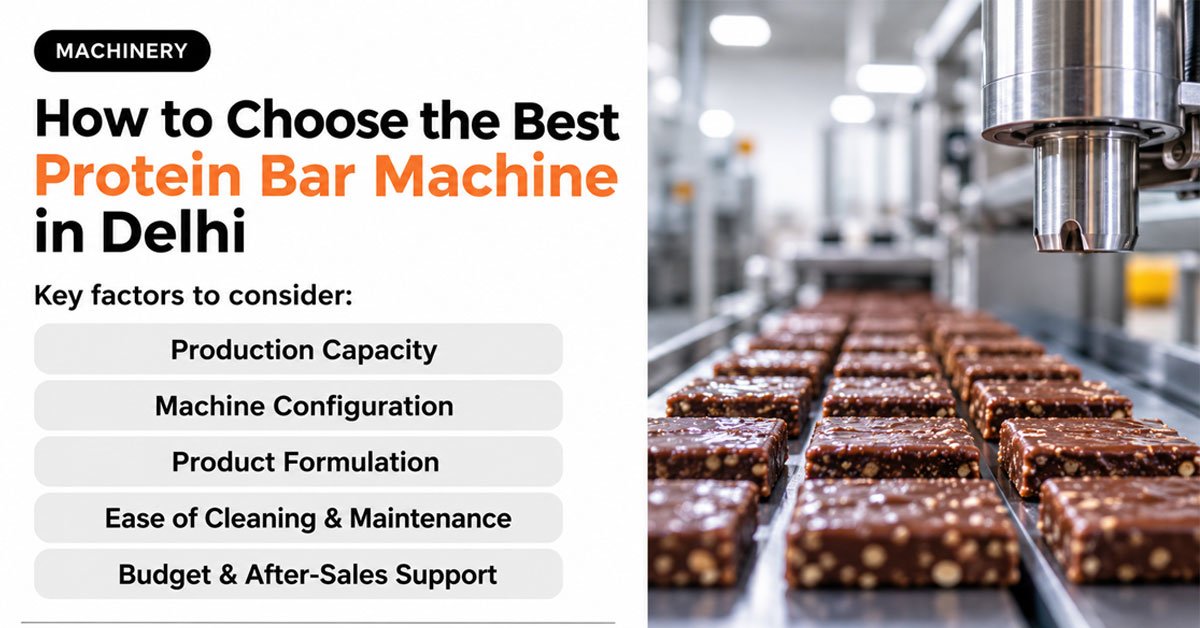
- Daily production target
- Budget and total cost
- Level of automation
- Stainless steel build quality
- Ease of cleaning
- Mould and shape flexibility
- Warranty period
- Spare parts availability
- Installation and operator training
Why Choose Foodsure for Protein Bar Machines?
At Foodsure Machines, we manufacture fully automated machines in stainless steel which process up to 500 kilograms per hour. Our 13 plus years of experience in aiding food companies have enabled us to provide all-round assistance to our customers in installation and training of the machine.
Start your protein bar business with Foodsure — Enquire now!
FAQs
What is the price of a protein bar manufacturing machine in Delhi?
Commercial machines cost between ₹5 lakh and ₹50 lakh or even above based on the capacity and automation of the machine.
What is the best protein bar machine for small scale manufacturing in Delhi?
Protein bar manufacturing machine which produces 100 to 300 bars per hour is ideal for small businesses to try their recipes.
Where do I get a manufacturer of protein bar machines in Delhi?
There are specialized suppliers/manufacturers of protein bar machines located in Delhi industrial areas like Samaypur Badli, Foodsure Machines.
How long is the installation time for a protein bar making machine in Delhi?
It generally takes one to two weeks depending on the complexity of the line.
Does the protein bar machine supplier in Delhi give warranty and training?
Most suppliers give a warranty of one to two years and some like Foodsure even give installation and training facilities to the customers.
Can one protein bar production line in Delhi manufacture different types of products?
Yes, all the machines manufacture nut, seed, grain and protein powder and molds of various sizes make different shaped bars.




