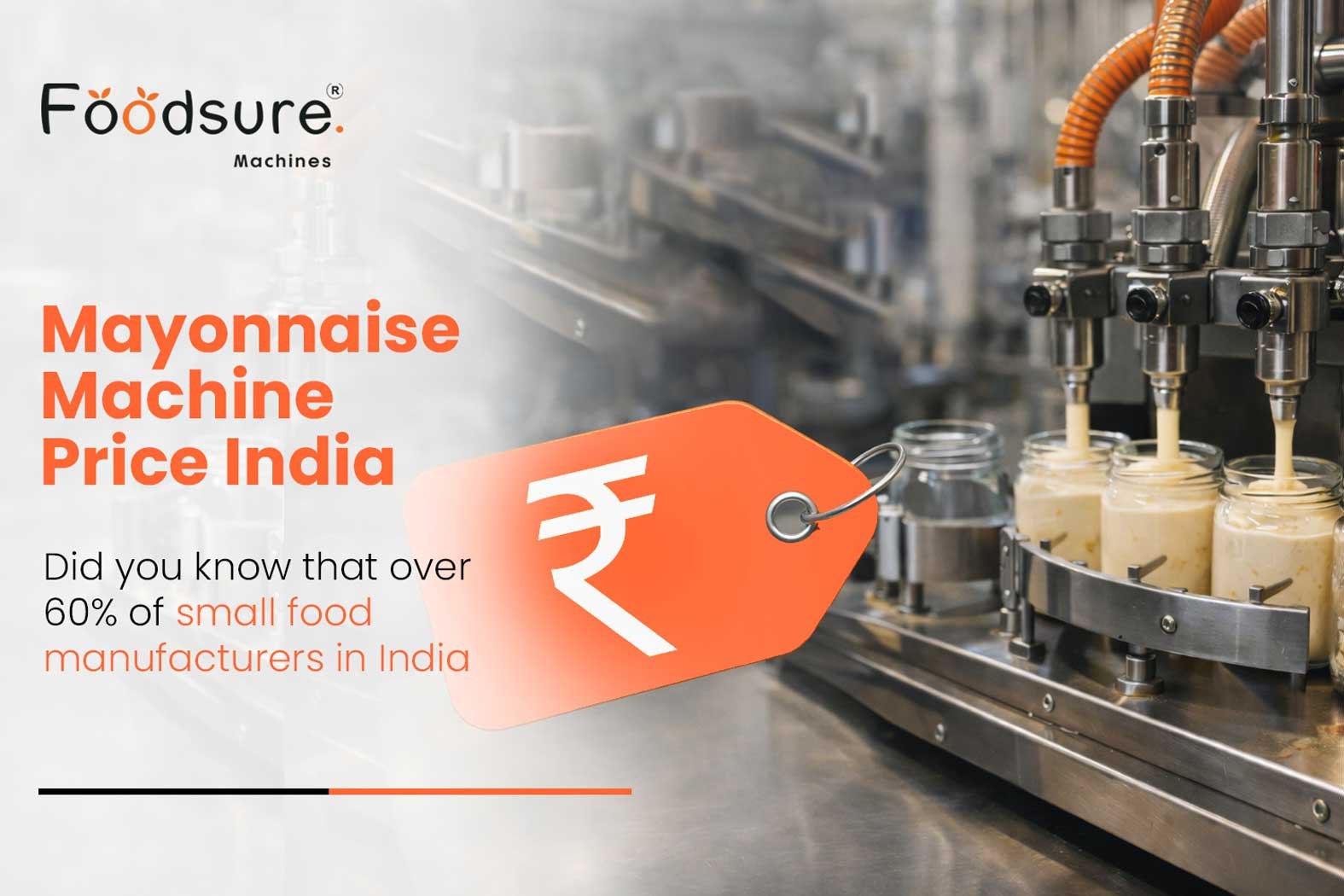
Did you know that over 60% of small mayonnaise units in India are unable to purchase machines that reach full capacity, losing lakhs of rupees in energy, labour, and waste? Are you risking the same hidden losses? Our Mayonnaise Machine ROI Checklist reveals exact numbers, percentages, and costs to help you choose a machine that truly scales your factory profitably. In this blog, we talk about how to pick the right semi-automatic or fully automatic machine, measure ROI, and avoid costly mistakes.
How to Choose a Mayonnaise Machine: Semi-Automatic vs Fully Automatic Mayonnaise Machine
The size of production, budget, and supply of labour are used to determine the choice of a mayonnaise machine for batches. Semi-automatic machines are optimally applicable to small batches, and fully automated machines are optimally applicable to large-volume businesses that demand consistency.
- Semi-Automatic Mayonnaise Machine: The manufacturing normally ranges between 20-100 kg/hr, operated by 2-3 people in a shift, who mix, load, and supervise. The advantages of low startup cost (₹2–12 Lakh) and flexibility for small/test batches. The disadvantages include high dependence on labour and slow scaling to high throughput due to manual processes.
- ROI monitor: It may experience net commercial output less than 70% of nameplate capacity. Pay close attention to tracking the mean time to failure.
- Fully Automatic Mayonnaise Machine: It can produce up to 100-1000 kg/hr and requires 1 -2 operators to monitor PLC controls and minimal interference. The benefits are high throughput, uniform quality of emulsions with inline homogenisers, and scale-up. The downsides are high CapEx ( ₹10–100 lakh) and maintenance by skilled personnel.
- ROI monitor: The target power consumption is 56 kWh/100 kg (e.g, 48 units/day at 50 kg/hr), with spares/training costs not exceeding 30% of total CapEx.
Read More: 2025 Buyer’s Guide: Fully vs Semi-Automatic Mayonnaise Machines – Which One Wins?
Mayonnaise Machine ROI Checklist Made Simple: A Smart Buyer’s Guide
The cost analysis of the mayonnaise machine ROI checklist must focus on losses in food production plants. The scaling of competitive markets, such as India and South Africa, is calculated using an in-built 8-point checklist to ensure that the payback is scaled to suit the targets.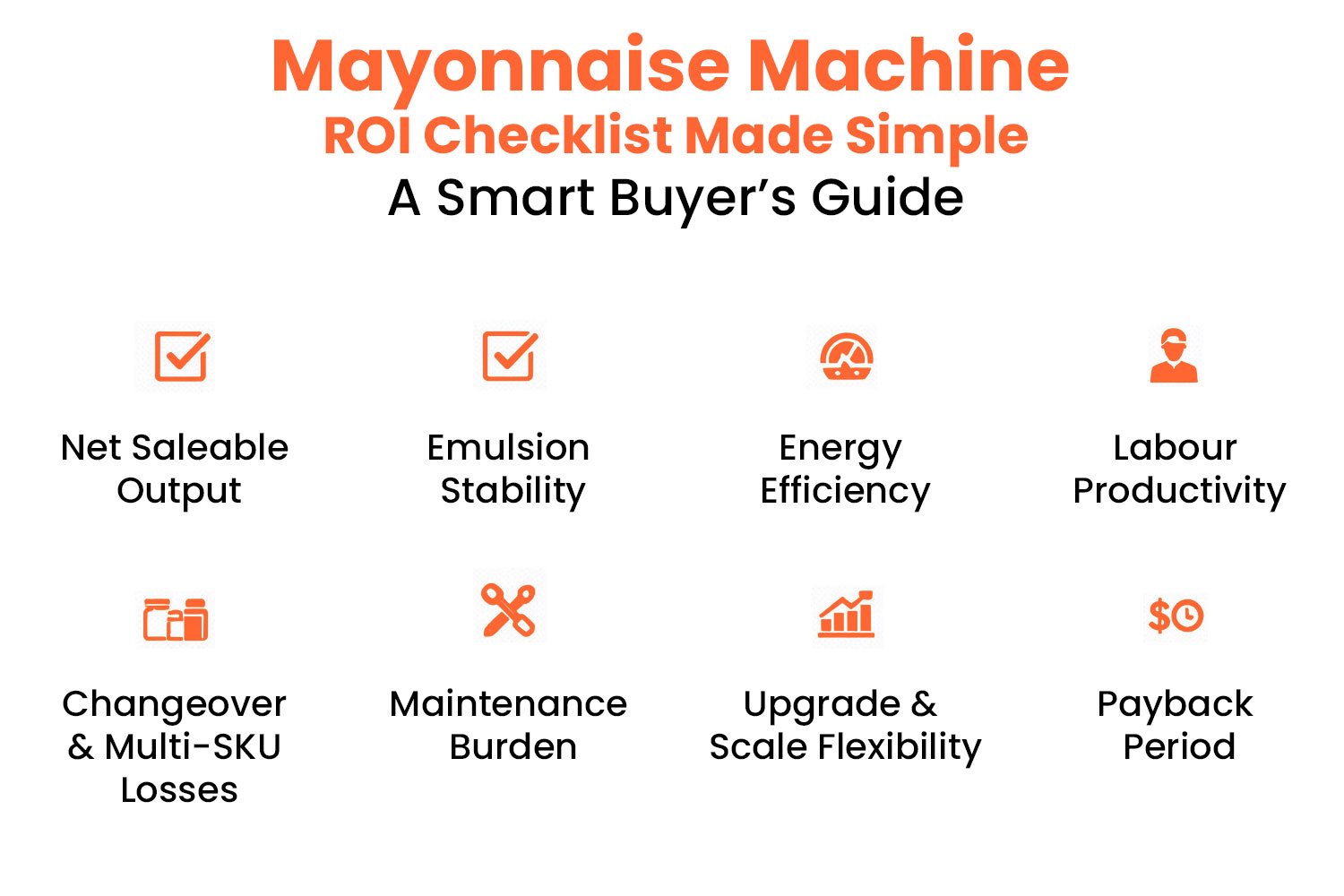
- Net Saleable Output: Achieve target capacity of 300kg/hr machine of ≥70% at rated capacity 210+ kg/hr post-downtime. Target net output ≥70% of rated 300 kg/hr (210+ kg/hr post-downtime). If actual output is 220 kg/hr, ROI may drop 25–30%. Track OEE via PLC logs.
- Emulsion Stability: 1% of batches may be unstable due to emulsion issues. This leads to 1000 kg/month of rejects, costing ₹1 Lakh. Use inline homogeniser checks at 5000–10,000 rpm to minimise rejects.
- Energy Efficiency: Ideal energy use is 5.8 kWh/100 kg. Excess 6.5 kWh/100 kg over 150,000 kg/month – ₹16,500 extra electricity. Cleaning-in-Place (CIP) time >20 min increases downtime and costs.
- Labour Productivity: Operators should achieve ≥5,000 kg/operator/month. Semi-auto machines require 2–3 cycles to reach full efficiency, adding extra labour cost. Use HMI interfaces to reduce interventions.
- Changeover & Multi-SKU Losses: Max changeover time 1.5 hrs/shift. Without optimisation, 3-SKU switches can cause ₹50,000/shift loss. Using recipes on PLC and pneumatic fillers can reduce losses by 50%.”
- Maintenance Burden: Preventive maintenance (PM) costs ₹50,000/year. Downtime >5 hrs/month from seal/bearing failures can hurt ROI. Maintain 10% spare inventory and vibration sensors to minimise breakdowns. Ensure BRCGS compliance.
- Upgrade & Scale Flexibility: Upgrades cost 30% of the initial price. Modular SS 316 design allows throughput doubling and extends machine life up to 7 years. Replacement after 3 years may cause a temporary negative ROI.
- Payback Period: Target payback: 18–30 months. Example: ₹50 lakh fully automatic machine at 150 kg/hr net output recovers faster than ₹12 lakh semi-auto at 40 kg/hr. Use a 12% discount rate in Excel NPV calculations.
Mayonnaise Machine ROI Checklist: Cost, Maintenance & Production Gains at a Glance
| Machine Type | Key Part | Cost of Part (₹) | Replacement / Maintenance | Production Impact | Notes |
| Semi-Automatic | Emulsifier | ₹1,20,000 | Replace every 12 months | +20–50 kg/hr output | Stability check monthly |
| Semi-Automatic | Motor | ₹45,000 | Servicing every 2 months | +2–5% output | Prevents downtime |
| Semi-Automatic | Pump | ₹35,000 | Servicing every 2 months | +1–3% output | Reduces rejects |
| Semi-Automatic | Mix Vessel | ₹80,000 | Minor maintenance every 2 months | +1–2% output | Ensure cleaning efficiency |
| Fully Automatic | Emulsifier | ₹2,50,000 | Replace after 1 year | +100–200 kg/hr output | Key for scale ROI |
| Fully Automatic | Motor | ₹90,000 | Servicing every 2 months | +3–5% output | High uptime required |
| Fully Automatic | Pump | ₹60,000 | Servicing every 2 months | +2–4% output | Affects batch consistency |
| Fully Automatic | Mix Vessel | ₹1,50,000 | Minor maintenance every 2 months | +1–3% output | CIP integration recommended |
| Fully Automatic | PLC / Automation Module | ₹2,00,000 | Optional upgrade after 1 year | +5–8% output | Improves multi-SKU efficiency |
Read More: Buy Mayonnaise Machine in India – 2025 Prices, Specs & Best Models
Conclusion
We assist factories in making the right mayonnaise machine equipment selections at Foodsure Machines. Our Mayonnaise Machine ROI Checklist ensures every mayonnaise making machine reaches its full potential to produce the best output at the lowest costs and increase profit. We take you through expenditures, repairs, and manufacturing profits so that your factory expands and grows efficiently and profitably.
Frequently Asked Questions
What is a Mayonnaise Machine ROI Checklist?
It’s a simple way to track what your machine costs, what it produces, and where money leaks during operation.
Why should I care about ROI for mayonnaise machines?
Because buying the machine is only the beginning. Idle time, energy waste, and inefficiency quietly drain cash every month.
How often should I track machine ROI?
ROI should be reviewed monthly by checking production output, energy usage, and labor hours to catch issues early.
Which machine type pays back faster – semi or fully automatic?
Fully automatic machines usually pay back faster because they scale production efficiently despite higher upfront cost.
What output should I aim for to hit ROI targets?
Machines should operate at least at 70% of rated capacity after accounting for downtime to remain profitable.
How does energy use affect ROI?
Higher energy consumption directly raises costs. Even small differences in kWh per 100 kg can add up to large monthly losses.
Does operator efficiency matter?
Yes. Higher output per operator significantly lowers labor cost per kilogram and improves overall ROI.
Do SKU changes hurt profits?
Yes. Frequent flavor or pack-size changes can be costly per shift unless optimized with PLC recipe memory and quick-release systems.
How does maintenance impact ROI?
Poor maintenance causes breakdowns and downtime, directly reducing production and damaging ROI.
Can upgrades improve ROI?
Yes. Upgrades like dosing pumps or aseptic fillers can boost throughput, extend machine life, and accelerate payback.
How long before I recover my investment?
Typical payback ranges from 18 to 30 months, with fully automatic machines recovering faster at higher output levels.
How does the ROI checklist actually help?
It highlights exactly where money is lost and shows what to fix, ensuring your machine generates profit instead of draining cash.