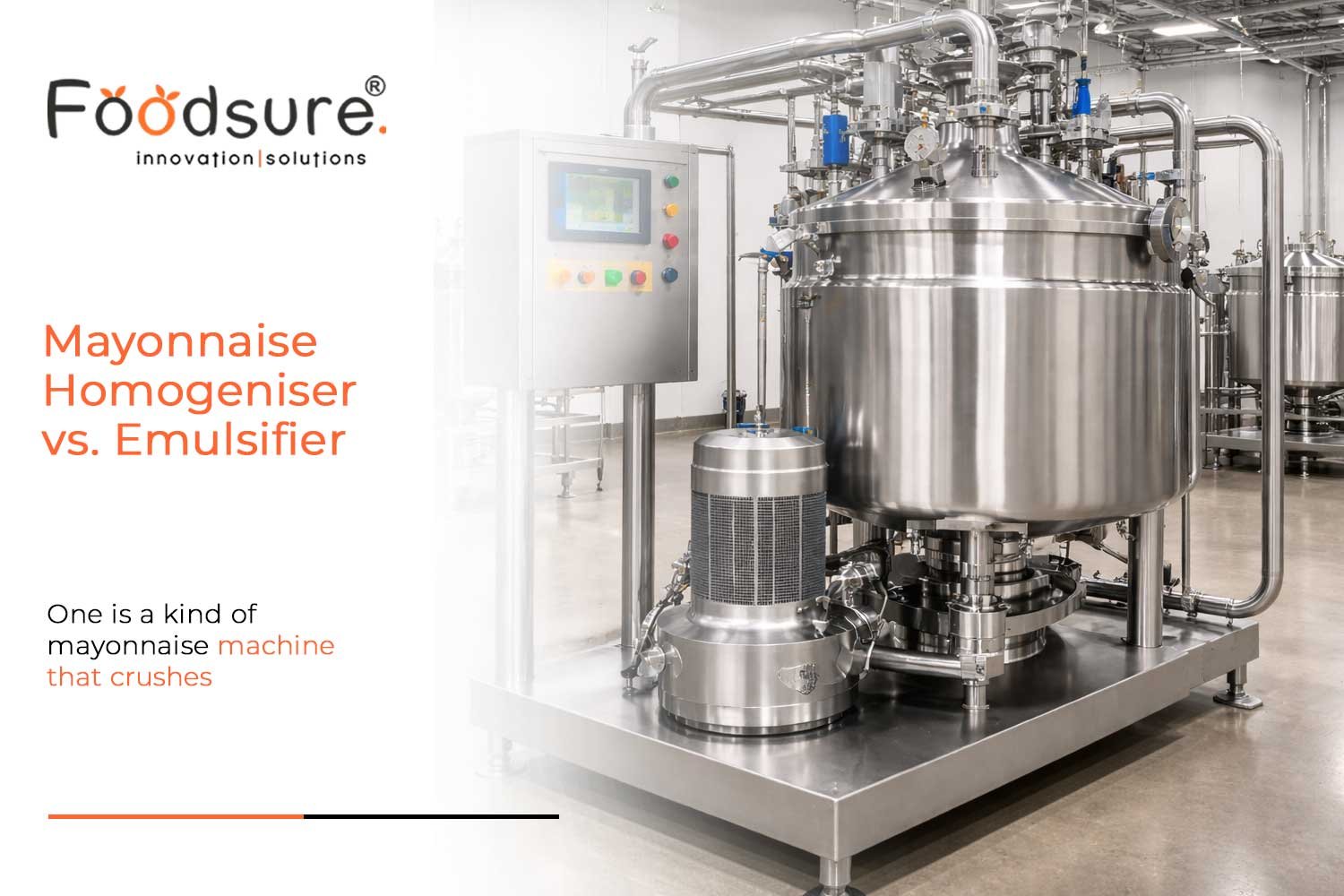
Even in the condiment production industry, mayonnaise homogeniser vs. emulsifier are used interchangeably, yet they perform different tasks. One is a kind of mayonnaise machine that crushes the oil into tiny, uniform particles; the other is a substance that prevents these tiny mist droplets from adhering. The difference between the two is an important aspect that should be understood by any manufacturer who seeks to have a shelf-stable, high-end, textured product that never breaks.
Mayonnaise Homogeniser vs. Emulsifier: Defining the Core Concepts
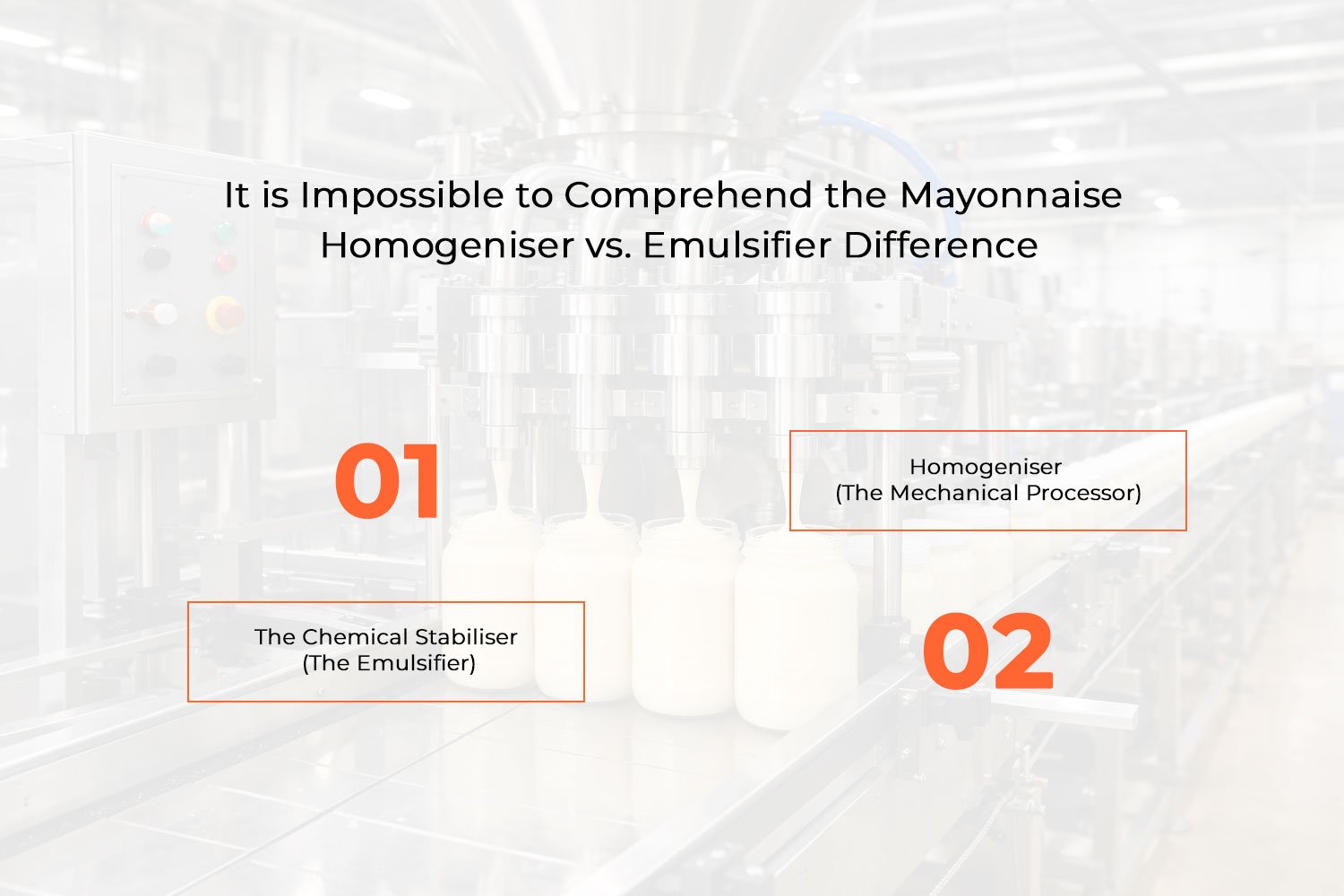
It is impossible to comprehend the mayonnaise homogeniser vs. emulsifier difference until we look at the chemical properties as well as the mechanical properties.
The Chemical Stabiliser (The Emulsifier)
Lecithin is an egg yolk emulsifying agent that is used as the primary one by Mayonnaise.
- Role: The substance decreases the surface tension between oil and water.
- Mechanism: The molecule is made up of two opposite ends; one end is hydrophilic in nature, and the other end is lipophilic in nature. The coating does not allow fusing of oil droplets by encircling them.
- Nature: The substance or ingredient is usually a matter of nature.
Homogeniser (The Mechanical Processor)
The homogeniser is industrial mayonnaise equipment.
- Role: The homogeniser mayonnaise machine uses brute force to convert oil droplets into tiny particles that are of a constant size.
- Mechanism: The system works by subjecting the mixture to a small valve as the turbulent rotors rotate at a high speed.
- Nature: A step in a mayonnaise making machine or a process.
Mayonnaise Homogeniser vs. Emulsifier: Key Technical Differences Explained
| Feature | Emulsifier (Ingredient) | Homogeniser (Machine) |
|---|---|---|
| Primary Goal | Chemical stability and shelf life | Physical texture and particle uniformity |
| Action | Coats droplets to prevent merging | Smashes droplets to make them smaller |
| Input Type | Chemical additive (e.g., Egg yolk, Mustard) | Mechanical energy (Pressure, Shear) |
| Result | Prevents the mayo from separating | Makes the mayo white, thick, and smooth |
Mayonnaise Homogeniser vs. Emulsifier: The Science Behind the Mayonnaise Mix
There are two ingredients of the mayonnaise production, which must adhere to the given procedure. The commercial-grade product operates in tandem with the two parts.
Step A: Emulsification
When you add the oil to the egg base, the emulsifier forms a protective coat on the oil. The oil and water will form two different layers since the stirring cannot be successful without the presence of an emulsifier in the mixture.
Step B: Homogenization
The inclusion of an emulsifier does not ensure that there is a uniform size of oil droplets. Homogenization is an intense process that makes use of mechanical force to get its outcome.
- Particle Size Reduction: It forms oil droplets with a size ranging 0.5-5 microns.
- Viscosity: Smaller droplets have more surface area. It has more resistance between particles. It is in virtue of this that the mayonnaise attains its stand-up qualities.
Why a Homogeniser Matters in a Mayonnaise Production Line
The skill of producing mayonnaise by whisking is a manual emulsification process, and therefore, it does not involve the use of a homogeniser to produce the product.
- Long-Term Stability: The smaller droplets are both stable in that they require longer to reach the surface of storage. But they are stable for several months on the grocery store shelves.
- Colour: The smaller the size of oil droplets, the more effective the light scattering and thus the attainment of the typical opaque white colour of the mayonnaise.
- Texture: The procedure yields a silky feel that cannot be obtained through manual mixing processes.
- Efficiency: The system allows better ratios of oil to water. It is also stable when it comes to the emulsion (it has no breaking issues).
Also read: Mayonnaise Market Trends
Types of Homogenisers Used in an Industrial Mayonnaise Machine
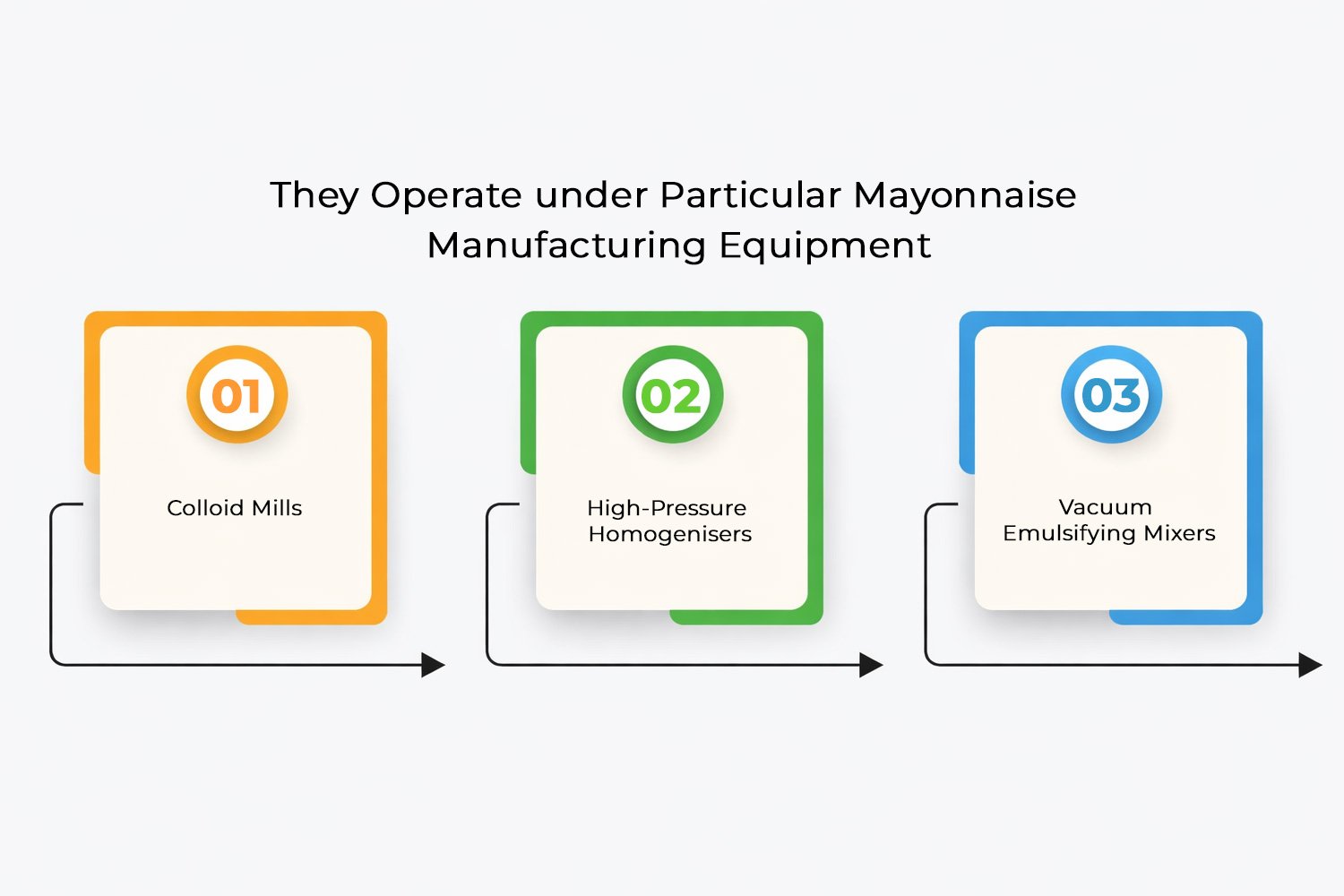
In industrial environments, producers do not simply take a big blender. They operate under particular mayonnaise manufacturing equipment.
- Colloid Mills: In these mills, the rotor and stator trap have a system that works with a minimal distance between the two parts. The mayonnaise is milled through the gap that creates strong shear forces.
- High-Pressure Homogenisers (HPH): The mayonnaise production line works by pumping the mixture through a valve under high-pressure levels. The pressure drop leads to the breakup of the oil droplets into minute particles.
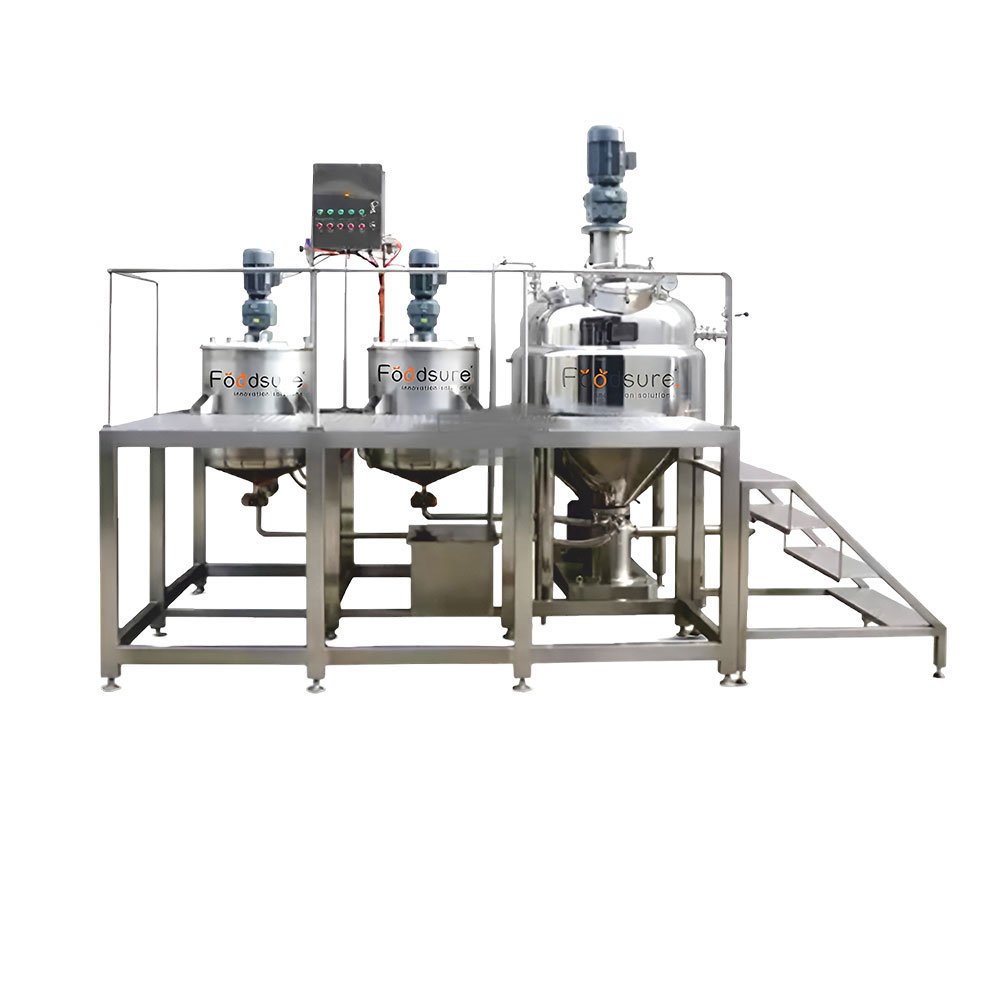
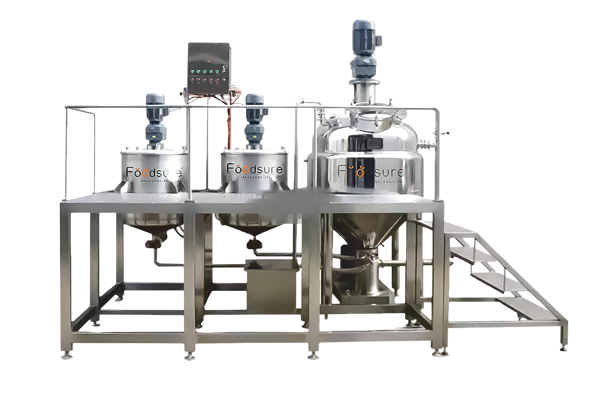
- Vacuum Emulsifying Mixers: The industrial small-scale mayonnaise machine uses two functions to take out air during the mixing action to produce a free air and solid structure that eliminates oxidation.
Conclusion
In the case of the Mayonnaise Homogeniser vs. Emulsifier, the right decision will depend on how much production, as well as expansion goals, you have. Foodsure Machines is fully convinced that it can help manufacturers in selecting the right technology. Our solutions have been created in order to perform, be consistent and successful in production over a long duration of time.
Mayonnaise Homogeniser vs. Emulsifier: Key Differences
Learn how homogenisers and emulsifiers affect mayonnaise texture, stability, and production efficiency. Selecting the right mixing technology helps improve emulsion quality, reduce separation, and scale up commercial sauce manufacturing.
FAQ
What is the difference between emulsifier and homogeniser in mayonnaise processing?
The distinction between emulsifier and homogeniser in the processing of mayonnaises is between chemistry and mechanics; one is to stabilise droplets chemically, and the other is to make them smaller.
What is the best homogeniser for mayonnaise manufacturing unit?
Homogeniser of a mayonnaise manufacturing unit is dependent on the capacity, although the high-pressure systems are suitable for large-scale stability and texture control.
Is a high shear homogeniser for commercial mayonnaise plant necessary?
A commercial high shear homogeniser is needed for making mayonnaise in large quantities that need uniform consistency and a long shelf life.
What equipment is included in an automatic mayonnaise processing plant equipment setup?
A mayonnaise processing plant equipment configuration is the type of equipment that is set up by default and is normally comprised of mixing tanks, a homogeniser, a vacuum system and a filling line.
What is the cost of homogeniser for mayonnaise factory setup?
Homogeniser price depends on the pressure rating, capacity, and the level of automation required to install in a mayonnaise factory.