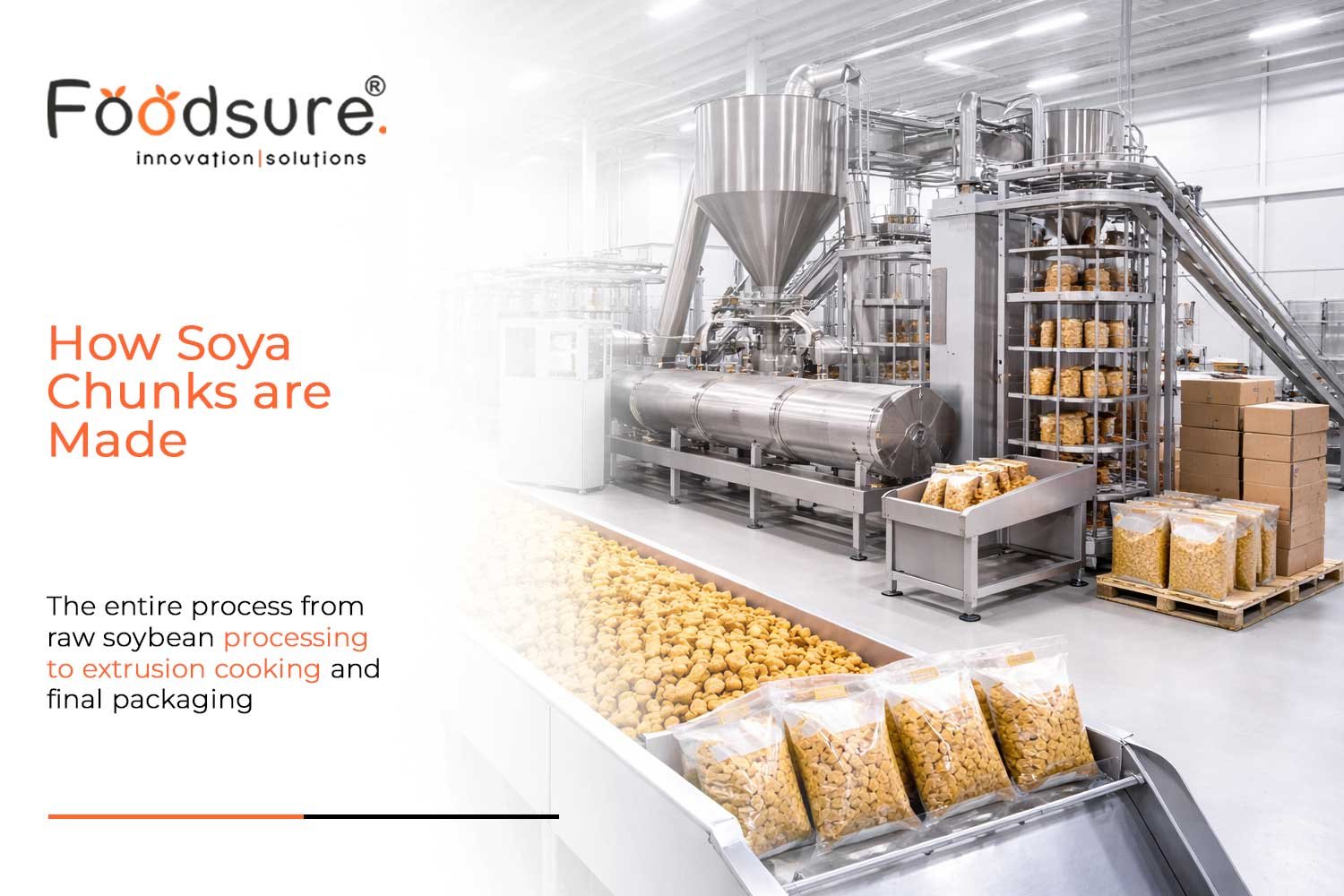
Most manufacturers know what soya chunks are, but very few understand how soya chunks are made at a process level, which creates equipment selection problems, product quality issues and operational inefficiencies that could have been prevented.
The entire process from raw soybean processing to extrusion cooking and final packaging determines both output consistency and operational efficiency, and the financial success of the business. The modern soya chunks production factory uses this blog to provide manufacturing details that help manufacturers, investors and processors develop scalable systems that produce high-quality products.
How Raw Materials Impact the Soya Chunks Manufacturing Process in Factory
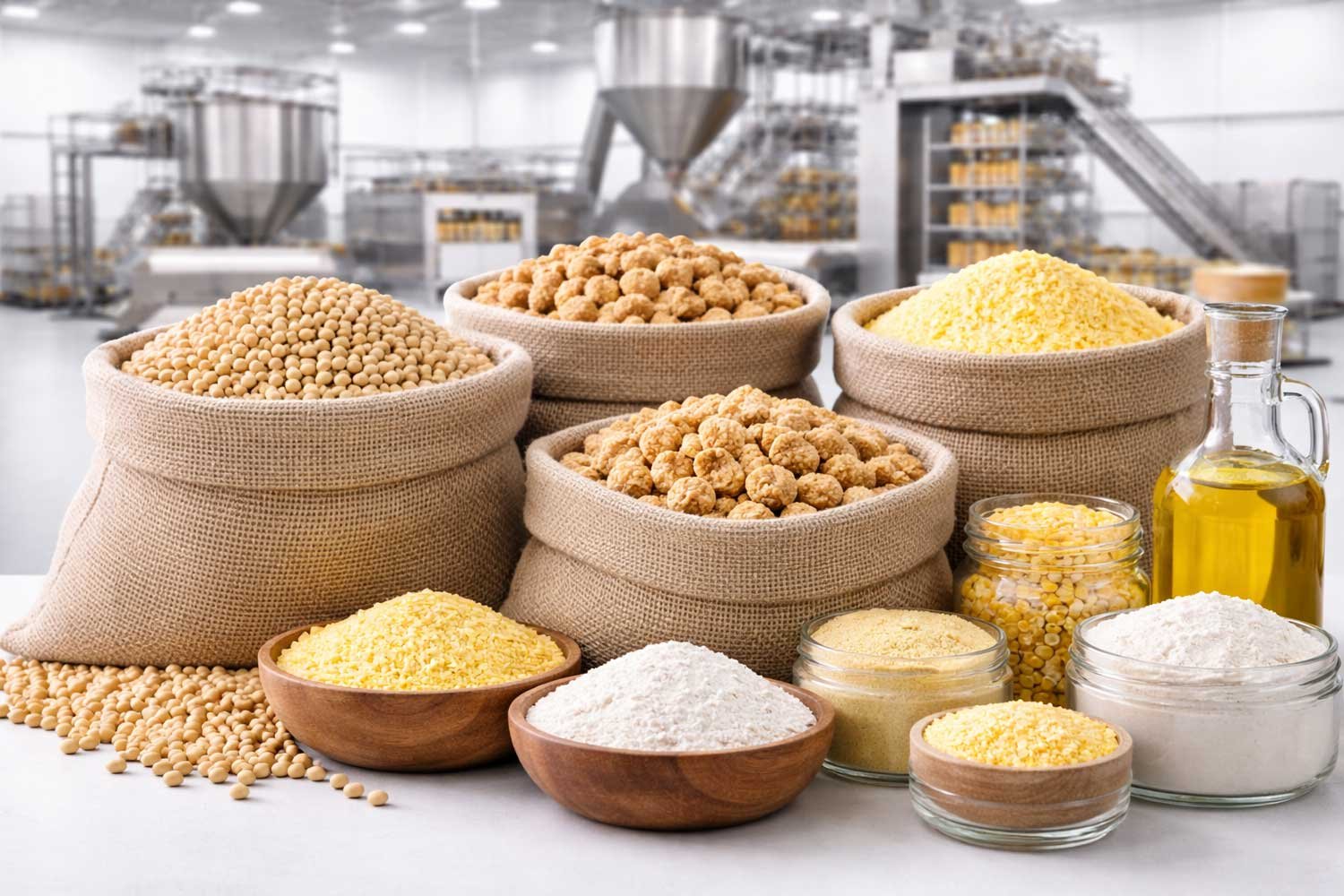
Primary Input: Defatted Soy Flour (DSF)
- Protein: 50–55%
- Fat: <1%
- Moisture: <10%
Why Defatting is Critical
- Improves extrusion stability: Extrusion stability improves through the process because it stops barrel slippage which leads to constant pressure and temperature maintenance.
- Extend shelf life: The product achieves extended shelf life through oxidation-free lipid elimination which prevents rancid development over time.
- Enhance protein texture: The process improves protein texturization because it enables the creation of disulfide bonds which produce the distinctive chewy texture.
How Soya Chunks Are Made in a Factory: Full Process Breakdown
Stage 1: Soybean Cleaning & Dehulling
The cleaning and dehulling stage functions as a precise mechanical process that removes all non-protein fiber materials and contaminants from the system.
The system uses high-frequency vibration together with air-density separation to separate the nutrient-rich cotyledon from the bitter fibrous hull. The processing of raw soybeans begins with their mechanical purification stage.
- Vibrating Screens: Multi-deck high-frequency sieves isolate beans by size, removing stones and oversized debris.
- Aspirators: The soya nugget machine uses high-velocity air together with density differentials for removing dust, pods, and lightweight impurities from the environment.
- Roller Mills: The soya nugget equipment uses precisely calibrated gaps to create 4 to 8 bean fragments, which the system breaks apart through shear and impact to separate the outer hulls.
Output: The process produces clean, dehulled soybean cotyledons, designed by scientists to achieve efficient protein extraction and consistent textural results.
Stage 2 – Solvent Extraction (Oil Removal)
Solvent extraction operates as a thermodynamic process that uses hexane’s ability to selectively extract nonpolar lipids from biological materials to extract oil from cell structures.
The extractor achieves its oil extraction efficiency through its design, which enables solvents to flow in the opposite direction of flaked soybeans, creating optimal conditions for solvent extraction, which reduces oil content from 20% to below 1%.
Objective: Decrease the oil content from 20% until it reaches less than 1% to achieve maximum protein yield.
Process:
- Hexane-Based Extractors: The counter-current solvent system washes flakes to remove triglycerides which dissolve in the solvent.
- Miscella Separation: The oil-solvent mixture undergoes distillation to recover the solvent while the raw soybean oil gets separated from it.
- Steam Stripping (DTDC): The Desolventizer-Toaster-Dryer-Cooler unit uses steam to eliminate residual hexane while it toasts the flakes.
Key Insight: The system functions as a closed-loop operation, which achieves 99.9% solvent recovery to reduce both environmental damage and operational expenses.
Output: Defatted Soy Flakes A low-fat, high-protein base prepared for fine grinding and subsequent extrusion.
Stage 3 – Defatted Soy Flour Production
The final milling stage operates as a mechanical reduction process that transforms defatted flakes into fine flour for uniform hydration during extrusion. The process uses high-speed hammer mills together with air-classification systems to achieve particle size reduction until they reach a specific mesh size, which typically falls between 100-200µm( microns).
The final refinement of protein flakes into a versatile manufacturing base.
Process:
- Hammer Mills: The system uses high-velocity impact to break down brittle defatted flakes into powder with a consistent particle size.
- Air Classification: The system uses cyclones to separate particles based on their size, which produces flour with uniform characteristics needed for extrusion.
Composition:
- Soya chunks contain approximately 50% protein which functions as their primary structural material.
- The cooking process uses carbohydrates at a 30% rate as its binding agent.
- The 8% fiber content provides both bulk and nutritional components.
Optional Additions:
- The process involves adding iron and Vitamin B12 to enhance the nutritional value of products.
- The combination of calcium carbonate and pH regulators functions as a functional additives which improve the product’s snap and texture.
Output: The system generates Defatted Soy Flour through its output process which produces uniform fine particles that are ready for high-pressure extrusion.
Stage 4 – High-Pressure Extrusion Cooking (Core Transformation)
The soya extruder process uses thermomechanical cooking to create materials by applying high shear forces and high temperatures, which range from 150-200 °C.
Process Conditions:
- Temperature: 150-200 °C (Controlled heating zones).
- Pressure: 30-50 bar (High-intensity compression).
- Equipment: Twin-screw extruder for superior mixing and shear.
What Happens Inside:
- Protein Denaturation: Globular soy proteins unfold into linear chains.
- Fibrous Alignment: Molecules realign into a cross-linked, meat-like matrix.
- Starch Gelatinization: Carbohydrates act as a structural adhesive.
Expansion Mechanism:
- Pressure Differential: A sudden drop at the die exit causes superheated water to flash into steam.
- Porous Matrix: Rapid expansion creates a sponge-like, open-cell texture.
Output: Textured Vegetable Protein (TVP), the physical foundation of the soya chunk.
Stage 5 – Cutting & Shape Engineering
The cutting stage demonstrates fluid dynamics principles through its analysis of blade movement. The die plate releases pressurized melt, which maintains a semi-plastic state that enables exact shaping until the material reaches its solid state.
Process:
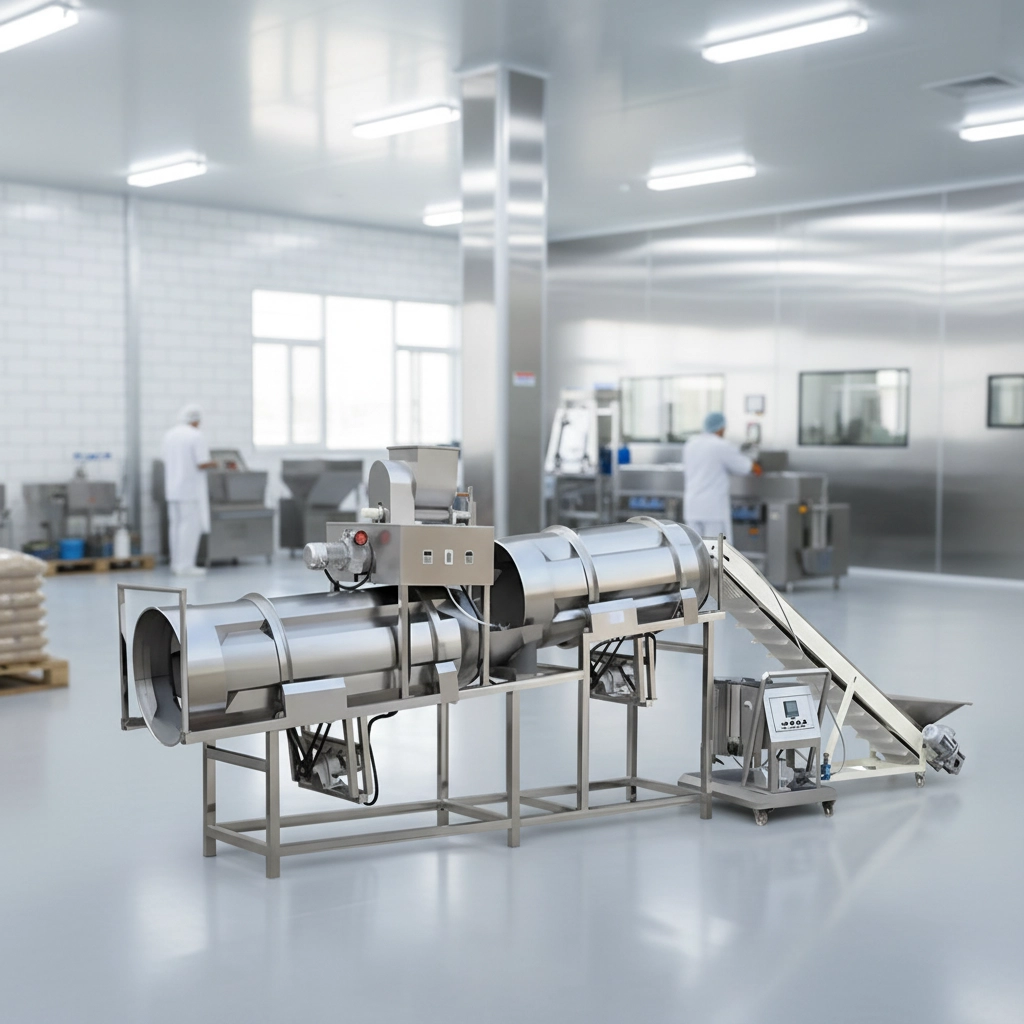
- Rotary Knives: The High-speed rotary knife system uses blades that operate at high speeds and attach directly to the die face to cut the continuous extrudate.
- Variable Frequency Drives (VFD): Control blade RPM to ensure millimetric precision in length.
Key Control:
Knife Speed + Die Diameter: The critical ratio that determines shape consistency, density, and the snap of the product when rehydrated.
Output: The process produces uniform pieces which will undergo moisture stabilization.
Stage 6 – Hot-Air Belt Drying
Drying functions as a mass transfer operation that uses controlled evaporation to keep the protein-matrix stable. The post-extrusion chunks contain 20-25% moisture, which exists in a rubbery state.
Technical Specifications:
| Parameter | Value | Impact |
|---|---|---|
| Air Temp | 70–90°C | No scorching |
| Time | 15–30 min | Even drying |
| Velocity | 1.5–2.5 m/s | Fast drying |
| aw | <0.60 | No microbes |
Why It Matters:
- Prevents Microbial Growth: Lowers water activity to stop bacteria and mold in their tracks.
- Extends Shelf Life: Enables a 12–18 month stability without chemical preservatives.
- Structural Integrity: Hardens the alveolar pores, which prevents packaging collapse of the chunk.
Output: The process produces crispy soya chunks, which maintain their freshness for storage until they undergo final cooling and metal detection.
Stage 7 – Cooling & Stabilization
The cooling process functions as an essential thermodynamic stabilization period during which the product changes from its glassy state to its brittle state.
Why It Matters:
- Prevents Condensation: The system removes the sweat effect, which creates damp areas that result in mold growth.
- Texture Lock: The technology quickly establishes stable protein structures that maintain their original form because it prevents them from becoming soft or rubbery.
- Structural Integrity: The system guarantees that internal honeycomb structures maintain the strength necessary to withstand crushing forces during automated bagging.
Output: The facility produces room-temperature soya chunks, which have been stabilized and will undergo final quality inspection before high-speed packaging.
Stage 8 – Quality Control & Packaging
The last phase includes a complete safety inspection together with compliance assessments, which confirm that products maintain their original quality and shelf life. The system uses optical sorters, which operate with NIR (Near-Infrared) sensors to eliminate items with color defects or insufficient size, while industrial metal detectors find both ferrous and non-ferrous contaminants. The last gatekeeper protects structural strength, together with nutritional value and customer protection.
Why It Matters:
- Safety Compliance: The soya processing machine fulfills all FSSAI food safety standards and international food safety regulations required for retail operations.
- Shelf Stability: The process of nitrogen flushing protects product freshness while stopping the emergence of beany off-flavors.
- Brand Consistency: Optical sorting guarantees that all bagged chunks maintain an identical size and golden-yellow color.
Output: The system produces certified soya chunks which meet retail standards and are designed for international distribution and worldwide market access.
Soya Chunks Manufacturing Cost vs Capacity in India (Plant Investment)
| Plant Type | Capacity | Investment Range |
|---|---|---|
| Entry-Level | 50–100 kg/hr | ₹3L – ₹8L |
| Commercial | 150–250 kg/hr | ₹12L – ₹28L |
| Industrial | 300–500 kg/hr | ₹35L – ₹65L |
| Turnkey Plant | 500–1000+ kg/hr | ₹75L – ₹1.5Cr+ |
How Soya Chunks Are Made – Key Process Control Factors for Quality Output
The technical variables that differentiate premium soya chunks from sub-standard exports.
- Extrusion Parameters: High-precise control of Specific Mechanical Energy and screw speed to obtain Specific Mechanical Energy values that determine the Expansion Ratio and final density.
- Moisture Conditioning: The 18-25% moisture range functions as a plasticizing material for the flour; this process enables the melt to flow through the die without experiencing internal friction spikes.
- Raw Material Quality: A high PDI (Protein Dispersibility Index) is non-negotiable; it ensures that globular proteins have the solubility required to realign into long-chain fibrous networks.
- Drying Efficiency: The soya extruder machine uses a two-phase temperature system that starts at 90°C and ends at 70°C to extract moisture from the core first. This method prevents surface cracking while maintaining a shelf-stable water activity level of <0.60.
Conclusion
Understanding how soya chunks are made requires technical knowledge because it determines the final product’s quality, uniformity, and financial results. The precise control of extrusion processes, together with drying processes and packaging operations, results in reduced production losses, which generate higher profit margins. The design of Foodsure Machines systems enables manufacturers to achieve operational growth while increasing production efficiency and safeguarding their financial assets. We provide performance, reliability and strong returns through our solutions, which help you operate your production process more efficiently while increasing your financial returns.
Want to Set Up a Soya Chunk Manufacturing Plant?
Get expert guidance on the complete factory setup, machinery required, production process, and investment needed to start your soya chunks business.
FAQ
Q1. What raw material is used to make soya chunks?
Defatted soy flour is made from dehulled, oil-extracted soybeans and is the main raw material used for production.
Q2. How are soya chunks given their fibrous, meat-like texture?
Soy protein denaturation due to high-pressure extrusion cooking (150–200°C) results in them being aligned in a parallel fibre formation.
Q3. Why do soya chunks expand so dramatically when soaked in water?
When extruded, the use of steam under pressure will cause the soy protein to expand rapidly due to the rapid vaporization of water, producing a highly porous internal structure that rehydrates rapidly upon adding water.
Q4. Which machine is the most critical in the soya chunk manufacturing process?
The twin screw extruder is the engine of production because it dictates the texture, density, soy protein alignment, and final shape of the finished product.
Q5. Why are soya chunks packaged using nitrogen flushing?
By using nitrogen gas (N2) to push the oxygen (O2) out of the package, the nitrogen will prevent the soy protein from going rancid by preventing oxidative rancidity for 12 months to 18-month shelf life without preservatives.