Protein Bar Manufacturing Machine in Ahmedabad: Gujarat’s Most Trusted Suppliers for High-ROI Production
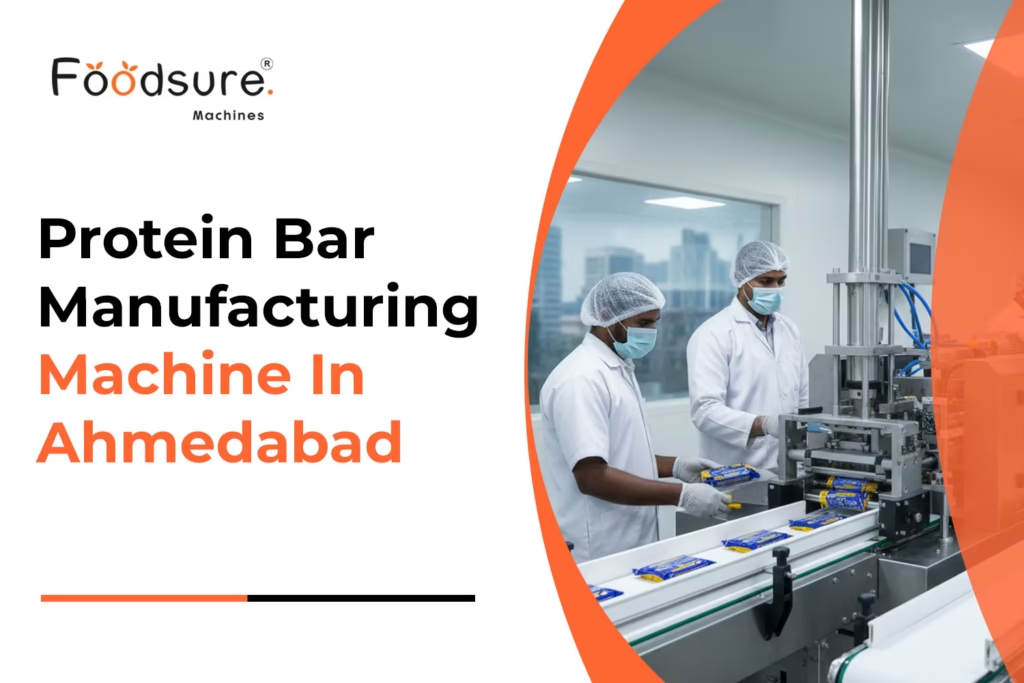
India’s protein bar market is no longer niche, it’s mainstream. For Gujarat-based nutrition brands, startups, and contract manufacturers, one decision outweighs branding or packaging: choosing the right protein bar manufacturing machine in Ahmedabad with reliable local support. Many new manufacturers discover too late that profits depend on correct machine capacity, automation level, and responsive suppliers. With ₹7–60+ lakh investments at stake, your equipment choice is a business-critical decision, not just a purchase. Why Gujarat Manufacturers Prefer Protein Bar Manufacturing Machines in Ahmedabad When investing in a commercial protein bar making machine, supplier location directly affects downtime, service cost, and production reliability. For this reason, many nutrition brands choose Ahmedabad-based protein bar machine suppliers. Decision Factor Local Ahmedabad Supplier Advantage Risk with Distant Supplier Advanced Production Impact Service Response Time Same-day or next-day engineer visits 3–7 day delay for technician travel Faster issue resolution prevents batch loss and missed dispatches Spare Parts Availability Critical components stocked locally Parts shipped from other states/countries Reduced line stoppage during auger, cutter, or motor failures Downtime Cost Control Immediate troubleshooting support Long idle production hours Continuous lines maintain temperature and texture stability Installation Accuracy On-site alignment and calibration Remote guidance or delayed supervision Proper die pressure and cutter alignment ensure uniform bar weight Logistics Risk Short-distance transport, lower vibration exposure Long transit increases impact damage risk Precision components like rollers and forming dies stay calibrated Commissioning Speed Faster trial runs and adjustments Extended waiting between setup steps Shorter time-to-production after machine purchase Recipe Compatibility Familiarity with Indian protein blends Trial-and-error adjustments Proper compression for whey, plant protein, and jaggery binders Climate Adaptation Experience handling Gujarat humidity and heat Generic setup not climate-tuned Better control of stickiness, binding, and extrusion consistency Scalability Support Easier upgrades and add-on modules Complex coordination with remote supplier Smooth transition from 50 kg/hr to 200+ kg/hr lines Factory Visit Access Physical machine inspection and live demos Only videos or catalogs available Buyers can verify hygiene, vibration levels, and output quality Training & Skill Transfer On-site operator training in Gujarati/Hindi Online or limited training Operators learn pressure control, cutting sync, and cleaning SOPs After-Sales Relationship Long-term regional support network Transactional supplier relationship Preventive maintenance reduces unexpected breakdowns Choosing The Right Protein Bar Manufacturing Machine In Ahmedabad Not all machines are made for every type of manufacturer. You need to pick what matches your production scale and goals. In Ahmedabad, you will mainly find two options for commercial protein bar making machine: Semi-Automatic Protein Bar Machine Semi-automatic protein bar machine are ideal for small startups and pilot batches. This machine is affordable with a low budget, and it is simple to set up. These machines are a combination of manual and machine, where mixing, shaping, or portioning is done by labor. What this really means is you can easily try recipes and manage all small orders without any stress. Fully Automatic Protein Bar Machine Fully automatic protein bar machine are designed for industrial-scale production. It combines mixing, shaping, cutting, and sometimes packaging into a single continuous line. This machine’s price is higher, but it saves labor and produces at a much faster rate. What this really means is you can scale your production, maintain consistent quality, and keep up with growing demand. Read More: Automatic vs Semi-Automatic Machines for Protein Bar Production (2026 Guide) How Much Profit Can a Protein Bar Manufacturing Machine Generate? Assumptions: Machine Capacity: 50 kg/hour (semi-automatic) Operating Hours: 6 hours/day Bar Weight: 50 g/bar Selling Price per Bar: ₹20 Raw Material + Packaging Cost per Bar: ₹14 Labor & Utilities Cost: ₹10,000/day Time Period Bars Produced Revenue (₹) Material Cost (₹) Labor & Utilities (₹) Net Profit (₹) Daily 6,000 1,20,000 84,000 10,000 26,000 Weekly (6 days) 36,000 7,20,000 5,04,000 60,000 1,56,000 Monthly (30 days) 1,80,000 36,00,000 25,20,000 3,00,000 7,80,000 Yearly 21,60,000 4,32,00,000 3,02,40,000 36,00,000 93,60,000 Notes for Gujarat Manufacturers: Daily Profit: ₹26,000 covers small operational costs and validates machine efficiency. Monthly Profit: ₹7.8 lakh sufficient to cover initial semi-automatic machine investment (₹7–10 lakh) within ~1 month of stable operation. Yearly Profit: ~₹94 lakh demonstrates strong ROI, even before scaling capacity or hours. Key Insight: Selecting the right Ahmedabad-based supplier minimizes downtime, protects consistent output, and safeguards this profit potential. Top Protein Bar Machine Suppliers In Ahmedabad: Trusted Options For Gujarat Manufacturers Picking the right supplier is as important as picking the right protein bar manufacturers in Gujarat. You want someone who understands your production and can support you on-site to increase your production goals. In Ahmedabad and Gujarat, a few supplier names stand out: Foodsure Machines (Ahmedabad) Our industrial protein bar production equipment is known for being food-grade and hygienic machines that are easy to clean. Our machines handle mixing, shaping, and give your product consistently. Machine parts are made from stainless steel to meet safety standards. We provide strong on-site support in Gujarat, which means if something goes wrong, we help arrive fast. What this really means is that startups and mid-scale manufacturers can get stable output without worrying about downtime. Lerel Health Foods (Surat) They offer custom nutrition bar manufacturing machine, ideal if you want your own formulations. They also handle private labeling and contract manufacturing. Their machines work with quality ingredients sourced locally, and they keep costs manageable. What this really means is you can launch your brand easily with guidance from experienced producers. Labh Group (Ahmedabad) They provide you with a turnkey solution for snacks and your food production. They customize the machines to your scale and your production needs. They offer you full support from installation to maintenance. What this really means is that larger manufacturers can scale efficiently and avoid growing pains. Read More: Best Protein Bar Machine Manufacturers Protein Bar Manufacturing Machine In Ahmedabad: Pricing And ROI Insights For Gujarat Manufacturers Machine Type Capacity Approx. Price (₹) Weekly Operating Cost Monthly Operating Cost Yearly Operating Cost Service Parts & Maintenance (Yearly) Semi-Automatic 50–100 kg/hr ₹7–10 lakhs ₹10,000–₹15,000 ₹40,000–₹60,000 ₹5–7 lakhs ₹1–1.5 lakhs Fully Automatic 200–500 kg/hr ₹25–60+ lakhs ₹40,000–₹60,000 ₹1.5–2.5
Protein Powder Blending Machine for Food Factories Delivering 95% Batch Consistency
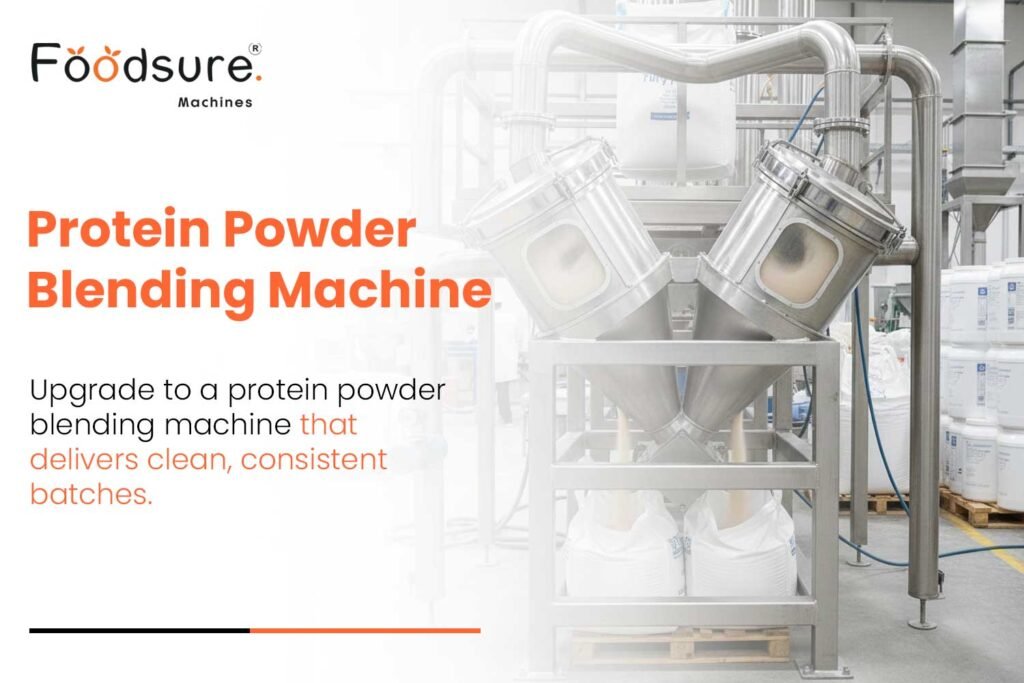
Over 70% of food factories lose consistency because their powders don’t blend evenly. Let’s see what’s really happening. Your formula stays the same, yet the batch shifts. Take a look at what that means. The mixer is holding you back. An food industry protein powder mixer machine closes that gap and stops the slowdowns, texture swings, and customer complaints eating into your output. Keep reading, and you’ll see how much consistency you’ve been leaving on the table and how to fix it for good. What a Modern Protein Powder Blending Machine Actually Does Protein powder manufacturing isn’t just about mixing, it’s about controlled, repeatable, validated blending. Industrial protein powder blending machines are designed to: Deliver uniform nutrient distribution. Eliminate dead zones and segregation. Reduce batch rejection and rework. Maintain protein integrity (heat & shear sensitive). Scale production without compromising quality. In real-world factories, batch capacities typically range from 200 kg to 1500 kg, with large operations exceeding 2000 kg per batch. The right mixer doesn’t just blend, it standardizes your output. The Real Difference Between Protein Powder Machine Mixers Every powder behaves differently. Flowability, density, fat content, and hygroscopic nature determine which blender succeeds. Mixer Type Mixing Principle Best For Typical Blend Time Uniformity Level Key Advantage Caution / Limitation Ribbon Blender Convective, low shear Whey protein, plant protein isolates, free-flowing powders 10–15 minutes CV ≤5–8% Dual counter-directional ribbons eliminate dead zones while keeping heat low Not ideal for very sticky or oil-heavy powders Plough Share Mixer High shear, turbulent mixing Agglomerated whey, maltodextrin blends, oil-coated powders 5–10 minutes CV ≤5–10% (depending on shear control) Creates fluidized mixing zones that handle dense and sticky powders Excess shear can damage heat- or shear-sensitive proteins Double Cone Blender Diffusion and tumbling (gentle mixing) Fragile crystals, vitamin premixes, nutraceutical blends 15–20 minutes CV ≤8–12% Ultra-gentle blending protects delicate ingredients Longer mixing time, not suitable for heavy or high-density powders Why Modern Protein Powder Machines Are Non-Negotiable Today Key Capability What It Means in Production Why It Matters for Your Factory Batch-to-Batch Consistency Speed, torque, mixing time, and fill levels are digitally controlled and repeatable Same recipe → same output every batch, reducing variability and customer complaints Fully Automatic Mixing Torque-based automation stops the blend at the exact uniformity point Eliminates guesswork, prevents over-mixing, and reduces operator dependency Food-Grade, Contamination-Free Design Mirror-polished stainless steel contact parts with hygienic construction Prevents flavor carryover, microbial growth, and cross-contamination between batches Vacuum & Hygroscopic Protection Vacuum-enabled or sealed systems limit moisture and air exposure Protects moisture-sensitive powders, improves shelf life, and maintains ingredient stability Read More: Protein Bar Production Process: A Beginner’s Guide to Step-by-Step Manufacturing Why Modern Protein Powder Blending Machines Are Key to High-Quality Protein Powders Consistency: Using the Same Ingredients for Every Batch Ensures You Know Exactly What You’re Getting. All Mixing Speeds, Times, and Amounts of Torque are Applied at the Same Rate. If You Follow the Same Recipe to Produce Protein Powder, You Can Expect to Get a Consistent Product Every Time. Automatic: By measuring Torque while whey protein powder mixing equipment, you eliminate the guesswork associated with mixing, and there are no “over-mixing” errors since the mixing will automatically shut off once the Mixing has been completed to a perfect blend of powdered product. Food-Grade Materials: To ensure that your product is manufactured using only stainless steel Protein Powder Mixing Machine Advanced Automation System, all Packaging and Product Components must be free from any form of contamination, including but not limited to residuals, microbiological Contamination, and flavor carryover. Vacuum Technologies: Vacuum Packaging is one of the best ways to store hygroscopic powders for an extended shelf life without compromising product quality, since it both minimizes Exposure to Air and Moisture during the packaging process. Read More: Investing in a Protein Bar Production Line – ROI, Costs & Profit Margins Why Compliance Matters for Protein Powder Manufacturing Machine These large-scale protein powder manufacturing equipment aren’t just about mixing powders; they are about doing it safely and consistently. They meet global food safety standards, so you can trust every batch. The use of cGMP-Compliant Design maintains a clean and managed environment for manufacturing, where the processed products comply with all cGMP guidelines. FSSC 22000 certification confirms that all process steps are consistently documented and easily searched for throughout your process chain. The BRCGS and HACCP controls are intended to assist in minimizing contamination, thereby maintaining product integrity. Why Foodsure Machines Stands Out in Protein Powder Making Machine Not all mixers deliver the same results, even if specs look similar. Feature Benefit to Your Factory 95% CV uniformity Consistent taste and nutrition in every batch SS316L mirror finish Faster cleaning, lower contamination risk Integrated CIP/WIP systems Reduced downtime between batches Custom mixing tools Handles sticky, fragile, and dense powders 100 kg – 2000+ kg batch range Scales with business growth Local service support Faster issue resolution, less production loss Read More: One Brand, Two Powers: How Foodsure Recipe & Foodsure Machines Support Food Startups From Idea to Production Conclusion At Foodsure Machines, we provide automated, sanitary, and local support for high-quality, safe, and efficient mixing, regardless of batch size. Therefore, our customers can utilize our machinery to mass-produce while maintaining the same level of quality standards in their end product. Contact Foodsure Machines today to get a quote or discuss the right solution for your factory. Have a Question? Let’s Connect! We’re here to assist you anytime. Contact us via call or email. 📞 Call Us ✉️ Email Now FAQs What causes inconsistent protein powder batches?Uneven mixing due to outdated or under-specified blending machines. Which blender is best for large-scale protein powder production?An automated ribbon blender with torque and speed control. What batch size should founders plan for initially?Most startups begin efficiently with 200–500 kg batch capacity. How do I measure blend quality objectively?By checking the coefficient of variation (CV), ideally ≤10%. Can one blender handle multiple protein formulations?Yes, modern computerized blenders manage varying densities and
Protein Bar Manufacturing Machine in Lucknow – Latest Price, Capacity & Top Manufacturers (2026)
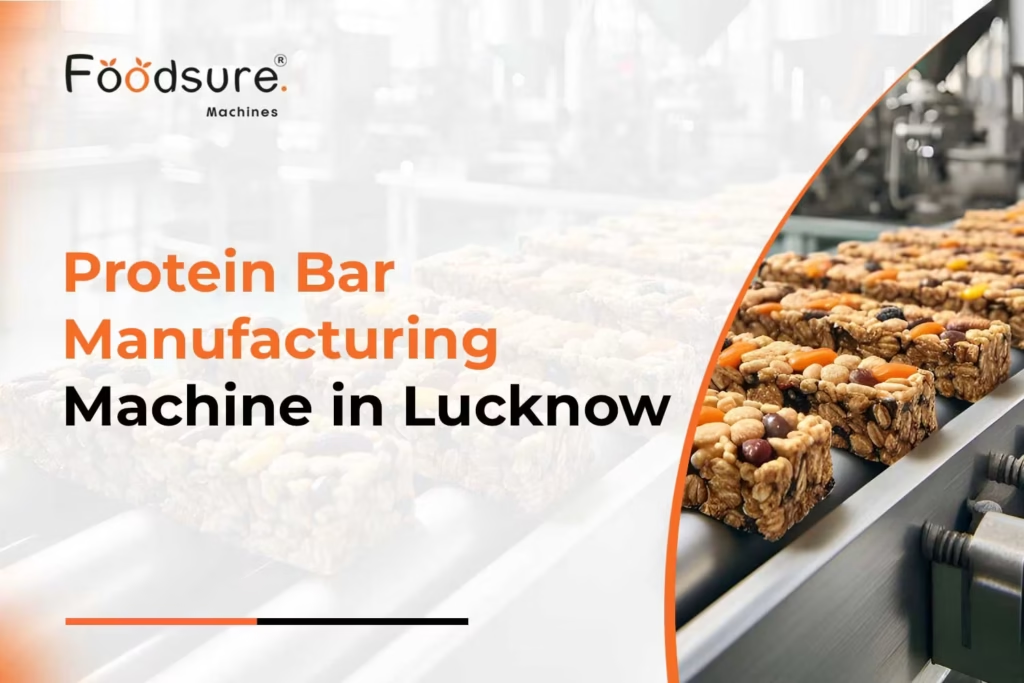
Protein bars are no longer a niche fitness snack. In Lucknow, demand for healthy packaged snacks is rising across gyms, cafés, retail stores, and online brands. That means one big opportunity for food startups and one critical investment decision. Protein bar manufacturing machines in Lucknow typically cost between ₹4.5 lakh and ₹25 lakh, depending on automation level, output capacity, and features. So the real question is: Which protein bar manufacturing machine in Lucknow fits your budget, production target, and growth plan? This blogs gives you real numbers, real capacities, and real buying advice so you can invest with clarity. ✔ Latest protein bar machine prices in Lucknow (2026).✔ Semi-automatic vs fully automatic comparison.✔ Production capacity & maintenance costs.✔ How to choose a reliable machine supplier. Quick Comparison: Semi vs Fully Automatic Protein Bar Machines Feature Semi-Automatic Fully Automatic Price in Lucknow ₹4.5–7.5 lakh ₹12–25 lakh Output Capacity 500–2,000 bars/day 5,000–20,000 bars/day Labor Required 2–3 people 1–2 people Automation Level Mixing + forming + cutting (partial manual) Continuous line with minimal handling Best For Startups, testing market Scaling brands, contract manufacturing Future Expansion Limited High scalability Real ROI: How Fast Can a Protein Bar Machine Pay for Itself? Example Startup Scenario (Semi-Automatic Machine) Daily production: 1,000 bars. Average selling price: ₹35/bar. Monthly revenue (25 days): ₹8,75,000. Raw material & operations (55%): ₹4,80,000. Approx. gross margin: ₹3,95,000. A ₹6 lakh machine can potentially recover cost in 2–4 months with stable demand. Example Growth Scenario (Fully Automatic Machine) Daily production: 8,000 bars Selling price: ₹30/bar wholesale Monthly revenue: ₹60,00,000 Operational cost (65%): ₹39,00,000 Approx. gross margin: ₹21,00,000 High-capacity machines scale profit dramatically when distribution is ready. Protein Bar Manufacturing Machine in Lucknow: Types and Features Picking the right protein bar production machine affects how fast you grow, how consistent your bars are, and how much effort you’ll need to put in every day. Semi-Automatic Protein Bar Machine – Best for Small Manufacturers Start smart: Semi-automatic machines handle mixing, forming, and cutting, but still need some manual input. It gives you control over recipes and batch sizes. Production capacity: It gives you a production capacity of over 500–2,000 bars per day, enough to test the market. Investment in Lucknow: A semi-automatic protein bar machine usually starts from ₹4.5 – 7.5 lakh, making it affordable for first-time buyers. Who it fits: Ideal for small startups and R&D testing. Here’s the thing: you can start small, learn what sells, and scale without wasting money on machinery you do not yet need. Fully Automatic Protein Bar Equipment – High Output Units Scale without stress: Fully automatic machines integrate mixing, forming, cutting, cooling, and sometimes wrapping into one continuous workflow. With minimal labor, consistent output. Capacity: Fully automatic machines give you a capacity of around 5,000–20,000 bars per day, which is ideal for supplying supermarkets and online channels. Investment in Lucknow: A fully automatic protein bar machine costs around ₹12 – 25 lakh, and it also depends on machine capacity and features. Who it fits: This protein bar processing machine is ideal for growing manufacturers and contract packers. Read More: Automatic vs Semi-Automatic Machines for Protein Bar Production (2025 Guide) Protein Bar Manufacturing Machine Price in Lucknow: 2026 When planning your production setup, one of the first questions founders ask is about protein bar making machine price. Understanding the protein bar machine price in Lucknow helps you budget accurately for your startup or expansion and compare semi-automatic vs fully automatic options. Here’s a detailed cost breakdown for 2026: Machine Type Initial Cost (₹) Monthly Spare Parts Cost (₹) 1 Week Maintenance Cost (₹) 1 Month Maintenance Cost (₹) 1 Year Maintenance Cost (₹) 2–3 Year Maintenance Cost (₹) Semi-Automatic ₹4.5–7.5 lakh ₹10,000–₹20,000 ₹5,000–₹10,000 ₹20,000–₹30,000 ₹2.4–₹3.6 lakh ₹4.8–₹7.2 lakh Fully Automatic ₹12–25 lakh ₹20,000–₹40,000 ₹10,000–₹20,000 ₹40,000–₹60,000 ₹4.8–₹7.2 lakh ₹9.6–₹14.4 lakh Want the exact price for your requirement? Request a Machine Quote Now — Get customized pricing within 24 hours. Top Tips to Find Reliable Protein Bar Manufacturers and Dealers in Lucknow Choosing a protein bar machine supplier is not just a purchase; it’s about finding a partner who keeps your business running smoothly. Buy protein bar machine locally you service parts fast and provide you with on-site support if something goes wrong. Visit the supplier workshop and request a demo to check the protein bar machine performance and quality. So, you cannot get a problem during production. Always get clear pricing, ask about warranty terms, and service policies to prevent surprises that affect your protein bar extruder machine. Ask for references and learn how responsive the supplier is to protein bar manufacturing equipment, how they address your issues, and how much it takes to recover them. What this really means is picking someone who can support your growth, help you keep your production smooth, and save you headaches. Read More: Top Protein Bar Machine Consultants in India (2025 Guide) Start Your Protein Bar Business in Lucknow: Choose the Right Machine Today Foodsure Machines provides protein bar manufacturing equipment India for every growth stage from startups to large-scale producers. Our machines are known for: Consistent bar quality. Scalable production design. Reliable post-sales support. Whether you’re launching your first batch or expanding capacity, we help you move forward with clarity. Request Your Free Quote Fast Please reach out to us anytime via phone or email. 📞 Call Us ✉️ Email Now FAQ Q1. What is the starting cost of a protein bar machine in Lucknow?₹4.5–6 lakh for semi-automatic; fully automatic can reach ₹25 lakh. Q2. Which machine type is best for first-time founders?Semi-automatic machines offer lower risk and recipe flexibility. Q3. How many bars per day are needed to break even?Around 300–500 bars/day depending on margins. Q4. Can one machine make multiple protein bar variants?Yes, most machines support whey, vegan, and nut-based bars. Q5. How much manpower is required to operate the machine?2–3 people for semi-automatic, 1–2 for fully automatic. Q6. Is FSSAI compliance easier with machine production?Yes, machines improve hygiene and batch consistency. Q7. How long does installation and
Investing in a Protein Bar Production Line: Costs, ROI & Profit Margins Explained for Startups
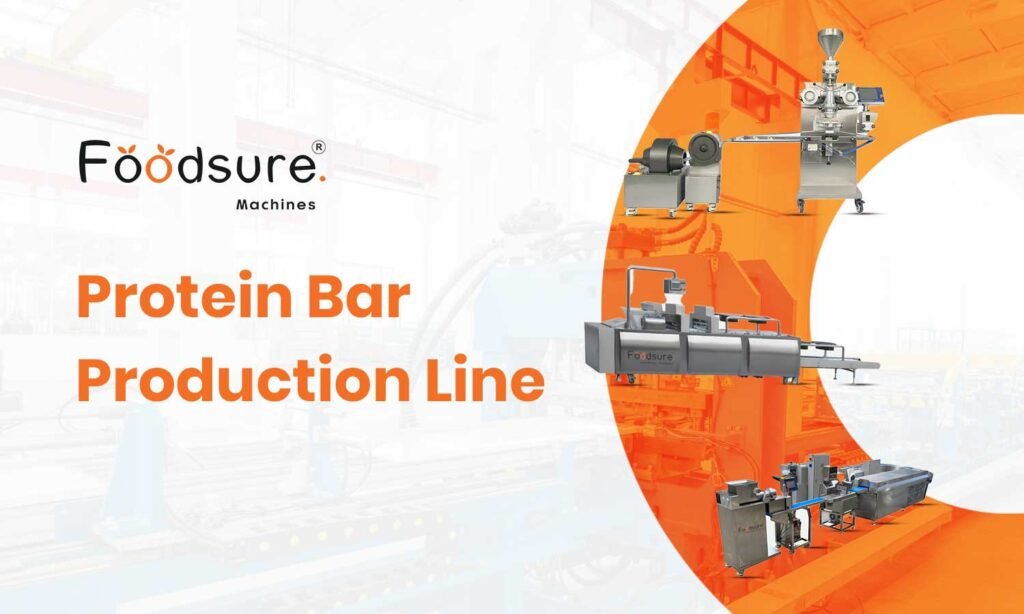
Starting a protein bar business is one of the smartest moves in today’s health-driven food market, but only if you build it on the right foundation. The backbone of success is a reliable protein bar manufacturing machine or protein bar production line that can mix ingredients uniformly, form consistent bars, and package them efficiently. For startups, early decisions around protein bar equipment directly affect product quality, operating costs, scalability, and ROI. Choosing the right production line from the beginning reduces trial-and-error, minimizes wastage, and allows you to scale smoothly as demand grows. This guide covers protein bar production essentials, packaging options, automation benefits, ROI, and efficiency tips, so you can start smart, stay lean, and grow with confidence. How a Protein Bar Production Line Works (Step-by-Step Process) This step-by-step flow is part of a complete bar processing line, and you can explore the detailed protein bar production process to understand how each stage impacts bar texture and shelf life. Ingredient Mixing: Proteins, syrups, fibers, and functional ingredients are blended in an industrial mixer to achieve uniform texture. Slab Forming or Extrusion: The mixture is shaped into continuous sheets or ropes using a forming or extrusion unit. Cooling Tunnel: The formed mass passes through a cooling tunnel to stabilize texture for precise cutting. Cutting & Shaping: Bars are cut into consistent sizes and weights, ensuring uniformity across batches. Chocolate Coating or Enrobing (Optional): For coated bars, an enrobing system applies chocolate or yogurt layers. Flow Wrapping & Packaging: The final stage of the protein bar production line seals bars for shelf life, hygiene, and branding. This integrated process defines a complete bar production machines, not just a single machine. How to Choose the Right Protein Bar Manufacturing Machine for Your Startup When you’re starting out, picking the right protein bar manufacturing machine or protein bar equipment can make or break your business. Key points to consider: Types of bars: Energy bars, chocolate protein bars, breakfast bars, or plant-based protein bars all need slightly different handling. Production capacity: Machines producing 500–1,500 bars/hour are ideal for startups. Key components: Mixer, forming machine, and packaging station. Coating or flavoring equipment is optional. Simplicity & versatility: Easy operation and recipe flexibility save time and reduce errors. By starting small, you can evaluate recipes, comprehend market demand, and grow at a measured pace without going over budget. Protein Bar Packaging Machines That Work With Your Equipment Choosing the right sealing and wrapping system is critical, and different protein bar packaging machine options suit different production speeds. Key considerations: Proper sealing to extend shelf life. Flow wrap machines for high-speed packing. Semi-automatic vs fully automatic systems depending on production scale. Branding compatibility for printed films and labels. Even a small automated packaging unit improves consistency and presentation while keeping the protein bar production line efficient. Protein Bar Production Automation Benefits Automation in protein bar production lines delivers: Consistency: Uniform bar size, shape, and flavor. Higher output: More bars per hour than manual processes. Reduced waste: Fewer defective products. Scalability: Meet growing demand without hiring extra staff. Look for a protein bar manufacturing machine with modular automation options to expand later. Protein Bar Manufacturing Machine Cost, ROI & Profit Margin Understanding cost and ROI is key if you plan to buy protein bar machine locally or work with a protein bar machine dealer near me. Metric Micro Setup (Home/Trial) Small Setup (Startup Brand) Medium Setup (Growing Brand) Large Setup (Commercial Plant) Protein Bar Manufacturing Machine ₹4–8 lakh ₹8–15 lakh ₹20–35 lakh ₹45–90 lakh Packaging Machines ₹2–4 lakh ₹3–7 lakh ₹5–10 lakh ₹12–25 lakh Total Initial Investment ₹6–12 lakh ₹12–22 lakh ₹30–55 lakh ₹60 lakh–₹1.2 Cr Operating Costs / Month ₹80k–₹1.5 lakh ₹1–3 lakh ₹3–5 lakh ₹6–12 lakh Daily Production 300–500 bars 1,000 bars 3,000–5,000 bars 8,000–15,000 bars Avg Selling Price / Bar ₹40–50 ₹50 ₹45–55 ₹40–60 (bulk) Revenue Potential / Month ₹4–7 lakh ₹15 lakh ₹1.5–2.5 Cr ₹4–9 Cr Break-even Timeline 10–14 months 12–18 months 12–24 months 18–30 months Profit Margin 20–30% 25–40% 30–45% 35–50% Micro Setup (Testing the Market) 400 bars/day × ₹45 ₹5.4 lakh monthly revenue Expenses – ₹3.8 lakh Profit – ₹1.6 lakh/month Ideal before scaling or approaching a protein bar machine dealer near me for a larger unit. Small Startup Setup 1,000 bars/day × ₹50 ₹15 lakh monthly revenue Monthly expenses – ₹10 lakh ₹5 lakh profit (33% margin) Perfect entry point when you buy protein bar machine locally for your own brand. Large Commercial Production (B2B + Retail) 10,000 bars/day × ₹48 average ₹1.44 Cr monthly revenue Monthly expenses ≈ ₹85–95 lakh ₹45–55 lakh profit/month (35–40%) Common for contract manufacturers supplying gyms, retailers, and export buyers using industrial protein bar equipment. Read more: Top Protein Bar Machine Manufacturers In India 2025 Profit Margin in Protein Bar Business Explained Profit margin in a protein bar production process is not just about selling price of automated production line. It depends on how efficiently your protein bar machine, labor, packaging, and distribution systems operate together. A well-planned setup using modern protein bar equipment can achieve significantly higher margins than manual or semi-organized production. Cost Component % of Selling Price (Small Brand) % of Selling Price (Scaled Brand) Notes Raw Ingredients 35–45% 30–38% Protein blends, nuts, syrups, fibers, flavors Packaging Material 8–12% 6–9% Flow wrap film, cartons, labels Labor Cost 10–15% 6–10% Reduced with automated protein bar production line Power & Utilities 3–5% 2–4% Efficient motors lower this over time Maintenance 2–4% 2–3% Depends on machine quality Distribution & Logistics 8–12% 10–15% Higher for national brands Marketing & Branding 5–10% 8–15% Online + retail promotions Total Operating Cost 70–85% 65–80% — Net Profit Margin 15–30% 20–35% Can go higher with volume Protein Bar Production Line Efficiency Tips Perform regular cleaning and preventive maintenance. Train operators for smooth machine handling. Plan batches to minimize raw material waste. Monitor ingredient usage carefully. Use energy-efficient operating schedules. Maintain quality checks at every stage of the protein bar production line. These practices increase output while reducing long-term costs. Invest
How to Make Tomato Ketchup in India: Buy Ketchup Machines Locally & Set Up a Tomato Ketchup Processing Plant
How to Make Tomato Ketchup in India is a staple condiment, consumed widely across households, schools, restaurants, and food chains. If you’re looking to start a ketchup manufacturing business, this guide will walk you through how to make ketchup with tomato, the tomato ketchup production process, the types of tomato ketchup machines, and how to buy ketchup machine locally. Whether you’re interested in a small-scale operation or setting up a large tomato ketchup processing plant, we have you covered. Top Reasons to Start a Tomato Ketchup Business in India India offers possibilities for growth, revenue, and access to production of tomato ketchup opportunity for food entrepreneurs, start-ups, and SHGs. The top reason for starting a tomato ketchup manufacturing. Significant Market Opportunity The tomato processing industry is a ₹4,000 crore industry in India tomato ketchup market. Ketchup and sauces are packaged in a method that they designed for consumers – there is always demand in cities, towns, and community primary schools. Considerable Consumer Base Ketchup is a popular item in both urban and rural settings. Schools just serve ketchup-based school lunches for many kids, street-food vendors use it, families use it after school, and fast food and restaurants use ketchup. Even export markets are emerging, with an increasing number of Indian ketchup manufacturers exporting ketchup with a focus on the Middle East and Southeast Asia. Shelf Stable Product When processed and packaged effectively, ketchup (to minimize waste from seasonal tomato availability) will last from 6-12 months, and also reduce spoilage losses by processing year-round sources of supply for the market. Low Capital Costs A small ketchup factory can be established in startup mode for a capital investment of ₹2-3 lakh, affordable for small businesses/startups/SHGs. Food processing machinery, easily followed recipes, and local conditions can allow a small, easy-to-follow entry point for start-up production that could start very small and increase production as demand grows. Profitable and Scalable Tomato ketchup making process yields large margins for transformation from fresh farm tomatoes to higher-value food products. It is a flexible model that can be a manual, semi-automatic line for entry-level production and move to full automation as the business grows. What You Need to Make Tomato Ketchup in India Tomatoes It is recommended to purchase green and ripe tomatoes that are bright red and have a Brix level of around 4.5-5+. Roma or hybrid varieties will provide the best product in terms of pulp content. You can generally find the best tomatoes from farmers in states such as Maharashtra, MP, Bihar, or Andhra Pradesh. Other Ingredients You will require sugar to provide sweetness and function as a natural preservative, vinegar or acetic acid to lower the sauce’s acidity, and spices such as onion, garlic, star anise, and cinnamon. If you have your desired, finished product presentation described in your mind. Step-by-Step Process: How to Make Tomato Ketchup in India Ingredient Qty (per 10kg batch) Purpose Tomato pulp 7 kg Base Sugar 2 kg Sweetness, body Vinegar 600 ml Preservation, pH control Spices (ground) 400 g Flavor Salt 200 g Taste, balance Processing Procedures of Tomato Ketchup Wash and blanch tomatoes (skin and seeds removed). Crush tomatoes and cook down pulp into a thickened consistency. Strain to get a smoother consistency. Mix in sugar, vinegar, salt, and spices → Simmer to achieve desired thickness. Pasteurize at 85–90°C (185–195°F) for 15-20 minutes. Hot fill into sterilized bottles or pouches. Seal, cool, label, and store. Tomato Ketchup Machines for Small and Large-Scale Production Machines for Small-Batch / Pilot Scale Typically, buy tomato ketchup machine locally, are less expensive and smaller than their industrial counterparts. A steam jacketed kettle (20-50L) is used to make the pulp. A steam jacket mixing kettle (20-50L) can either stir automatically or by hand, and helps reduce/prevent burning. A filling machine (manual/semi-auto) is used to fill various types of containers, including bottles and pouches. A basic pasteurizer also assists with shelf life. Industrial Tomato Ketchup Line For medium to larger ketchup plant manufacturer, there is an tomato ketchup making plant available with several different automation controls and throughput. A pulper/crusher is used to get the pulp at a batch volume. Cooking mixing kettles (500-1000L) are used for steam heating with auto stirring kettles. A homogenizer helps provide a smooth overall product. A pasteurizer (tubular/plate) is also passed for microbial safety. Filling line and Capping – 1,000+ bottles per hour. CIP system – Clean in place – Preference. How to Buy Tomato Ketchup Machine Locally & Find Ketchup Machine Supplier Near Me To buy a tomato ketchup machine locally and choose the right supplier near you, follow these key points: Search “tomato ketchup plant/machine supplier + your city” and check local industrial directories and manufacturer websites. Prefer vendors who specialize in tomato or sauce processing plants (kettle, pulper, homogenizer, filling and packing units). Confirm food-grade contact parts (SS304/SS316), CIP‑friendly design, and compliance with FSSAI, GMP, and ISO guidelines. Match ketchup manufacturing process capacity (kg/hr) and automation level (semi/automatic) with your planned daily production and future scale. Ask for customization options: hot‑fill vs cold‑fill, bottle/sachet/pouch filling, viscosity handling, and spice-mix flexibility. Evaluate after‑sales: installation, on‑site training, preventive maintenance, spares availability, and response time SLAs. Compare 2–3 quotations on total cost of ownership (price, power load, material, warranty, AMC, utilities needed, and space). How to Package and Brand Your Tomato Ketchup You can package in various formats: glass bottles, PET bottles, sachets, and doy packs. Sachets are typically used in fast-food outlets, while bottles are usually seen when purchased in the retail space, and pouches are usually only found when purchased from bulk buyers. (e.g., Studying end use would be valuable for maximizing sales). Labeling must be in accordance with FSSAI and packaging standards. How Much Does Ketchup Manufacturing Plant Cost? Expense / Revenue Item Cost (₹ per 10 kg batch) Notes Raw Materials (Tomatoes, spices, sugar, vinegar, etc.) ₹400 – ₹500 Quality tomatoes and food-grade ingredients Packaging (bottles, caps, labels) ₹200 – ₹300 Varies with glass / PET bottles and branding Overheads +
Industrial Emulsification vs High Shear Mayonnaise Machines: What Your Engineer Needs to Know
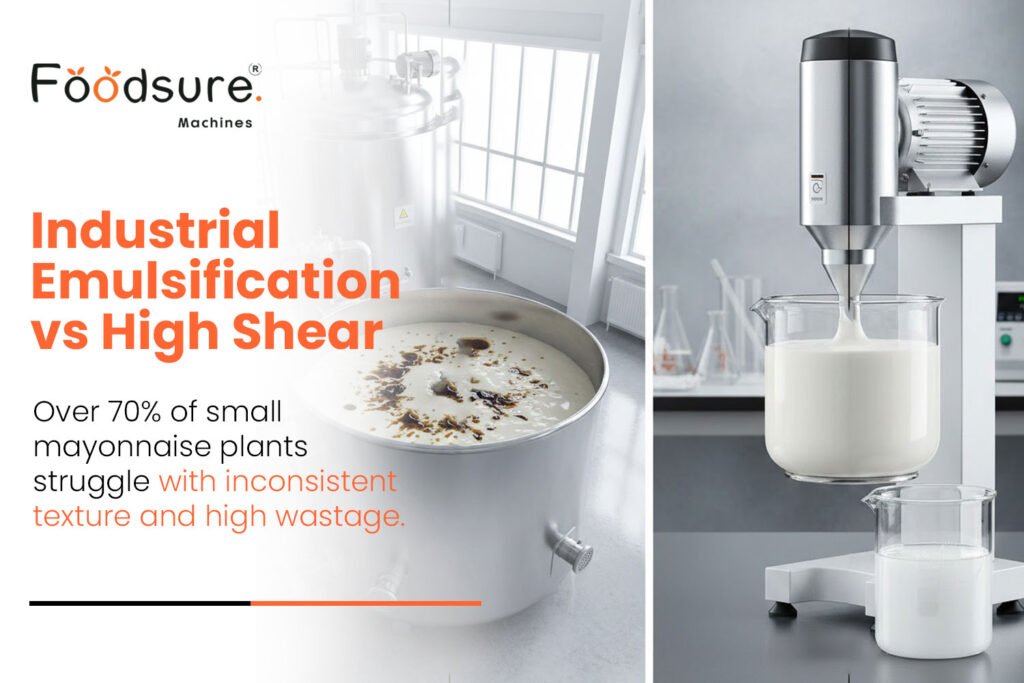
Over 70% of small mayonnaise plants struggle with inconsistent texture and high wastage. Between industrial emulsification vs high shear machines, which truly scales your factory? If your output stalls or costs soar, this blog reveals the hidden performance gaps your engineer must know to fix them. Why Choosing the Wrong Emulsification System Hurts Your Mayonnaise Production When the emulsion system is improperly matched with mayonnaise mixing technology, surface quality, stability, and expandability can be compromised. This is especially true for small FPOs (Farmer-Producer Organisation) and start-up companies. An incorrect match between the emulsifying system and mayonnaise production can create discontinuities in oil-in-water emulsions, resulting in waste, rejection, and higher costs. The following are risks associated with improper emulsion systems for mayonnaise: Inconsistent Texture: Poor shear mixing results in uneven droplet sizes, leading to grainy or separated batches that result in 20–30% batch rejection for failing sensory standards. Oil Separation: Poor levels of homogenization will result in the formation of cream and a shelf life of less than 3 months, resulting in spoilage and recall due to oxidation. Scalability: Fixed-capacity batch mixers will add 15-20% to the cost per kilogram as production grows, or during scale-up, and will not allow for inline upgrading. Investment Traps: Startups will tend to over-purchase, oversized unitary systems or under-capacity, resulting in capital being locked up with no return on investment and non-compliance with FSSC 22000 standards. What Is Industrial Emulsification? Industrial emulsifiers are capable of producing stable emulsions using very high shear forces. The production of a uniform mayonnaise requires a uniform emulsification. How Industrial Emulsifiers Work: A rotor-stator model is made up of a fast-rotating rotor that fits inside a fixed stator. The rotor rotates at speeds up to 30 m/s, drawing the material into it, creating large shear forces that break the oil into 1-5μm droplets through viscous turbulence, and expelling the fine emulsifying mixture of droplets through the discharge valve. High-pressure versions of industrial emulsifiers employ a positive displacement pump to pump a liquid mixture through a valve at pressures between 100-2000 bar. Production Capacity and Industries: The production capacity of industrial emulsifiers ranges from 500kg/hr to 2,000kg/hr for batch mode production, while the same industrial emulsifiers in continuous-mode run can produce upwards of 5,000kg/hr. Commercial and industrial mayonnaise companies use industrial emulsifying systems to produce mayonnaise types that contain high oil levels (60%-80%) and also produce sauces and dressings. Best Applications for Industrial Emulsifiers: Industrial emulsifying systems are designed to accommodate very high continuous volumes and to be used in plants that operate on a continuous basis (24/7). Also read: Mayonnaise Machine Price India: 2026 Cost Guide & ROI What Is a High-Shear Mayonnaise Machine? Through intense mechanical force using rotor-stator technology, high shear mayonnaise machines create stable emulsions (oil droplets evenly dispersed in water phases). The rotor-stator principle is as follows: A high-speed rotating rotor creates a narrow gap between itself and the stationary stator. The force of the rotating rotor draws materials into this narrow gap, where experienced tip speeds of up to 30 m/s. This shear rate creates turbulence and cavitation, which results in the breaking apart of the oil droplets into 1-5μm size droplets. For mayonnaise producers to maintain a consistent product texture throughout the life of their products, it is essential to utilise the higher shearing rates of the high shear mayonnaise machines. The use of low shear (below 10,000s-1) results in inconsistently sized oil droplets, which produces grainy or split mayonnaise and contributes to a significantly shorter shelf life. The average output range of units is 50-500kg/h. This is the ideal output range for pilot plants, start-ups, and mid-scale FPOs that are looking to transition from lab to commercial without making excessive investments in equipment. Advanced Insights into Emulsification Systems Food Processing Emulsification Solutions: Ensures stable emulsions with uniform texture. High-shear emulsification breaks oil into 1-5μm droplets for smoothness. Optimizes process control with automation for consistency and reduced waste. Industrial Mixing and Emulsifying System: Uses rotor-stator technology to create uniform emulsions. Designed for both batch and continuous production. Customizable for varying viscosities and production volumes. Industrial Food Emulsification Technology: High-pressure homogenization creates finer oil droplets for stable emulsions. Nanoemulsions and microfluidics offer enhanced texture and stability. Focus on energy efficiency and sustainability, including ultrasonic emulsification. Each of these systems ensures optimal quality, scalability, and cost-effectiveness in large-scale food production. Industrial Emulsification vs High Shear: A Clear Side-by-Side Comparison for Mayonnaise Plants Factor Industrial Emulsification High-Shear Mayonnaise Machine Texture control Superior, ensures ultra-smooth, stable emulsions even in large batches Good for small batches, but may show slight graininess in high-volume production Batch consistency Very high, replicable results across multiple shifts Moderate; variations can occur when scaling up Oil incorporation Optimal, handles higher oil ratios efficiently Adequate; may require adjustments for richer recipes Scalability Excellent, ideal for large industrial plants Limited to small-to-medium production Maintenance Medium-high, specialised parts require skilled technicians Low-to-medium; simpler design, easier to clean Cost efficiency Best for large-scale plants, ROI improves with volume Best for small setups; lower upfront cost, but less scalable Industrial Emulsification vs High Shear: Which System Fits Your Factory Size? The production of mayonnaise is broken down into three groups of producers depending on their needs, small (usually high-shear emulsifiers)manufacturers and growing brands (budgeting for 1 to 2 tons/day), and multi-shift industrial plants. The first group typically uses high-shear machines with low start-up costs (usually well below $20,000), allowing flexibility with recipe development (200 to 1000 kg/day). For India, these are the preferred emulsification systems for scaling from lab tests to commercial production. The second product type is industrial emulsifiers with a cost associated with producing products at 1-2 tons per day, plus a 30% lower rejection rate than high-shear production due to inline processing, which further enables these emulsifiers to provide a cost-effective means to transition pilot products to commercial products by allowing incremental modularity, providing a more efficient processing for 8-hour shifts. The third group of producers are fully equipped industrial
How to Start a Tomato Sauce Business in India: Machines, Cost & Setup
India produces more tomatoes than most countries in the world, yet the majority are sold at wafer-thin margins. For processors, this gap between production and profitability is where tomato sauce and ketchup manufacturing begins to make sense. What looks like a simple product on the shelf actually depends on the right processing machine, correct batch control, and food safety compliance. Many first-time manufacturers invest in tomato sauce machines without fully understanding how to make tomato ketchup at scale, the ketchup manufacturing process, or the realities of a tomato ketchup recipe commercial scale, and realise the mistake only after production starts. This guide breaks down how tomato sauce businesses actually work in India from choosing the right tomato sauce making machine and understanding plant costs, to compliance, suppliers, and profitability. So you can plan your unit with clarity before investing. Why Tomato Sauce Demand in India Is Growing Every Year The processed sauce making machine market in India is on an upswing: In 2023, the Indian tomato ketchup and sauces market was a touch above ₹1,200 crore, growing approximately 5-6% CAGR. The increase in consumption of fast food, snacks, and semi-prepared food is driving demand for tomato-based condiments, including sauces and ketchup. While Indian tomato paste and sauces have already gained traction in the Middle East and Europe, opportunities are also available in Africa. Tomatoes are grown throughout India, and the over 21 million tonnes of tomatoes produced each year guarantee growth in the supply chain for processors. As demand rises, understanding the ketchup manufacturing process and using the right machinery becomes essential to maintain consistency, shelf life, and margins, especially when scaling beyond small batches. Read More: Tomato Ketchup Market Size, Demand & Growth Trends in India [2026] Choosing the Right Tomato Sauce Machine for Your Business The biggest mistake first-time manufacturers make is buying a machine based on price, not production reality. A low-cost machine may not support the actual tomato ketchup recipe commercial scale required for market demand, leading to bottlenecks, hygiene failures, or uneven consistency. Here’s how to choose the right tomato sauce machine based on where your business actually stands. Semi-Automatic Tomato Sauce Machines Semi-automatic machines work best for regional brands and first-time manufacturers who are testing demand or supplying local markets. These systems automate cooking, heating, and mixing, but still rely on manual handling for ingredient loading and packing. They are suitable if: Your daily output is limited. You want lower upfront investment. You are comfortable with some manual labour The trade-off is scalability. As demand increases, labour dependency and batch inconsistency begin to affect margins. Fully Automatic Tomato Sauce Production Lines Fully automatic lines are designed for commercial-scale units, exporters, and co-packers. These systems automate tomato processing from washing and pulping to cooking, homogenising, filling, and sealing with minimal human intervention. They make sense when: Output consistency matters. Hygiene compliance is critical. Labour costs are rising. You plan to scale without frequent upgrades. Although the initial investment is higher, fully automatic plants usually deliver lower cost per unit, better shelf stability, and predictable production over time. The Practical Rule If your goal is to stay small, semi-automatic machines control risk. If your goal is to grow, fully automatic lines control cost. Top Features to Look for in a Tomato Sauce Machine Food-Grade Stainless Steel Every contact surface and every component in contact with food must be made out of SS304 and SS316, which offer hygiene, chemical, and rust protection and are easy to clean. Stainless steel meets not only construction standards and safety standards, but also reduces the risk of contamination. Uniform Heating and Homogenising Machines should have controllable heating options (electric or vapour) that have mixing/homogenising capabilities to provide automated blending of the product and provide a universally blended, lump-free consistency. The importance of uniform consistency is especially important for raw ingredients like tomato sauce and ketchup. Energy Efficiency Tomato ketchup machines should utilise insulated tank heating vessels and motors and processes that are energy efficient. Any reduction in energy consumption will lead to a reduction in operating cost and thus improve the operating profit for the producer. Automatic Filling and Sealing Automatic filling and sealing units are necessary to lower the labour costs of the plant workforce and also increase the speed of output. Increased speed is an absolute must with semi-automatic and fully automatic plants. A tomato sauce manufacturing unit offering the option to fill needs the capacity to dose accurately and also be adjustable, seal cleanly, and seal to a standard to eliminate, to the highest degree possible, pack integrity concerns. Read More: Affordable Tomato Sauce Making Machine Price That Boosts Your Production and Profits Licenses and Food Safety Rules for Starting a Tomato Sauce Business If you are looking to sell tomato sauce in the Indian market commercially, you will require an FSSAI licence (either Registration, State, or Central), depending on the capacity of your plant, to ensure compliance for food safety purposes. You will also require a food safety label on the packaging for your product, which will require adding to the label the ingredients, nutrition information, batch number, expiry date, and food safety and standards information. Wholesaler or retailer sales will also require GST registration. The processes will ensure you are compliant to trade your product legally and safely, and produce products where you can be confident your consumers & other buyers will trust. Choosing the Right Supplier for Tomato Sauce Machines Quality Assurance: It is important to prevent impurities, ensure long machine life, ensure food safety, and ensure product quality. After-Sales Support: A Trustworthy supplier gives after-sales support, which will reduce break time of the machine, servicing, available service parts, and trained operators. Scalability: Scalability allows for the supplier to have upgrades and modular solutions for growth and minimise the costs of new equipment. Working with a supplier tomato sauce manufacturers in India, who has these advantages, a company can conserve operating costs, extend long-term capital investment, and assure consistent product quality. Read More: Tomato
Top 4 Energy Bar Machine Manufacturers in Gujarat – 2026 Price Comparison
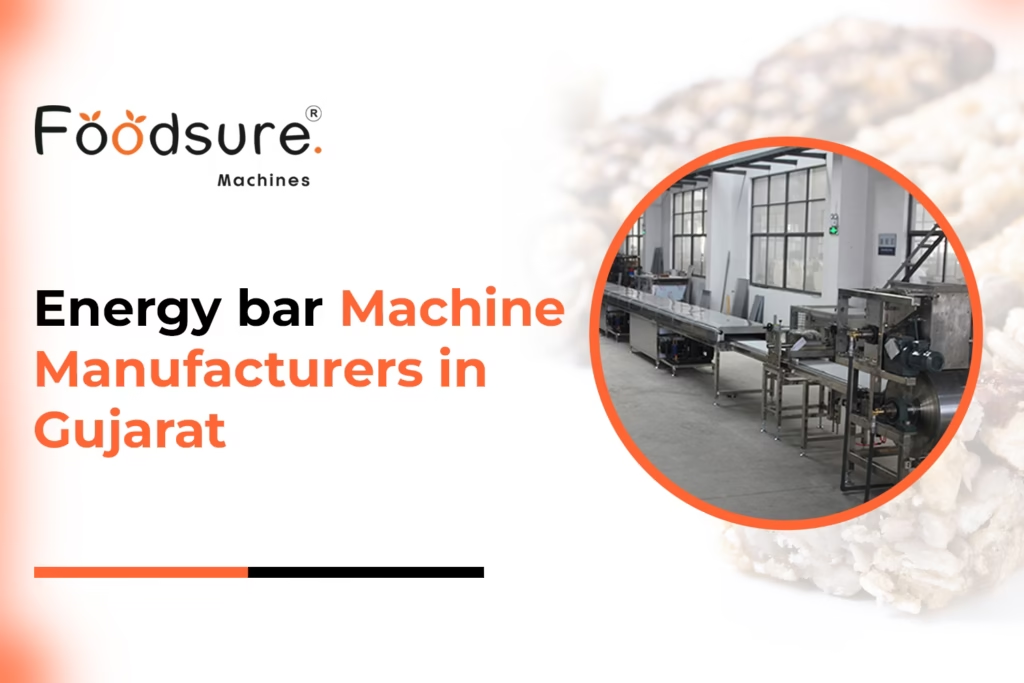
Choosing an energy bar machine manufacturers in Gujarat is no longer just about starting production. It is about choosing a setup that controls costs, maintains hygiene, and scales smoothly as demand grows. Many manufacturers begin with a low-cost machine, only to face uneven bar sizes, frequent downtime, and capacity limits within months. In Gujarat, where demand for protein and nutrition bars is rising fast, the right energy bar manufacturing machine can directly impact your margins. Prices range from small ₹1.5–5 lakh startup machines to fully automatic lines producing up to 500 kg per hour. The challenge is knowing which manufacturer and machine actually fit your business stage. This guide compares the top energy bar machine manufacturers in Gujarat, their machine types, capacity ranges, and ideal use cases so you can make a confident, profit-focused decision before investing. Quick Buyer Snapshot: Energy Bar Manufacturing Machine in Gujarat Startup / Pilot Setup ₹1.5 – 5 lakh (Approx) Best for test batches & new brands Output: 25–80 kg/hour Semi-Automatic Units ₹6 – 15 lakh (Approx) Ideal for growing manufacturers Output: 50–150 kg/hour Fully Automatic Lines ₹18 – 40+ lakh (Approx) Low labour, high consistency Output: Up to 500 kg/hour Who should go fully automatic? Brands planning scale-up, exports, or multi-flavour production. Top Energy Bar Machine Supplier in Gujarat (Side-by-Side Comparison) Manufacturer Machine Type Capacity Range Best For Why Choose Foodsure Machines Semi & Fully Automatic Lines Up to 500 kg/hour Scaling brands & large units High automation, hygiene, strong after-sales Snackfoodmachines (Kanchan Metals) Tabletop & Semi-Automatic 25–120 kg/hour Startups & pilot plants Compact, low power, quick setup ABC Agro & Food Machine Semi & Automatic Nutrition Bar Lines 50–200 kg/hour Product experimentation & variety Recipe flexibility & customization Shriram Associate Nutrition Bar Machines 50–250 kg/hour SMEs upgrading production Low maintenance, steady output Foodsure Machines Experience & Certifications: We have been in this business for over 13+ years and hold an ISO 9001:2015 certification. Machines Key Features: High automation with PLC controls and a touch-screen interface. Recipe memory for consistency. Our energy bar manufacturing machine are made of stainless steel (SS304/316), designed for hygiene and long-lasting use. Automatic energy bar machines have adjustable settings for different bar sizes, along with electric heating mixers for even blending. These machines have also automated servo blades for uniform cutting and included flow-wrap packaging. We also provide training and installation support, plus a 1-year warranty. What this really means is you get a scalable, hygienic setup trusted by businesses searching for an energy bar machine manufacturer near me who can support growth without compromise. Advantages: Excellent hygiene and food safety compliance. Fast changeovers between different bar types. Trustworthy in post-sales service. Snackfoodmachines (Kanchan Metals Pvt Ltd) Experience & Certifications: They have been working in the snack machinery space for over 15 years. Key Features: Their machines are designed for space-saving, easy operation, and cleanliness. Automatic energy bar machines handle accurate bar molding, cooling, energy bar cutting machine, and wrapping. You can easily perform quick changeovers, and setup assistance is included. Advantages: Their machines need minimal space and energy requirements. It is affordable for startups and pilot plants. abcfoodmachine (ABC Agro & Food Machine India Pvt Ltd) Experience & Certifications: They have been around for 20+ years and are a registered manufacturer-exporter with the IndiaMART Trust Seal. Key Features: Their machines support diverse recipes, protein bars, chikki, and granola. Machine service parts are made with stainless steel and equipped with efficient extruders, rollers, and cutters. They also offer recipe guidance and remote technical support. Pros: Works well for Indian flavors and both export and local markets. Flexible options for startups adding new products. Shriram Associate Experience & Certifications: With over 15 years of experience, they specialize in nutritional bar and snack equipment. Key Features: Their machines are low-maintenance, efficient designs. Meets GMP(Good Manufacturing Practices) hygiene standards and is easy to operate. Their machines do quick cleaning, real-time monitoring, and technical support. Pros: Durable, cost-effective machines with support for recipe development. Scalable setups for SMEs and larger units. Easy to integrate with packing lines. How to Pick the Right Manufacturer to Help Your Energy Bar Business Succeed Match Machine Capacity to Your Business Needs Always buy a machines that match scalability as your demand grows. There are two types of machines: the first is semi-automatic, which has a 50kg/hr capacity, ideal for small-scale production. The other is fully automatic machines in Gujarat, which range from 50 kg/hr up to 500 kg/hr, ideal for large-scale production. It helps you align investment with actual production goals. Prioritize Quality, Hygiene, and Certifications Machine service parts should be made of food-grade stainless steel (SS304/316) construction. Because it is important for hygiene, efficiency, and safety certifications like FSSAI and ISO 9001:2015. Check Training and After-Sales Service Local installation, operator training, and spare parts availability matter, especially if you are searching for an energy bar machine manufacturer near me. Balance Cost with Long-Term Value Do not just go for the cheapest energy bar production line. Focus on warranties, maintenance ease, and proven efficiency. Slightly higher upfront investment often pays off in fewer breakdowns and smoother production. Read More: Everything You Should Know Before Buying an Energy Bar Machine Conclusions Choosing an energy bar machine manufacturer in Gujarat is about more than price comparison. The right machine must align with your production scale, hygiene standards, and long-term growth plans. Businesses that buy energy bar machine locally from reliable suppliers benefit from faster service, smoother scaling, and reduced downtime. Comparing manufacturers on automation level, output capacity, and after-sales support ensures a confident investment decision. At Foodsure Machines, we help brands select energy bar machines that balance cost, automation, and scalability, making us a trusted choice for businesses searching for an energy bar machine manufacturer near me. Expert guidance today can prevent costly reinvestment tomorrow. Have a Question? Let’s Connect! Please reach out to us anytime via phone or email. 📞 Call Us ✉️ Email Now FAQs Which energy bar machine manufacturers in Gujarat offer export
Energy Bar Production Line Cost & Automation in India (2026 ROI Guide)
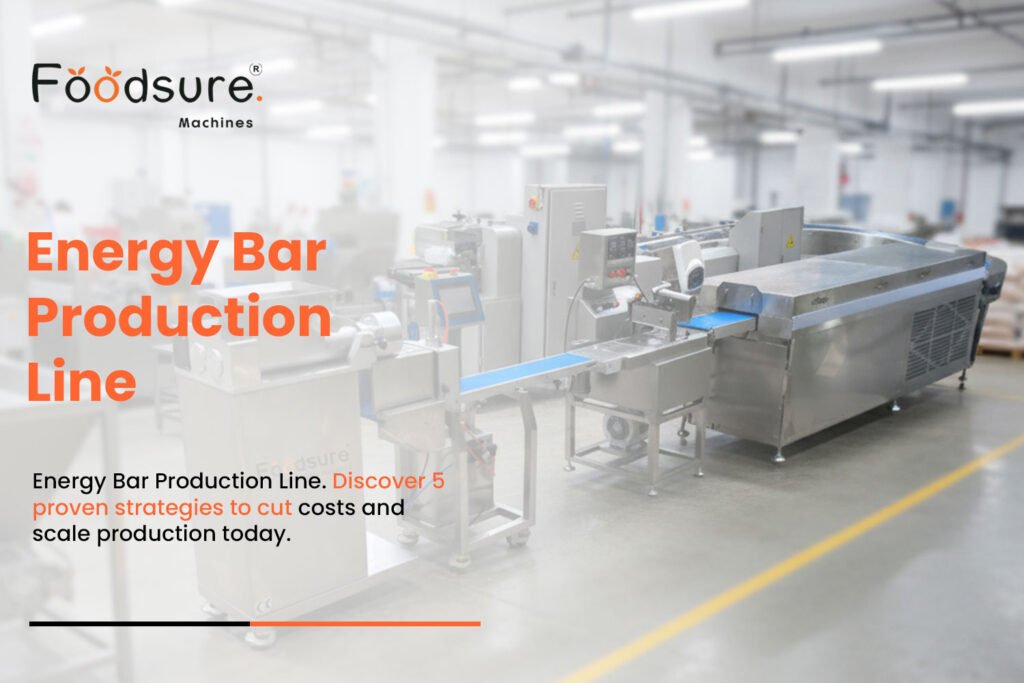
Nearly 40% of energy bar profits are lost due to inefficient production line design. Rising raw material prices, labour shortages, and outdated workflows silently eat into margins for growing energy bar manufacturers. What starts as a low-cost setup often turns into high wastage, inconsistent output, and rising operational stress as volumes increase. This guide explains how manufacturers cut production costs by 30–40% by redesigning their energy bar production line. You’ll see actual cost ranges, automation choices, and capacity trade-offs so you can decide what makes financial sense before investing further. Quick Cost Snapshot Small-Scale Line ₹35 – 80 Lakh Industrial Line ₹3.5 – 8 Crore Cost Reduction Potential 30 – 40% Small-Scale vs Industrial Energy Bar Production Line: Cost Comparison Cost & Feature Category Small-Scale Energy Bar Production Line Industrial Energy Bar Production Line Production Capacity 50 – 200 kg/hr (Startup / Pilot) 500 – 2,000+ kg/hr (Industrial) Automation Level Semi-automatic, operator-assisted Fully automated PLC & HMI controlled Mixing System Planetary / ribbon mixer High-torque continuous industrial mixer Mixer Cost ₹3 – 8 Lakh ₹25 – 60 Lakh Ingredient Dosing Basic load-cell or semi-manual Automated multi-ingredient dosing Forming & Cutting Semi-auto slab former & cutter High-speed automatic former with guillotine Forming & Cutting Cost ₹6 – 12 Lakh ₹40 – 90 Lakh Cooling System Short conveyor or static cooling Multi-zone industrial cooling tunnel Cooling Equipment Cost ₹4 – 8 Lakh ₹35 – 70 Lakh Optional Enrobing Tabletop unit (optional) Full-width continuous enrober Enrobing Cost ₹6 – 10 Lakh ₹50 Lakh – ₹1.2 Cr Packaging Type Semi-automatic flow wrapper High-speed servo flow wrap line Packaging Machine Cost ₹10 – 18 Lakh ₹60 Lakh – ₹1.5 Cr Quality Control Manual inspection & basic testing Inline metal detector & check-weigher QC Equipment Cost ₹2 – 4 Lakh ₹20 – 50 Lakh Labour per Shift 6 – 10 operators 2 – 4 operators Total Line Investment ₹35 – 80 Lakh ₹3.5 – 8 Crore Best For Startups, D2C brands, pilot batches FMCG brands, export & contract manufacturing What’s Driving High Energy Bar Manufacturing Plant Cost in Growing Factories Founded on a small scale of operation, many small businesses produce their own energy bars line using less expensive manual or semi-automated equipment. This keeps initial costs low for the owner (the entrepreneur), but it can also create additional unknown control costs in future years as your volume grows. The most important issues facing small energy bar producers include: Inconsistent mixing can lead to loss of some batches. A high reliance on human labour for the forming, cutting, and handling of energy bars. The manual movement of raw materials can lead to more waste in each batch of production. Bottlenecks can develop between the mixing, cooling, and packing processes. The 5 Biggest Cost Drivers in an Energy Bar Production Line Understanding where costs originate is the first step toward reducing them. Loss of Material When Mixed: User error with mixers, whether it is with improper technique when using a machine or mixing by hand without adequate experience, will cause uneven or too much contamination in the product. When you look at getting a 2-3% loss per batch is what you have at the end of the month, that number will begin to build. Manual Cutting and Forming Waste: Manual forming of the bars alone can yield different weights for each bar, resulting in: Overweight bars (loss of material). Underweight bars (loss of quality). Worker Intensive: The majority of smaller operations have a minimum of 8-12 workers per shift solely to form, handle, and align the materials. The cost of each of these people will increase yearly; however, the amount of output remains static. Poor Setting/Cooling of Bars: If bars are improperly set or cooled, they will become warped, bent, or stuck at the time of packing. This will lead to downtime during the packing process. Energy and Maintenance Waste: Motor sizes that are larger than what is needed, poor insulation, and unplanned and frequent maintenance will cause higher energy costs and unscheduled interruptions of production. Automation Strategies That Cut Energy Bar Manufacturing Costs by 40% The smartest way to energy bar machine your work process is to make sure that you identify and automate the right stages of your process so that you do not have to spend a lot of money on bar processing line to achieve good results. Continuous Mixer vs Batch Mixer: Using a continuous mixer allows you to produce a product that has a consistent appearance and texture, taste, and has the added benefit of lower raw material loss and fewer operators needed to run the machine. $5 to $7 per 100 lbs of labor and raw material costs saved. Automatic Bar Forming and Cutting: With a servo-controlled bar forming and cutting machine, you will automate the processes of bar forming and cutting, with the benefits of: A consistent weight for each bar was produced. Less waste of materials in cutting. An increase in production rate (more bars produced / hour) $10 to $15 per 100 lbs on raw material and reject costs saved. Inline Cooling System: A patented inline cooling system stabilizes the product before packaging, resulting in lower product breakage and lower production downtime costs. Less time lost due to product breakage and less time spent repacking products due to the inline cooling system. One Operator Model Production Line: With a well-designed automatic energy bar production line, you will have only 2-3 operators to operate the line, vs 8-10 on a traditional energy bar production machines. Therefore, you will save 12-18% on your labor expense each year. Real-World Example: 500 kg/day Unit That Reduced Costs by 38% An average-sized nutritional product company that manufactures protein and energy bars had been impacted by increased labour costs resulting in inconsistently weighted bars. With the installation of an automated bar forming, cutting, and heating/cooling system: Labor Reduced: The number of labourers decreased from nine personnel working per shift to three personnel. Raw material loss changed from a
Find the Best Protein Bar Machine in Kanpur with Affordable Prices & Trusted Manufacturers
A few years ago, protein bars were rare in Kanpur. Today, local shops in Kanpur and startups are joining the health snack trend. What is helping them? The right protein bar machine in Kanpur and trusted suppliers of machines that help them grow their business. With an advanced protein bar manufacturing machine, the same high-quality product is consistently produced, reducing mistakes and making scaling simple. Let’s turn your simple ingredients into ready-to-sell protein bars. Kanpur’s trusted protein bar equipment is made for growth. Protein Bar Machine Supplier In Kanpur That Support You from Setup to Success Foodsure Machines Best for: Startups → Large-scale manufacturers. Capacity: 200–1000 kg/hr (automatic extruder lines). Certifications: ISO 9001:2015, ISO 22000. Experience: 13+ years across India & exports.. Social Proof: 120+ verified IndiaMART reviews Kanpur Support: On-site installation, operator training, spare parts. Notable Features: PLC touchscreen control, SS304 food-grade build, custom dies, nitrogen-flush packaging. Hovert Machines & Furnaces Pvt. Ltd. Best for: Custom industrial setups Capacity: Built-to-order food bar extrusion systems. Certifications: ISO 9001:2008, GST verified. Experience: Established in 1995. Ratings: 4.8★ on Justdial, 3.6★ on IndiaMART. Kanpur Support: Local service team + rapid installation. Strength: Engineering reliability & long-term maintenance. Vecchocotech Best for: Precision & premium bar manufacturing. Capacity: Up to 400 kg/hr. Certifications: In-house QA lab, export-ready standards. Experience: Serving since 2009. Core Strength: Chocolate enrobing + protein bar lines. Features: Modular machines, exact dosing, energy efficiency. Snackfoodmachines Best for: End-to-end turnkey food lines. Capacity: 100–900 kg/hr full production lines. Compliance: CE-compliant parts, FSSAI-ready, EU imports. Support: Remote troubleshooting + on-site installation. Automation: Semi & fully automatic stainless-steel systems. Local Support & Delivery in Kanpur All brands provide protein bar extruder machine demos, warranties, spares, and support in Kanpur. Installations are typically completed within 30–90 days of order. Warranty options available for 1–2 years, with AMC plans offered for ongoing service. How to Choose the Right Protein Bar Machine with the Features That Matter Most These machine service parts are made from SS304 stainless steel, which makes machines easy to clean, also keeping hygiene and maintenance simple. High-speed cutting with zero-waste technology that cuts each bar carefully while minimizing product loss, so you save on raw materials. Touchscreen PLC for programmable settings that help you switch recipes quickly, automate mixing, extrusion, and cutting, and adapt to changing production needs. Precision cooling conveyor that maintains the shape and texture of each bar, ensuring consistent quality batch after batch. Low power consumption with optimized throughput. Designed to run efficiently, reducing energy costs while maximizing output for continuous production. Adjustable and cost-effective production, which offers control, trustworthiness, and efficiency without unnecessary detail, is perfect for scaling your protein bar business. The Real Costs of Protein Bar Manufacturing Machines in Kanpur Before you buy protein bar machine locally, you need to understand what it really costs to set up a Protein Bar Plant Setup in Kanpur. What that means is you get to know the price of the equipment and, factoring in installation, operator training, raw materials, and ongoing maintenance, before investing in a business. Category Semi-Automatic Fully Automatic Capacity (kg/hr) 50–200 200–500 Base Machine Cost (₹) 4,70,000 – 6,50,000 12,00,000 – 36,00,000 Installation & Training (₹) 50,000 – 1,00,000 1,00,000 – 2,00,000 Ingredients & Raw Material Cost (₹/month) 50,000 – 1,50,000 1,50,000 – 3,50,000 Maintenance / AMC (₹/year) 40,000 – 80,000 80,000 – 1,50,000 Total Minimum Investment (₹) 5,60,000 14,50,000 Total Maximum Investment (₹) 9,80,000 43,00,000 Conclusion Choosing the right protein bar machine in Kanpur sets the stage for a profitable production setup. At Foodsure Machines, we provide automatic machines with features like touchscreen controls, high-speed cutting, and energy-efficient designs. What this really means is you can scale your production smoothly while keeping every bar consistent in quality. You also get certified, trusted equipment, transparent pricing, and post-sales support you can trust. So your margins stay healthy and your business can grow without unnecessary risk. Request Your Free Quote Fast Please reach out to us anytime via phone or email. 📞 Call Us ✉️ Email Now FAQ Q1. Is a protein bar machine profitable in Kanpur?Yes, automation lowers labor costs and waste, increasing profit margins. Q2. Who should invest in protein bar machines?Startups, gyms, FMCG units, and nutrition-focused brands benefit most. Q3. Is India’s protein bar market growing fast?Yes, rising health awareness is driving strong nationwide demand. Q4. Are protein bars profitable to manufacture in bulk?Yes, bulk production with machines delivers high ROI and consistency. Q5. What is the cheapest protein base for bars in Kanpur?Peanuts and oats are the most cost-effective protein ingredients. Q6. How much space is needed for a protein bar machine setup?Around 300–600 sq. ft. is sufficient for small to mid-scale setups. Q7. Can one machine handle multiple protein bar recipes?Yes, PLC-controlled machines allow quick recipe and size changes. Q8. What is the minimum investment to start protein bar production?You can start from around ₹5–6 lakh with a semi-automatic machine. Q9. Are protein bar machines easy to operate for beginners?Yes, most suppliers provide training and user-friendly controls. Q10. How long does it take to install a protein bar machine in Kanpur?Installation typically takes 30–90 days after order confirmation.