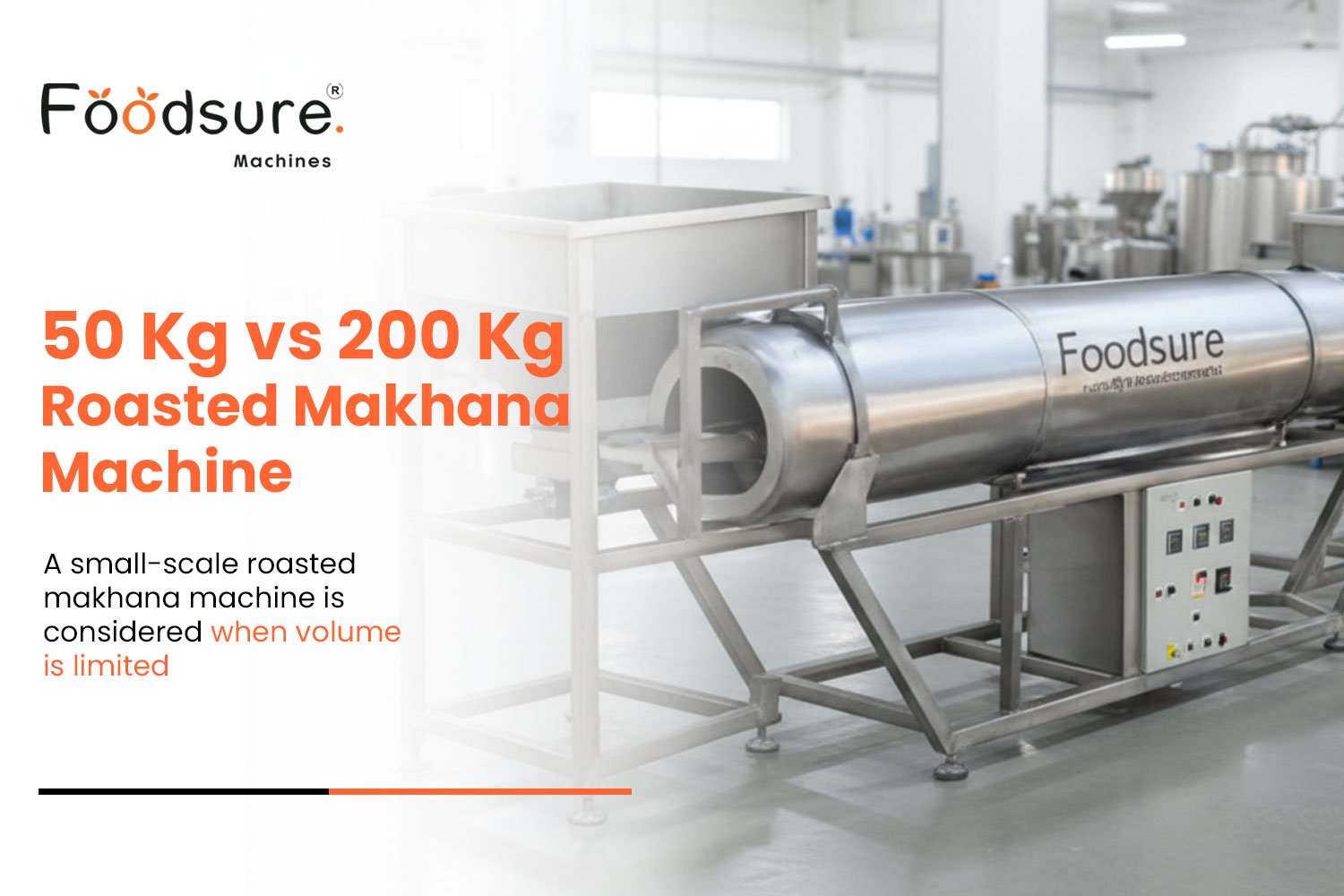
The correct equipment selection establishes the operational efficiency of your organisation. The 50 Kg vs 200 Kg Roasted Makhana Machine comparison shows that equipment size does not determine which machine performs better because the correct machine for each situation exists.
A small-scale roasted makhana machine is considered when volume is limited, and cash flow is the only point to matter. The industrial roasted makhana machine requires three elements which include demand and manpower and systems to function properly. The right roasted makhana making machine for startups is the one that matches today’s reality, not tomorrow’s assumptions.
Quick Comparison: 50 Kg vs 200 Kg Roasted Makhana Machine
Here’s a quick overview for startups that want to establish Foxnut roasting facilities.
| Feature | 50 Kg Machine | 200 Kg Machine |
|---|---|---|
| Batch Capacity | 50 kg per batch (ideal for small operations) | 200 kg per batch (suited for industrial scale) |
| Investment Range | ₹3–5 lakhs | ₹12–15 lakhs |
| Output Per Hour | 50–70 kg (depending on roasting cycle) | 180–220 kg (industrial batch cycle) |
| Power Requirement | 8–12 kW | 22–30 kW |
| Labor Requirement | 1–2 operators | 3–4 trained operators |
| ROI Timeline | 6–9 months (steady local demand) | 12–18 months (bulk demand required) |
| Best For | Startups, pilot production, local brands | Expanding businesses, bulk supply, distributors |
Key Takeaway:
A 50 Kg roasted makhana machine keeps risk low and is ideal for testing markets. The 200 Kg roasted makhana machine enables businesses to handle large shipments through its lower cost per kilo pricing system, which operates when demand remains stable.
50 Kg vs 200 Kg Roasted Makhana Machine: Which Capacity Is Right for Startups?
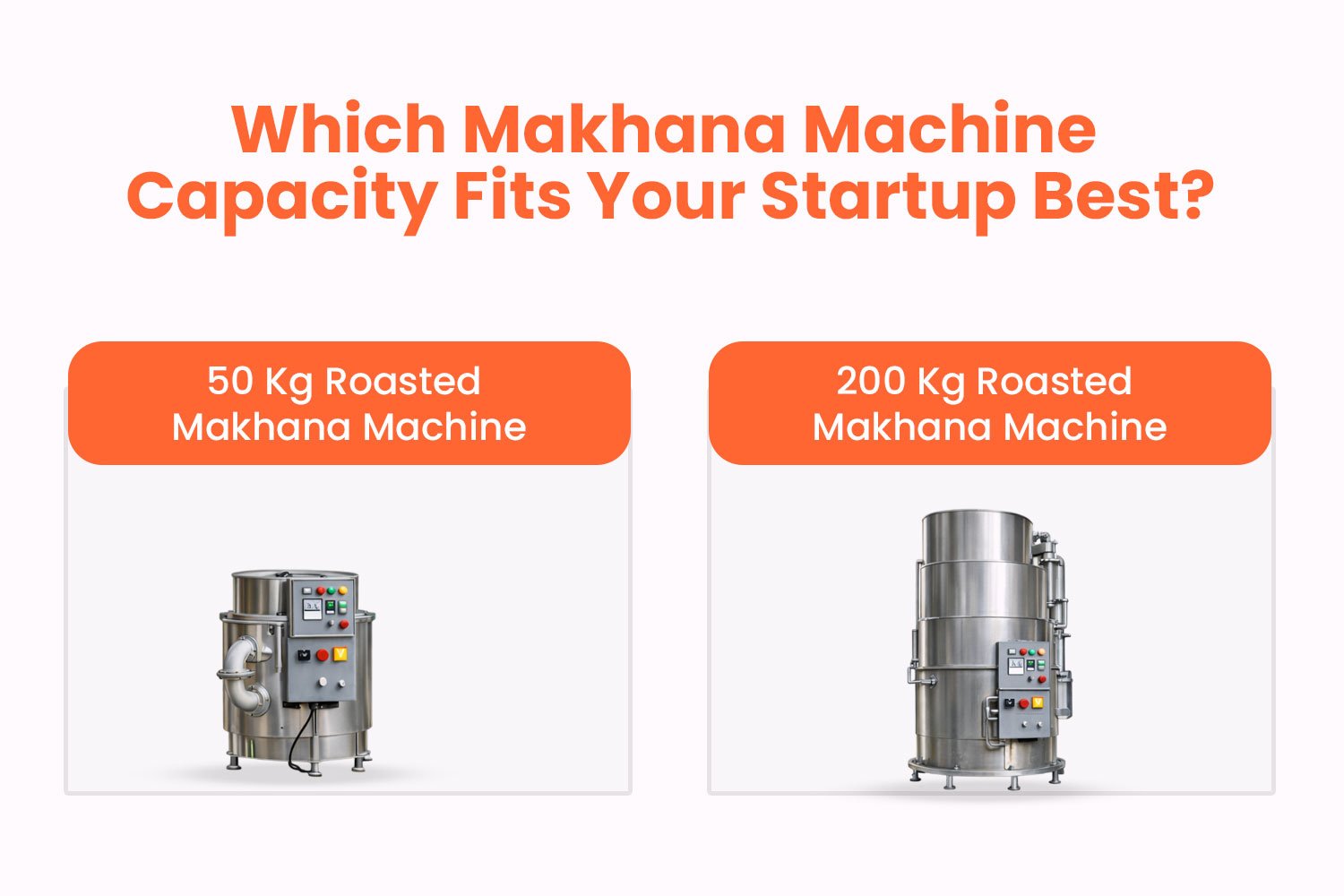
- A 50 Kg Roasted Makhana Machine works best for small batches and trial runs. It needs very little manpower, keeps the initial investment manageable, and supports modest daily output. This option makes sense when you want to test the market, refine your product, and learn operations without locking in high costs.
- A 200 Kg Roasted Makhana Machine only makes sense when demand already exists. It delivers higher output and lowers roasting cost per kilo. But it also needs more space, trained operators, and serious capital. Without steady orders, that efficiency turns into pressure.
Who Should Buy a 50 Kg Roasted Makhana Machine?
- Market Testers: The startup companies conduct local foxnut demand tests to validate their market potential before they proceed with business expansion.
- Budget-Savvy: The budget-friendly investment range of ₹8-12L costs less than 2-3 workers.
- Space-Constrained: The system provides a compact design that suits residences and small units while achieving a production capacity of 150 kg per hour.
- Beginner-Friendly: The program provides beginners with a safe learning environment that allows them to develop skills and test their recipes while evaluating product quality.
Ideal For: The system provides controlled business expansion capabilities without causing financial distress to the organisation.
Who Should Invest in a 200 Kg Roasted Makhana Machine?
- Bulk Confirmed: The system requires wholesale and export orders to be confirmed before bulk confirmation can proceed.
- Scale-Ready: The business requires ₹25-40L capital expenses and 5-7 employees to achieve its capacity-ready status.
- Large Facilities: Needs robust power, bigger space.
- Volume-Focused: The system achieves cost reductions through its ability to process high volumes of material.
Ideal For: The solution works best for established businesses that aim to lead in retail, but it does not suit new companies.
50 Kg vs 200 Kg Roasted Makhana Machine Price Comparison
Calculating the entire cost of a roasted makhana machine setup is not limited to the price displayed on the machine alone. Startups have to budget for purchase cost, installation charges, and regular operating expenses. A comparison table is presented below, which lists the typical cost components of a small-scale roasted makhana machine in contrast with an industrial roasted makhana machine.
| Cost Component | 50 Kg Roasted Makhana Machine | 200 Kg Roasted Makhana Machine |
| Purchase Price | Lower entry price – ideal for pilots & micro units | Higher investment – industrial-grade build |
| Installation | Simple setup; minimal electrician work | Requires more space layout & skilled installers |
| Infrastructure | Small floor area & basic utilities | Larger footprint, ventilation & power upgrades |
| Power Consumption | Lower daily energy cost | Significantly higher energy draw per shift |
| Labor Costs | 1–2 operators | 3+ operators/shifts for full utilisation |
| Maintenance | Lower part replacement cost | Higher servicing and periodic repair costs |
| Packaging Line Needs | Basic packing setup | Automated/semi-automated packaging recommended |
| Training & SOPs | Short training cycle | Longer SOP adoption & quality management training |
Daily Production of 50 Kg vs 200 Kg Roasted Makhana Machine
When production is planned, knowledge of the daily output is crucial:
- 50 Kg Roasted Makhana Machine: It produces around 50-60 Kg per batch. With 23 batches per day, startups can expect 100-180 Kg of roasted makhana daily. It is suitable for pilot operations or local sales.
- 200 Kg Roasted Makhana Machine: It produces 200-220 Kg per batch. By running 2 batches daily, the output reaches 400-440 Kg. It is a good fit for high-demand markets or bulk supply.
50 Kg vs 200 Kg Roasted Makhana Machine: Quick Comparison Table
| Feature | 50 Kg Roasted Makhana Machine | 200 Kg Roasted Makhana Machine |
| Daily Production | 50–60 Kg | 180–220 Kg |
| Purchase Cost | ₹3–5 Lakh | ₹12–15 Lakh |
| Monthly Operating Cost | ₹50–60 K | ₹2–2.5 Lakh |
| Staffing Requirement | 2–3 workers | 5–6 workers |
| Energy Consumption | Low | High |
| ROI Timeline | 6–8 months | 12–15 months |
| Ideal For | Small startups, pilot projects | Medium to large-scale operations |
| Maintenance | Simple, low-cost | Requires trained staff, higher cost |
| Scalability | Limited — need a new machine to scale | High — can meet growing demand |
Operational & Maintenance Differences Between 50 Kg and 200 Kg Roasted Makhana Machines
Evaluating operational and maintenance requirements gives startups real control over their decisions. When you compare a 50 Kg vs 200 Kg Roasted Makhana Machine, the differences show up clearly once operations begin.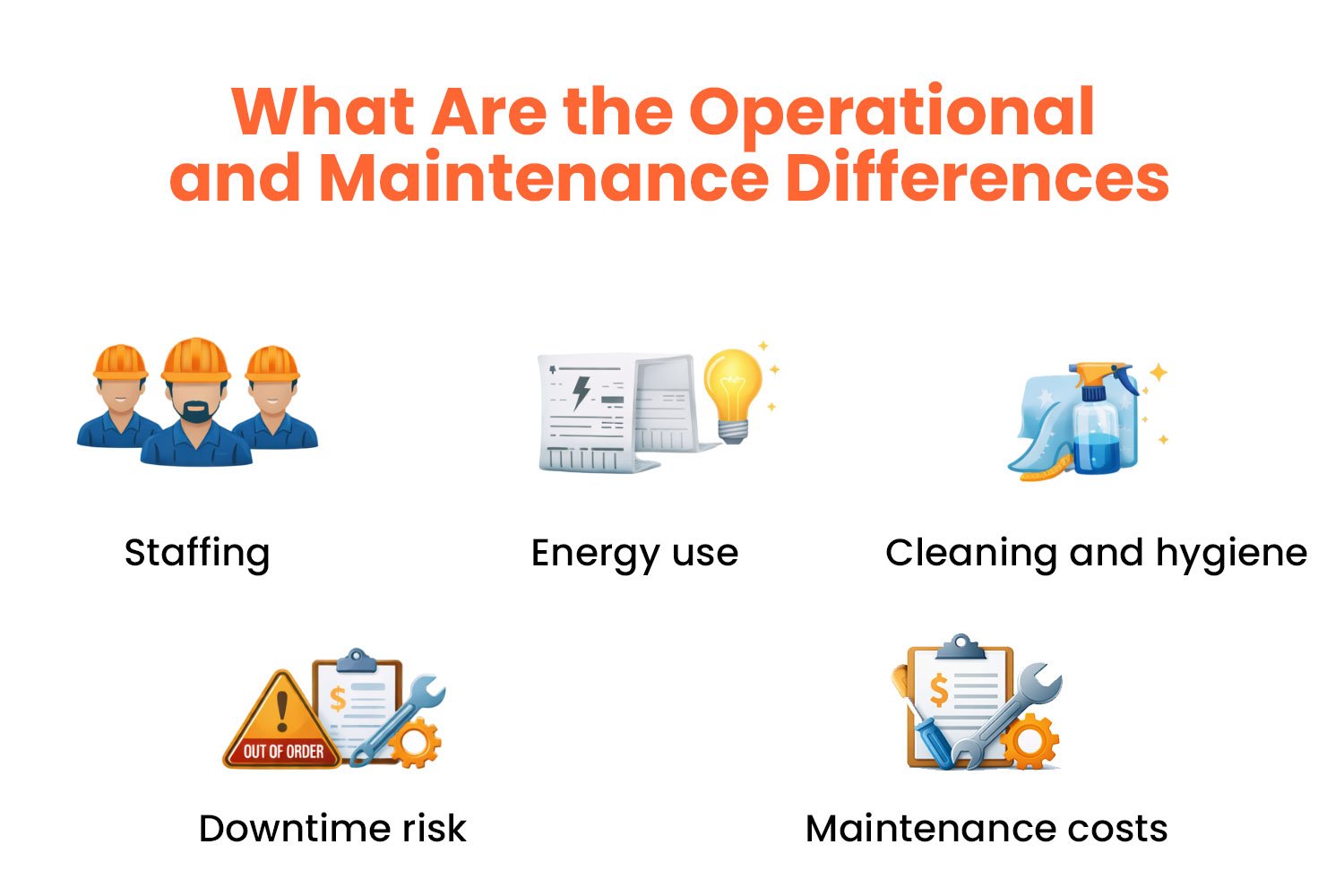
- Staff members change their work: According to their current ability to handle their tasks. An operator with basic skills can handle a 50 Kg machine with either one or two operators. The 200 Kg setup requires three trained people to maintain roasting operations while preventing any mistakes.
- Energy usage patterns exhibit identical behaviour: The semi-automatic makhana-making machines use less electricity which results in stable electricity expenses. The fully automatic makhana production machines require higher electricity consumption which creates additional costs for each production cycle.
- Cleaning and Hygiene: The cleaning process for a 50 Kg machine can be completed on a daily basis with minimal effort. The cleaning process for a 200 Kg machine requires more time because all parts of the machine need to be cleaned. The cleaning process needs to address all areas because even one missed spot will lead to residue problems.
- Equipment downtime increases: The higher-capacity machines become more vulnerable to errors that operators make or faults that occur. The production process incurs higher repair expenses while operational downtime results in increasing production losses.
- Maintenance expenses: The small-scale roasted makhana machine requires only a few parts to be replaced throughout its entire operational period. The industrial roasted makhana machine needs both planned maintenance work and ongoing maintenance expenditures which exceed general maintenance requirements.
Space and Power Requirement for 50 Kg vs 200 Kg Roasted Makhana Machine
| Requirement | 50 Kg Machine | 200 Kg Machine |
|---|---|---|
| Floor Space | 100–150 sq ft | 300–500 sq ft |
| Power Load | 12–15 kW | 30–45 kW |
| Ventilation Capacity | 500 CFM | 1500+ CFM |
| Phases Required | 1 Phase | 3 Phase |
| Operators Needed | 1–2 | 3–4 |
| Backup Power Size | 3–5 kVA | 10–15 kVA |
| Extra Infra Cost | Low | ₹2–5 Lakh |
The key tip indicates that 50 Kg functions as a startup solution, which requires 200 Kg to undergo a pre-site audit because it will lead to ₹2-5L infrastructure costs. All backup power systems need to be planned because both systems must meet FSSC requirements.
ROI Comparison: 50 Kg vs 200 Kg Roasted Makhana Machine
Startups use ROI calculations as their method to determine business value. It shows whether your numbers make sense before cash starts leaking.
- The 50 Kg Roasted Makhana Machine achieves break-even within a shorter period because its lower investment requirement. The window for most local and regional setups extends between six and nine months.
- The 200 Kg Roasted Makhana Machine requires a period of twelve to eighteen months before it can recover its full operating expenses. The payoff comes later.
The company must monitor its daily output together with current makhana market prices and its energy expenses and workforce costs and packaging expenses and production interruptions. Startups use demand planning as their primary factor to assess ROI while machine size remains less important.
Final Verdict: Should You Buy a 50 Kg or 200 Kg Roasted Makhana Machine?
Choosing between a 50 Kg vs 200 Kg Roasted Makhana Machine comes down to scale, budget, and how ready you are to grow. There’s no one right answer, only the right fit. At Foodsure Machines, we work with startups from day one to make that decision practical, not theoretical. That means clear guidance, honest capacity planning, and solutions that match where your business actually stands today.
FAQ
1. What is the difference between a 50 kg and 200 kg makhana machine?
A 50 Kg machine for roasting makhana is a good small batch steady machine, while a 200 Kg roasted makhana machine is a big-batch, high-production, big machine.
2. Which is better: 50 kg vs 200 kg makhana roasting machine for beginners?
The 50 kg machine is preferred by beginners who want to roast makhana because they want to use the 50 kg machine as their first equipment. The equipment provides a lower price and simpler operation while allowing users to acquire skills before they advance to more complex tasks.
3. What is the 200 kg makhana roasting machine investment cost?
The 200 kg makhana roasting machine investment cost typically ranges from ₹12 to 15 lakh. The final price of the 200 Kg roasted makhana machine depends on three factors which include its automation level and heating system and complete equipment design.
4. Is a 50 Kg roasted makhana machine profitable for startups?
Yes, a 50 Kg roasted makhana machine allows your business to expand steadily because it maintains operational costs at a level which allows for growth until you reach the 200 Kg roasted makhana machine.
5. How much production can I expect from a 50 kg vs 200 kg makhana roasting machine?
The 50-kilogram makhana roasting machine can only produce enough daily output to meet the requirements of local sales. A 200 Kg roasted makhana machine produces significantly more, which only works if your market can absorb it.
6. Who should invest in a 200 kg makhana roasting machine?
The 200 kg makhana roasting machine becomes cost-effective for businesses with verified bulk orders because the machine decreases their expenses when producing larger quantities of roasted makhana.
7. What space is required for 50 kg vs 200 kg makhana roasting machine?
Space planning shows the difference between 50 kg and 200 kg makhana machine setups which require different setups. A 50 Kg roasted makhana machine fits into compact production areas, while a 200 Kg roasted makhana machine needs a larger, well-organised layout.
8. Does the 200 kg makhana roasting machine investment cost include installation?
The 200 kg makhana roasting machine investment cost includes basic installation work, but the electrical upgrades and layout modifications required for the 200 kg roasted makhana machine installation will incur additional costs.
9. Can I upgrade from a 50 Kg roasted makhana machine later?
Absolutely. The majority of businesses start their operations with a 50 Kg roasted makhana machine which they replace with the 200 Kg roasted makhana machine when their business needs become predictable.
10. How do I choose between 50 kg vs 200 kg makhana roasting machine?
You should allocate machine resources according to current customer needs. The 50 kg vs 200 kg makhana roasting machine decision should be based on budget, available space, and confirmed sales volume.