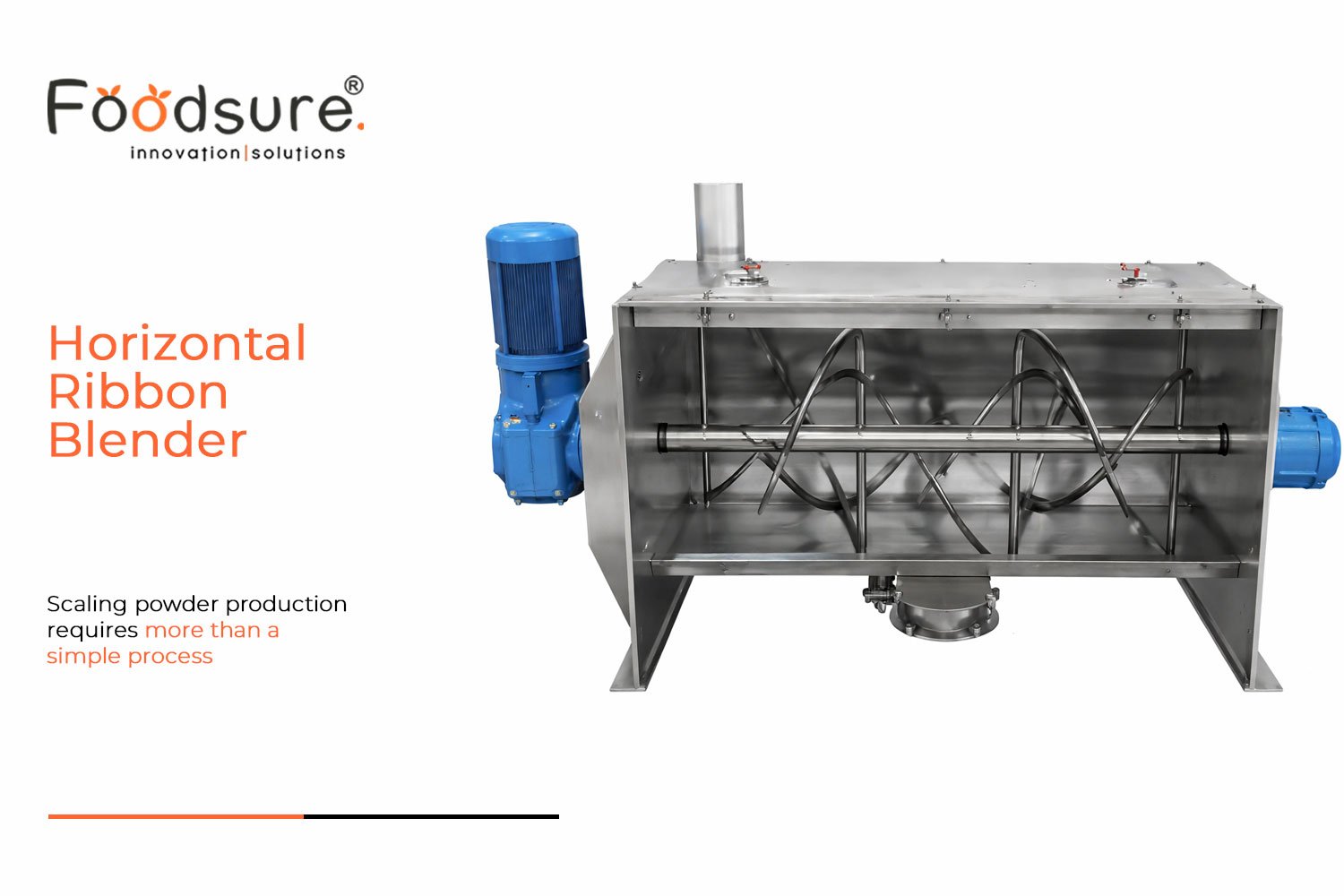
Scaling powder production requires more than a simple process because it involves a fundamental change to physical laws. The common practice among manufacturers to grow their production capacity by increasing their batch size results in three major challenges; first, they experience higher energy expenses, second, their product quality becomes unstable, and third, their operations become less efficient.
The efficiency of standard mixers breaks down at their maximum capacity because they cannot produce uniform outputs. The horizontal ribbon blender operates as the engineering standard for large powder mixing because it uses bulk processing difficulties to its operational advantage. The system uses a counter-current axial flow mechanism which maintains continuous particle movement and achieves high blend uniformity results through its ability to remove all dead zones.
The blog will demonstrate how a horizontal ribbon blender operates which makes it more effective than traditional industrial mixing systems. The analysis will show different advantages of the system which include benefits to capacity, uniform product distribution, and reduced energy use. The ribbon mixer machine shows applications for food production and pharmaceutical manufacturing and chemical processing.
How a Horizontal Ribbon Blender Machine Works in Industrial Powder Mixing
The performance optimization of a Horizontal Ribbon Blender requires engineers and plant managers to concentrate on certain mechanical attributes. The following section provides a detailed technical analysis of essential components that determine effective mixing performance at high operational capacities.
Technical Specifications & Performance Markers
- Double-Helical Agitator Precision: The design of both the inner and outer ribbons includes two different pitch directions. The Outer Ribbon generates centripetal forces which direct material movement toward the center point, whereas the Inner Ribbon establishes axial flow which moves particles to the outer ends of the system.
- Optimal Trough Clearance: The efficiency of operations depends on the distance between the ribbon edge and the U-trough which serves as an essential “pointer” measurement. The system requires a precise clearance range between 3mm and 5mm because this range prevents material accumulation and “blind spots” while reducing frictional heat.
- Loading Ratios (Fill Factor): The system reaches its maximum efficiency when the fill level stays between 40% and 70% full. The ribbons will not achieve full material contact when operating below 30% while overfilling beyond ribbon tips will result in convective flow stoppage.
- Coefficient of Variation (CV): High-tier industrial ribbon blenders aim for a CV of less than 5%. This metric serves as the gold standard for demonstrating batch-to-batch consistency which regulated industries like food and pharmaceuticals require.
- Sealing Technology: The Air-Purged Gland Seals offer superior performance for large-scale powder mixing applications when compared to standard stuffing boxes. The system operates by preventing fine particles from entering the bearing housing area, which extends machine operational life while decreasing maintenance requirements.
- Discharge Efficiency: The combination of a Pneumatic Slide Gate with a Flush-Fit Plug Valve system guarantees complete trough emptying, which prevents cross-contamination between various batches.
The Physics Advantage: Why Horizontal Ribbon Blender Outperforms at Scale
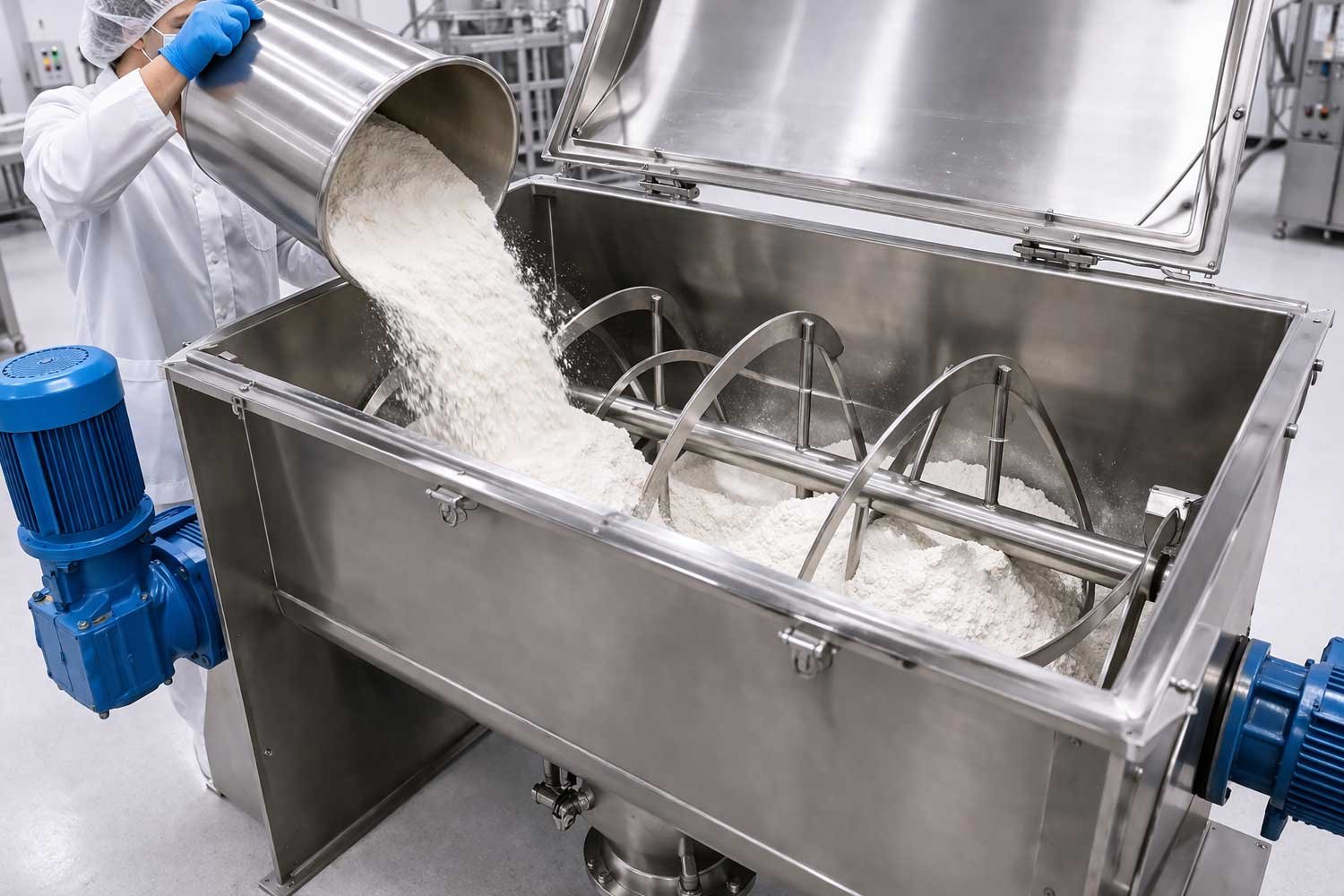
The Horizontal Ribbon Blender shows mechanical superiority because its operational system depends on convective displacement which uses physic principles. The ribbon agitator creates a shear-to-bulk ratio which keeps material suspension in contrast to tumble mixers which depend on gravitational forces.
1. Axial + Radial Flow Eliminates Dead Zones
The axial movement creates high-velocity cross-currents that prevent the strata effect, where heavier particles settle. The machine uses a peripheral tip speed of 70-100 meters per minute to create sufficient energy which achieves 99% homogeneous blending without generating frictional heat that causes material caking.
2. Optimized Load Factor (40–70% Fill Efficiency)
The material remains beneath the outer ribbon top at this particular load factor which creates a rolling effect that enhances particle contact. The system delivers results through:
- Higher usable volume per batch.
- Reduced cycle frequency for better ROI.
3. The system achieves balance through
A low-RPM, high-torque configuration ensures that even high-density bulk loads are processed without mechanical strain. The system operates standalone through its combination of gentle agitation and powerful displacement system which enables it to keep granule structure intact during industrial production.
Capacity & Throughput of a Horizontal Ribbon Blender for Industrial Demand
The Horizontal Ribbon Blender system operates in high-capacity settings after developing its ability to process heavy materials without decreasing its ability to produce torque. The manufacturing process achieves better quality control results because it combines several small production runs into one large production process which decreases the inter-batch variance problem that usually causes quality control issues.
Batch Capacity Range
| Machine Size | Working Capacity | Typical Use Case |
|---|---|---|
| 500–1000 L | 200–600 kg | Pilot plants / niche specialty lines |
| 2000–5000 L | 800–3000 kg | Mid-scale food & chemical production |
| 10,000–30,000 L | 4–20 tonnes | High-volume industrial plants |
Impact on Operations:
- Fewer batches per shift: The process of combining different production elements results in time savings because it reduces the duration needed for loading and cleaning operations.
- Lower labor cost: The use of automated pneumatic systems for feeding and discharging processes in large-scale blenders requires less manual work from operators.
- Higher production throughput: The 5000L unit achieves its capacity to process more than 10 tonnes of materials per shift because it operates at cycle times which regularly stay below 15 minutes.
A ribbon blender machine for food factory setups is specifically designed with a U-shaped trough that facilitates a first-in, first-out discharge flow. The design enables the machine to operate at 20-tonne capacities because it produces a coefficient of variation (CV) < 5% while using less energy to process materials compared to multiple smaller mixers.
Energy Efficiency of Horizontal Ribbon Blender: Low Power, High Output Performance
The industrial scaling process uses Specific Energy Consumption to measure its financial success because this metric tracks the energy needed to process one tonne of material. The Horizontal Ribbon Blender performs best because its agitator design achievesmaximum materialdisplacementwithminimal drag coefficient. The ribbon blender achieves an efficient operation because it utilizes mechanical advantage to produce high torque-to-volume ratios while operating at reduced kilowatt power.
Typical Energy Comparison (1000L Batch)
| Mixer Type | Power Consumption | Mixing Time | Cost Efficiency |
|---|---|---|---|
| Ribbon Blender | Low (7.5–11 kW) | 10–15 min | High |
| Paddle Mixer | Medium (11–15 kW) | 12–18 min | Medium |
| Tumble Blender | Low (5.5–7.5 kW) | 20–30 min | Medium |
| High-Shear Mixer | High (22–37 kW) | 5–10 min | Low |
Key Insight:
- Optimal Energy Balance: Ribbon blenders achieve their optimal energy balance because they reach 99% homogeneity without experiencing energy surges which high-speed dispersers create. This makes them the goldilocks solution for manufacturers who need speed without a massive utility footprint.
- Reduced Thermal Load: The agitator generates less heat because it operates at a lower tip speed which decreases its kinetic energy output. This process becomes essential for temperature-sensitive food powders because energy waste results in product quality loss.
- Ideal for Continuous Operations: The machines maintain 24/7 operational capacity because their gear-drive system experiences low mechanical stress which requires only basic cooling needs. This operational method results in lower Total Cost of Ownership (TCO) expenses.
Horizontal Ribbon Blender Machine: One Solution for Multiple Powder Mixing Applications
Engineers can adjust the machine’s metal components and its protective systems according to the specific material characteristics which they need to work with. The process of customization requires more than additional equipment because it needs to improve the interface between surfaces and products which will provide both security and prolonged functionality.
For Food Processing
- SS304 / SS316 construction: The use of high-grade austenitic stainless steel protects against organic acid corrosion damage.
- Mirror polish (low Ra value): The surface treatment maintains a maximum surface roughness of 0.8 microns which prevents any bacterial development within the tiny cracks of the surface.
- CIP (Clean-in-Place) systems: The system includes spray balls which create a complete 360° sanitization coverage between production cycles.
- Dust-tight seals: The system uses Teflon-braided packing and air-purged seals to create an environment which prevents any leaks from occurring.
For Chemicals
- Abrasion-resistant liners: Chemicals require abrasion-resistant liners which use hardened steel or polymer coatings to protect against damage during the processing of silica and minerals and abrasive pigments.
- Heavy-duty ribbons: Increased blade thickness and reinforced spokes to handle high bulk density materials.
- Explosion-proof motors: ATEX/IECEx certified drives for environments with combustible dust or volatile vapors.
For Pharmaceuticals
- GMP-compliant design: Strict adherence to good manufacturing practices with easy-access disassembly for inspection.
- Crevice-free welding: Full-penetration, ground-smooth welds (radius corners) that eliminate cross-contamination traps.
- Validation-ready structure: Machines designed to pass rigorous IQ/OQ/PQ (Installation, Operational, and Performance Qualification) protocols.
Discharge and Cleaning Efficiency in Horizontal Ribbon Blender: A Hidden ROI Driver
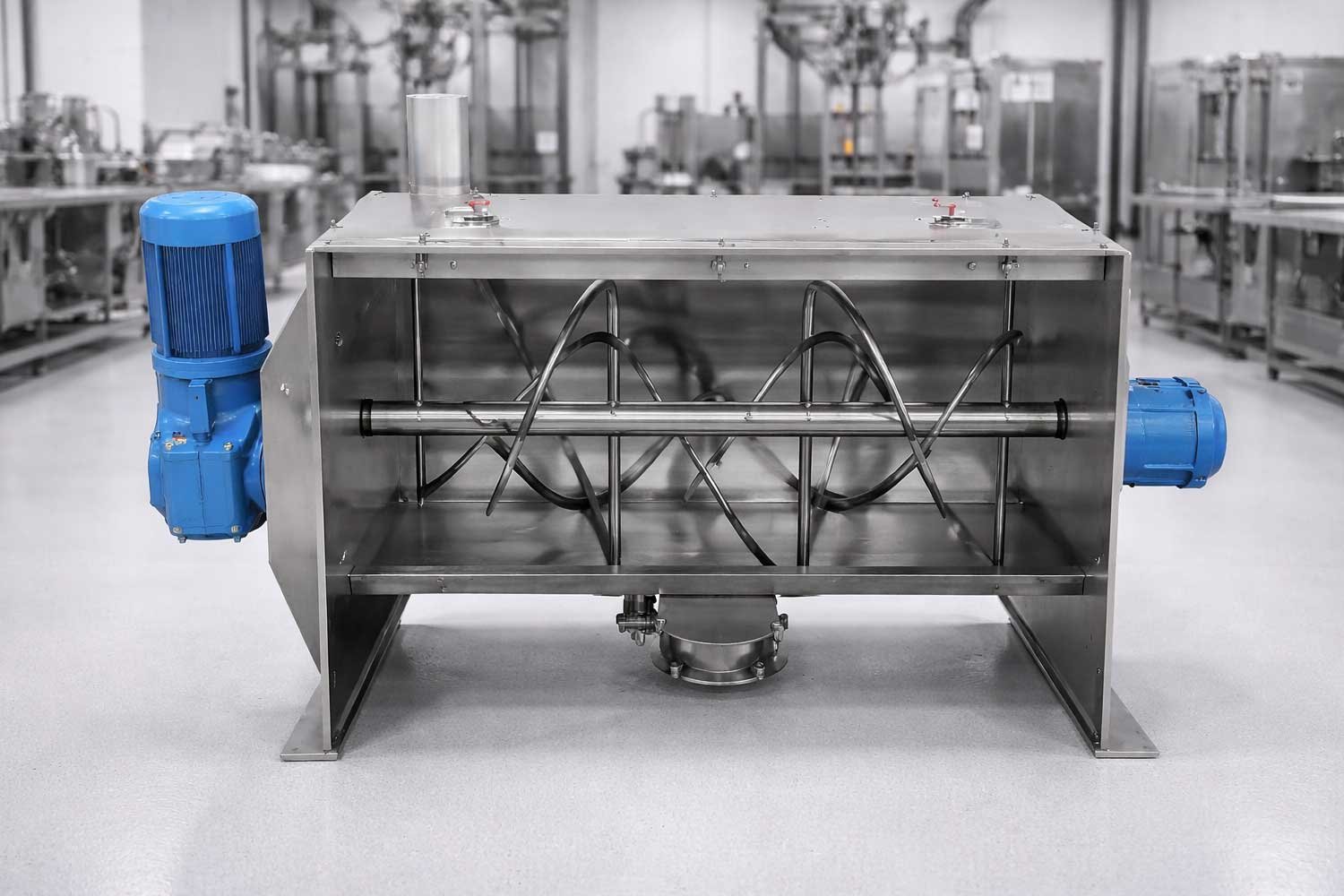
The actual expenses of a mixer in high-volume production environments emerge from the leftover material which remains after each operational cycle. The Horizontal Ribbon Blender reduces waste production through its exact vessel-to-blade clearance operation which usually maintains a 3mm to 5mm setting. The system achieves material recovery through its design which uses outer ribbons as mechanical scrapers to direct particles into the discharge area.
The Physics of Product Recovery
The horizontal U-trough system uses gravitational force together with outer ribbon centrifugal force to move materials because vertical mixers allow materials to stick to their side walls.
- Full-length bottom discharge valves: The discharge neck dead pockets problem gets resolved by using either Pneumatic Slide Gates or Flush-Fit Plug Valves.
- 99–99.5% product recovery: High recovery rates result in reduced manual scraping work while increasing the amount of sellable products that can be obtained from each batch.
Operational Benefits:
- Reduced product wastage: A 0.5% recovery improvement for high-value ingredients results in annual raw material savings that reach thousands of dollars.
- Faster batch turnaround: The system achieves rapid “dry-cleaning” and pneumatic air-purge operations because it retains minimal residue.
- Lower cross-contamination risk: The smooth design of radius-corner welding prevents allergen traps which help maintain FSSAI and ISO audit compliance.
Conclusion
An effective option for providing all of these characteristics is the horizontal ribbon blender. The horizontal ribbon blender is the most efficient equipment for providing consistent, uniform mixing, minimised energy consumption and maximised throughput in all industries.
At Foodsure Machines, we recognise the need to solve problems that arise during production and develop systems to relieve operational difficulties. Our ribbon blender equipment is purpose-built and designed for maximum longevity, accuracy, and return on your investment (ROI). If you want to grow your business with confidence, we provide you with the experience necessary to produce a consistent, high-quality product using our industrial ribbon blenders for bulk powder mixing.
Scaling Up Powder Mixing Production?
Choose the right ribbon blender for higher capacity, faster mixing cycles, and consistent large-batch output.
FAQ
Q1. What is an industrial ribbon blender used for?
A ribbon blender used in manufacturing is designed to uniformly mix solid powders that are produced as bulk products.
Q2. How does a ribbon mixer machine improve mixing efficiency?
A ribbon blender uses two ribbons wound around a shaft to provide constant product flow during the mixing process for effective, rapid, and uniform blending.
Q3. Is a ribbon blender suitable for bulk powder mixing?
Yes, A blender for bulk powder mixing (a ribbon style) was an appropriate choice because it has very large mixing capacities but maintains a high degree of uniformity with minimal off-specification product. So they work well for mixing large amounts of powder.
Q4. Can a ribbon blender machine be used in food factories?
For ribbon blenders used in the food factory sector, they are made of stainless steel and conform to FDA requirements for hygienic processing.
Q5. What industries commonly use ribbon blender machines?
A variety of industries utilize ribbon blenders, including food, pharmaceutical, chemical and animal feed production.