The food processing industry in India has reached a critical stage of planned development. The production of textured soya protein operates at a point where two strong market forces meet because institutional clients demand more products while mid-sized distribution networks have not yet reached their full market potential. This blog delivers a complete financial analysis framework that enables investors and operators to assess their capital expenditures based on its detailed cost analysis, which includes soya chunk plant designs and equipment choices, and their financial returns for three different production capacities to create an investment decision soy chunk production line that provides trustworthy investment knowledge about the food manufacturing sector, which shows strong fundamental operations in India.
Total Investment Framework for Soya Nugget Manufacturing Plant Setup Cost in India
In order to build a cattle feed plant by 2026, two major parts of strategic management will be necessary to appropriately manage the investment’s overall cost. Those two parts are Automation Costs and Raw Material Management Costs. While you have an excellent foundation for your initial framework, thorough analysis confirms that the actual cost drivers for this TVP plant setup cost are now predominantly linked to two major factors: most energy-efficient operational methods and high-quality output with precision mixing.
The invested funds to create this TVP plant setup cost, as of 2026 and beyond, also reflect current inflation rates based on 2026 market activity (GST will affect the machinery by 12%-18% range), and that the use of smart sensors for quality control (as reported by the Smart Sensor Institute) is becoming standard practice as part of a modern operation.
2026 Investment Deep-Dive
| Component | Small (100–200 kg/hr) | Medium (500–1,000 kg/hr) | Large (3–5 TPH) |
|---|---|---|---|
| Smart Machinery | ₹12–18 Lakhs | ₹40–70 Lakhs | ₹1.5 – ₹3 Cr |
| Infrastructure | ₹5–10 Lakhs | ₹20–40 Lakhs | ₹60 Lakhs – ₹1.2 Cr |
| Working Capital | ₹10–15 Lakhs | ₹30–50 Lakhs | ₹1.5 – ₹3 Cr |
| Total (Est.) | ₹27–43 Lakhs | ₹90 Lakhs – ₹1.6 Cr | ₹3.6 – ₹7.2 Cr |
- The Technology Shift: Ring Die mills have replaced Flat Dies in medium scales because they use 30% less power than Flat Dies do.
- PLC Automation: Precision batching is standard because a 1% error in additives will ruin a batch that costs ₹2 Lakh.
- Vertical Setup: Large plants now use vertical gravity-flow designs, which reduce conveyor expenses but require higher civil construction costs.
- Subsidies: Programs like AHIDF can provide a 3% interest subvention, which makes the high entry cost manageable.
Key Machinery Configuration for Soya Chunk Plant Cost in India (Output & Quality Focus)
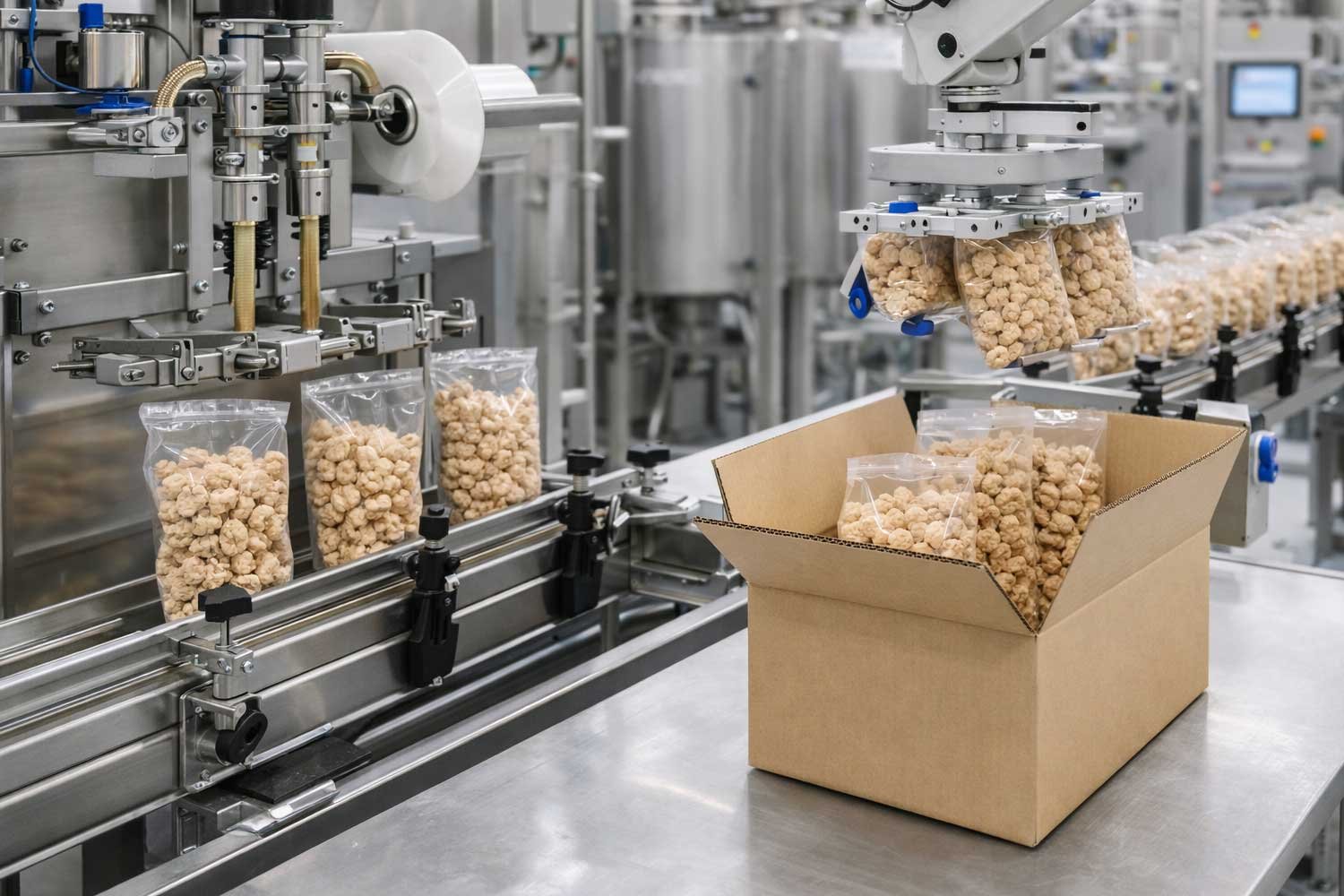
- Twin-Screw Extruder: The critical variable. The 2026 models will use IoT-enabled torque sensors as their standard equipment for preventing “burning” the soy flour. The texture changes from fibrous to spongy when your screw speed reaches a 5% deviation from its normal value.
- The Dryer Bottleneck: The multistage Belt Dryer system outperforms Tray dryers because it maintains constant moisture levels, which do not exceed 10%. The drying process creates uneven conditions, which result in internal mold growth that destroys products within weeks.
- Thermal Control: A Boiler with high-pressure steam capability (140- 160 °C) is necessary for complete soy protein denaturation because the product will taste beany and raw without it.
- Cooling Stabilization: The process of stabilizing cooling soy chunk production line needs to happen because packaging moisture creates the most favorable conditions for bacteria to grow in soya chunks.
The Decision Matrix (2026 Reality)
- Extruder (The Quality Engine): The Twin-Screw setup is mandatory for high-protein fibers. If the extruder fails to maintain a steady temperature of 150-170 °C, the protein won’t cross-link, resulting in a product that dissolves when cooked.
- Dryer (The Profit Guard): The Profit Guard system identifies profit loss and profit preservation. Drying processes that operate inefficiently create hot spots, which result in moisture pockets. A 3-pass Belt Dryer ensures a consistent 8-10% moisture level. Anything higher leads to fungal growth; anything lower makes the product brittle and dusty.
- Packaging (The Silent Salesman): In 2026, consumers demand Nitrogen Flushing (MAP). This process extends product shelf life from three months to twelve months because it prevents soy residual fats from becoming rancid through oxidation without using chemical preservatives.
How Production Capacity Impacts Soya Chunk Plant Cost in India & Investment Efficiency
The Goldilocks Zone requires a capacity of 250 kg/hr because it delivers both dependable industrial performance and acceptable operating expenses. The 250 kg/hr soya chunk making machine provides automatic drying operations through its continuous loop system, which decreases operational expenses and human mistakes while operating at full capacity.
Efficiency Deep-Dive
- The ROI Spot: At 2 tons/day, your fixed costs, which include electricity and rent, licenses, will be distributed across a volume that enables your per-kg price to match national brands, but your volume remains insufficient for national distributors to purchase.
- Operational Stability: A PLC-controlled soya chunk making machine becomes essential because this scale requires it. The industry standard for 2026 requires real-time moisture-on-the-fly sensors at this level, which stop 15% of waste that occurs in manual systems that operate at smaller capacities.
- Market Agility: It is the minimum viable scale for white labeling. The large retail chains that search for regional partners refuse to consider plants that operate below 2 tons per day because these plants cannot maintain a consistent supply.
Strategic Scale Insights
- 100 kg/hr (Mini soya chunk plant): The Pilot Scale works best at 100 kg per hour for Fresh Loose local markets. The main risk here is inconsistent texture; without high-end automation, every batch might feel different, making it hard to build a premium brand.
- 250 kg/hr (The Efficiency Sweet Spot): This is where you can afford Continuous Belt Dryers instead of Tray Dryers. The soya chunks making machine reduces labor requirements by 60% through a single switch, which also decreases drying time to 50% while enabling operations to continue throughout the day when demand increases.
- 500 kg/hr (The Industrial Powerhouse): Required for Institutional & Export Sales. International buyers in the UAE or Europe demand system consistency (ISO/FSSC 22000), which becomes financially feasible only when your production level meets the expense of automated quality sensors and clean-room packaging.
Soya Chunk Plant Setup Cost in India: Medium Plant Monthly Cost Structure Explained
The OPEX (Operating Expenditure) for a medium-scale soya nugget plant is heavily influenced by energy costs and raw material grade. While defatted soy flour (DSF) is the primary cost, the efficiency of your specific energy consumption (SEC) determines your final margin in a competitive market.
Advanced OPEX Structure (Monthly Analysis)
| Expense Head | Monthly Cost (₹) | % of Total |
|---|---|---|
| Raw Material (DSF + Fortificants) | ₹6,00,000 – ₹8,50,000 | 62% |
| Energy (Grid + Steam/Boiler) | ₹1,80,000 – ₹3,50,000 | 18% |
| Labor (Skilled/Semi-Skilled) | ₹1,20,000 – ₹2,20,000 | 9% |
| Packaging (Multilayer/MAP) | ₹1,00,000 – ₹2,00,000 | 7% |
| Maintenance & Consumables | ₹60,000 – ₹1,20,000 | 4% |
| Total Monthly OPEX | ₹10.6L – ₹17.4L | 100% |
Strategic OPEX Pointers
- The Energy Variable: The Extruder and Dryer combination operation at the plant will use 85% of its total energy consumption. The extruder motor operating with a VFD Variable Frequency Drive system will produce a 15-20% reduction in electricity expenses.
- Yield Loss: Actual data demonstrates that the extrusion process results in a 3-5% hidden expense, which includes fines, dust and moisture loss. Advanced plants recapture this dust to re-process, which enables them to save approximately ₹30,000 every month.
- Trends In Enhancement: The specification for producing high-quality nutritional retail items includes the addition of vitamin B12 or iron-based supplements that are produced at a cost of about ₹0.50 per kg.
- Management: Cleaning and Maintenance of double-screw barrels is more specialized than most other types of barrels because, if they are dirty, the additional torque creates a higher risk of torque overload, resulting in a repair bill of ₹4 Lakh.
Revenue & Profitability Model in Soya Chunk Plant Setup Cost in India
The profitability and revenue model is built on the texture premium because the company sells its product at a cost of ₹90/kg to be a part of the bulk commodity markets, while needing High-PDI (Protein Dispersibility Index) extrusion to mimic meat fibers to attain a targeted sale price of ₹120/kg. The net profit of the company is based on Yield Efficiency in this case; therefore, if the fines (dust) produced from the drying process decrease by 5%, this will result in a loss of ₹40,000 on the bottom-line profit for the month.
Revenue & Profitability Model (2026 Benchmarks)
Production Assumption
- Daily Output: 500 kg (8-hour shift)
- Monthly Volume: 13,000 kg (26 Working Days)
Revenue Calculation
- Selling Price: ₹95–130/kg (Branded/Fortified)
- Monthly Revenue: ₹12.3 Lakhs – ₹16.9 Lakhs
Profitability Pointers
- Value Addition: The process of fortifying with Vitamin B12 and Iron, together with the 2026 trend costs ₹0.60/kg while enabling a ₹10/kg retail price increase.
- The Invisible Loss: Moisture shrinkage and dust loss create an invisible loss that consumes 4% of raw materials. The most efficient method to enhance net revenue by 2-3% involves using cyclonic dust collectors to decrease this loss.
- Energy Hedge: At this operational level, power represents 18% of total expenses. The implementation of VFDs on the soya extruder machine results in a production cost reduction of almost ₹2/kg.
Soya Chunk Plant Setup Cost in India: Compliance & Regulatory Cost Breakdown
India has implemented a new food safety inspection and licensing system that is based on risk, providing a perpetual license to businesses once they pass an annual safety inspection and comply with safety standards that were set forth by the Food Safety and Standards Authority of India (FSSAI).
Compliance & Regulatory Cost
Mandatory Licenses & Setup
- FSSAI License: State FSSAI License: Revised annual turnover threshold for obtaining a State License is ₹1.50 Cr – ₹50 Cr (license fee ₹2,000-₹5,000).
- Pollution Prevention Control (NOC): All food processing units must apply to the Pollution Control Authority for permission to operate in an Orange or Green category. The cost of the NOC will range from ₹10,000-₹30,000, depending on the total capital cost of the manufacturing facility.
- GST/Udyam registration: Udyam registration and GST registration are both free or nominal costs to the business; however, both are important to qualify for the interest subsidy of 3% (assuming being an MSME).
Operational Compliance & Testing
- Food Hygiene Zoning: A physical separation from the raw material storage (soya flour) and clean processing area (extrusion and packing) will eliminate the risk of cross-contaminating the product.
- Laboratory Testing: Mandatory laboratory testing will cost ₹2,000 – ₹5,000 for each six-month testing period for protein, moisture, ash, and aflatoxin levels.
- Material Integrity: The facility is required to maintain a copy of the MTC (manufacturer’s test certificate) for all food contact components made of SS304 to be compliant in 2026.
Total Initial Compliance Budget: ₹70,000 – ₹1.2 Lakhs.
Key Pointer: Under the 2026 rules, a single major non-compliance in moisture levels (10%) can trigger an immediate computer-assisted risk inspection, increasing your audit frequency from once every 2 years to every 6 months.
How to Select Plant Scale in Soya Chunk Plant Setup Cost in India
The selection of a soya processing machine scale is no longer just about budget; it is a choice between Market Agility and Operational Excellence. FSSAI adopted risk-based inspections, while the demand for high-protein meat-mimic textures has created a technology divide between small and medium-sized enterprises.
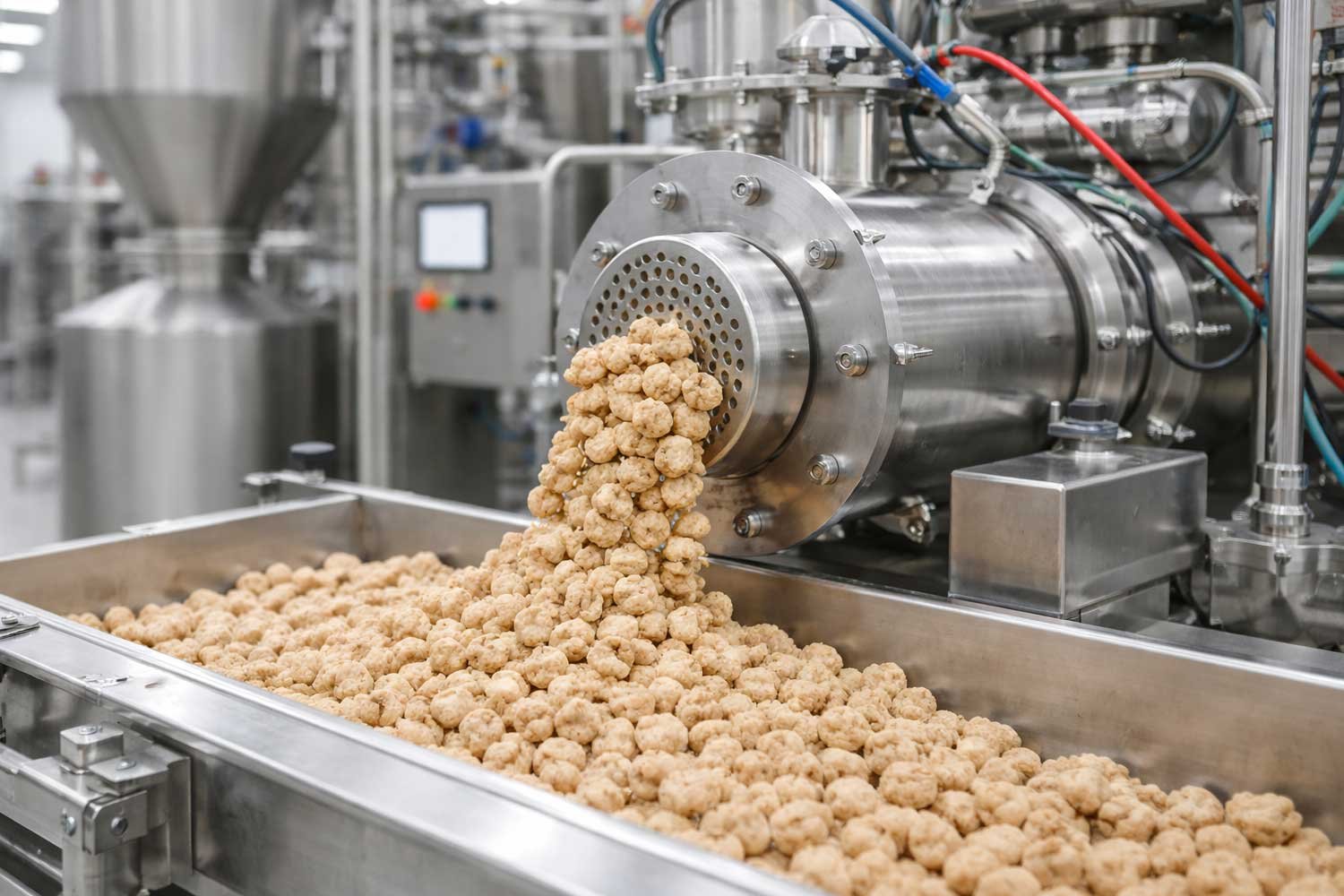
Scale Selection Strategy (Decision Framework)
Mini soya chunk plant (100 kg/hr)
- Budget: < ₹30 Lakhs (All-in).
- Strategy: Hyper-local distribution or loose mandi sales where branding is secondary.
- Risk: High labor dependency and manual moisture control may lead to 15% batch inconsistency.
Medium Plant (250 kg/hr)
- Budget: ₹65 Lakhs – ₹1.3 Cr.
- Strategy: Targeting regional distributors and E-commerce (Quick Commerce) private labels.
- Advantage: Best ROI. Justifies a Twin-Screw Extruder and Automated Belt Dryer, which reduces operational expenses by 40% when compared to smaller equipment.
Large Plant (500 kg/hr+)
- Budget: > ₹2.5 Cr.
- Strategy: FSSC 22000 certified export focus or Tier-1 FMCG contracts.
- Requirement: Industry 4.0 features (IoT torque sensors and PLC recipe management) are mandatory to meet international quality audits.
Conclusion
The cost of a properly built soya chunk plant in India will affect your profit, your ability to expand, and how competitive you are in the marketplace. Having the proper number of machines at the correct level of working efficiency will be the determining factor for the long-term success of your business.
At Foodsure Machines, we have made it our mission to provide precision-engineered equipment that helps you produce the maximum possible output while lowering production costs per kg. We work with our manufacturing partners to develop optimum layouts for the plant and to recommend machines based on actual production needs.
Want Exact Plant Cost & Machinery Details?
Get a complete cost breakdown, machine list, and production capacity plan for your soya chunk manufacturing plant in India.
✅ Detailed Investment Plan
✅ Machine Configuration Guide
✅ ROI & Capacity Planning
FAQ
What is the total soya chunk plant setup cost in India for small-scale units?
In India, the typical investment needed to start and operate a small-scale soya chunk manufacturing business is approximately between ₹15-30 lakh, depending on several factors, including machinery size, production output (rated capacity) and level of automation.
Which machinery is required for a soya chunk manufacturing plant in India?
The basic equipment required to set up a soya chunks production unit includes an extruder, dryer, mixer/cutter, and packets/containers.
What is the profit margin in soya chunks manufacturing business in India?
A return on investment (ROI) for a soya chunk manufacturing company is typically achieved within 12 to 18 months of commencing production operations.
How much space is needed for setting up a soya chunk production plant in India?
As a general rule of thumb, soya chunks are generally expected to provide gross profit margins of between 18-28% depending upon efficiencies and size of the operation.
What is the ROI period for soya chunk manufacturing plant setup in India?
To set up a soya chunk production unit requires an investment in physical space ranging from 800 sq. ft. to 3000 sq.ft. Depending on the business size, however, some companies may operate out of as little as 300 sq. ft. if their goal is to manufacture small batches of soya chunks per month or even daily.