The Industrial Powder Mixer requires proper selection, as oversized or undersized equipment can lead to operational problems. The majority of manufacturers select their equipment based on their current production volume, which leads to bottlenecks, broken mixing processes, and higher operating expenses during peak demand. The selection process requires more than basic capacity ratings because it involves matching production methods to material characteristics and throughput goals to develop an expandable production system.
The blog provides a framework for organisations to calculate their output needs, decide between batch and continuous production methods, select the appropriate mixer based on material properties, and determine industrial powder mixer capacity for their large-scale operations.
Output-First Approach for Industrial Powder Mixer Selection (Avoid Capacity Mismatch)
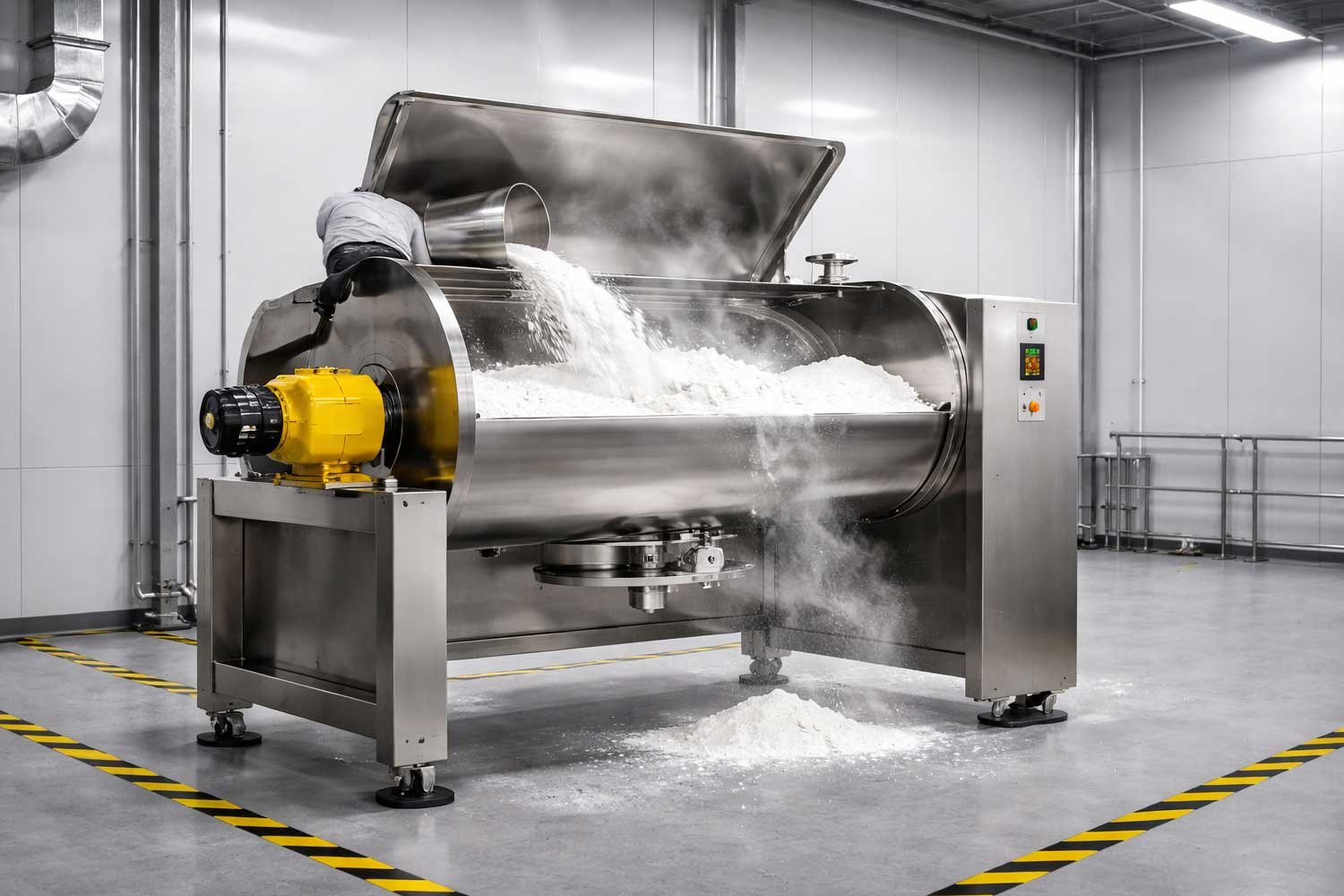
In an Output-First frame of reference, you have to stop thinking about the capacity of the machine and start thinking about the speed of the machine. When a mixer is chosen solely on the basis of tank volume, there will likely be bottlenecks if the cycle time (loading, mixing, discharging) is so slow that it cannot meet the daily target.
You are able to determine the required throughput by first calculating the required output. This will avoid a capacity mismatch, an oversized mixer is idle, or an undersized mixer is used on a continuous basis, causing an early mechanical breakdown and missed deadlines.
Formula: Required Output (kg/hr) = Daily Output ÷ Total Working Hours
Key Takeaways
- Throughput > Volume: A small and fast mixer will usually beat a large capacity industrial powder mixer and a slow mixer.
- The Hidden Cycle: Loading ingredients and cleaning not only contribute to the total time but also to the active mix.
- Buffer to Longevity: The safety margin of 20-30% takes into consideration the unexpected surges and avoids burning of the motor.
- Scalability: The equipment will be scaled to the demand of your store per hour, making the floor space and energy costs efficient.
Batch vs Continuous Industrial Powder Mixer Selection for Output Efficiency
Your choice between a batch powder mixer and a powder mixer for continuous production directly impacts throughput, labour utilisation, and scalability. The machine you select operates as a fundamental element that shapes your entire production system.
Core Difference: Cycle-Based vs Flow-Based Mixing
- Batch Mixing: Fixed quantity processed per cycle (fill → mix → discharge)
- Continuous Mixing: Uninterrupted material flow (feed → mix → discharge simultaneously)
Detailed Comparison Table (Decision-Critical Factors)
| Parameter | Batch Powder Mixer | Continuous Powder Mixer |
|---|---|---|
| Output Mode | 100–2000 kg/batch | 500–50000+ kg/hr |
| Throughput | 60–75% efficiency | 85–95% efficiency |
| Downtime | 10–25% | <5–10% |
| Flexibility | 80–100% | 20–40% |
| Recipe Control | 90–99% accuracy | 80–90% accuracy |
| Labour Requirement | 2–5 operators | 0.5–2 operators |
| Cleaning Frequency | Every 1 batch | Every 8–24 hrs |
| Scalability | 10–20% (per batch increase) | 30–100% (flow increase) |
| Space Utilization | 60–75% | 80–95% |
| Best Fit Output | 100–2000 kg/day | 2000–50000+ kg/day |
Capacity Planning for Industrial Powder Mixer: Think Beyond Today’s Output Demand
The Total Cost of Ownership (TCO) requires effective planning to achieve its optimal balance. An industrial mixer that is too large increases electricity costs and causes cleaning interruptions, while one that is too small results in continuous operational delays.
Strategic Pointers
- ROI Alignment: The capacity is synchronised with a 5-year forecast, which prevents falling into the trap of purchasing machines too soon.
- Operational Sweet Spot: Any equipment that operates at 70-80% load in normal demand must be targeted to permit peak surges.
- Cleaning vs. Scale: Heavy duty powder mixer require more time to clean; be sure to factor in more downtime in the growth plan.
- Modular Thinking: In case of uncertainty, there are two mid-sized mixers to think of, which are redundant instead of one huge mixer.
Example:
- Daily need – 8000 kg
- 8-hour shift – 1000 kg/hr
- Buffer – 12001500 kg/hr mixer required.
This guarantees a steady output even when the demand is at the peak level.
Hidden Throughput Drivers in Industrial Powder Mixer Performance
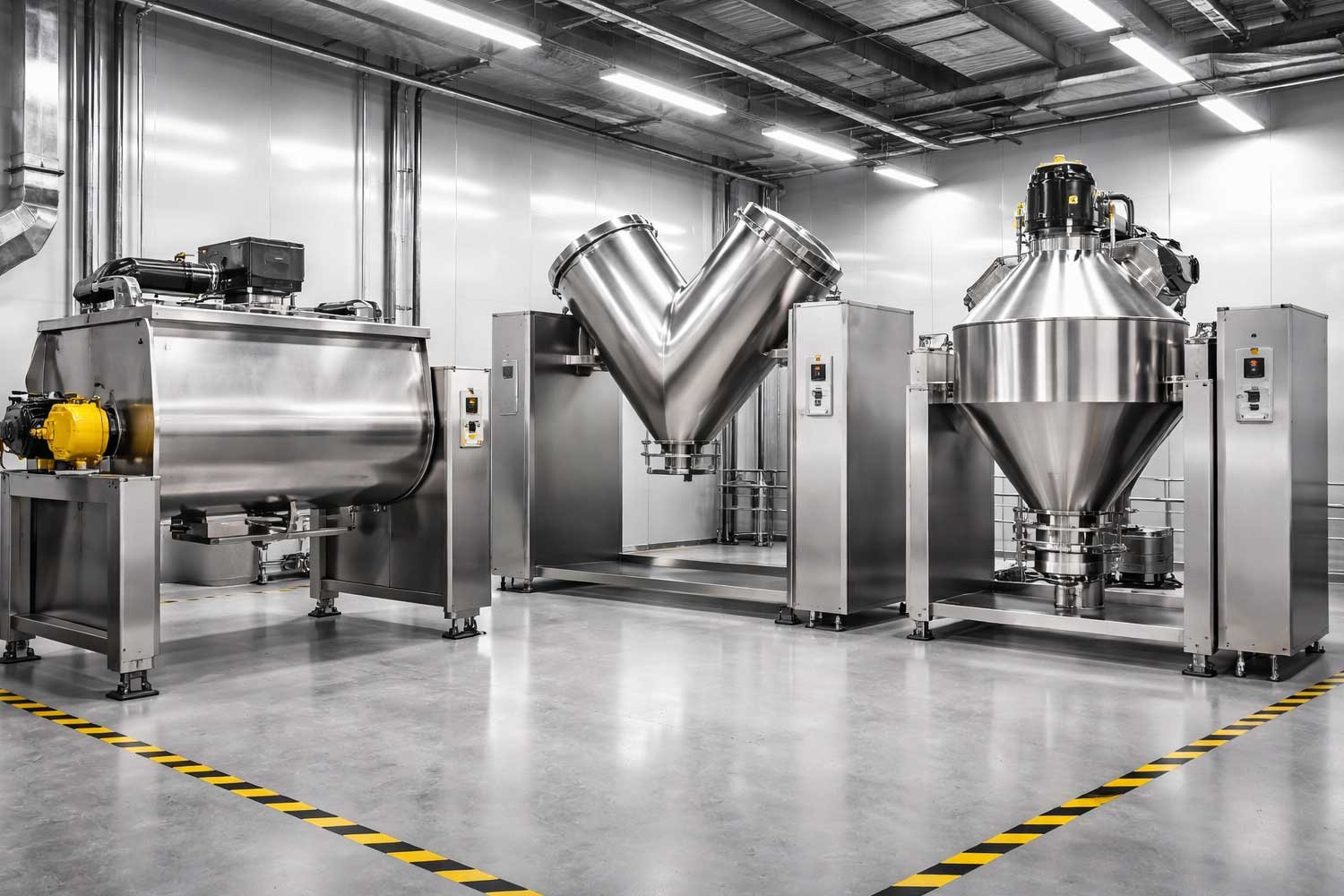
The Industrial Powder Mixer requires its core operating parameters to be optimised because even its highest capacity settings will fail to deliver proper performance. The actual output of a system depends on the efficiency with which it conducts each mixing process, not its equipment dimensions.
Key Output Drivers
- Fill Level (60–80%): Overfilling reduces mixing uniformity; underfilling wastes capacity.
- Mixing Time (5–20 min): Material-dependent; overmixing wastes energy, undermixing affects quality.
- Discharge Speed: Faster discharge reduces idle time and improves cycle frequency.
- Automation Level: The system reduces all manual work interruptions while maintaining uniform batch processing times.
ROI Impact of Industrial Powder Mixer Selection (Quantified Comparison)
| Factor | Poor Selection | Optimized Selection |
|---|---|---|
| Output Stability | 60–70% consistency | 90–98% consistency |
| Capacity Utilization | 40–60% | 70–85% |
| Labour Cost | 25–40% higher | -20–35% lower |
| Downtime | 15–25% production loss | <5–10% loss |
| Energy Efficiency | 20–30% waste | 10–25% savings |
| Product Rejection | 5–12% | <2–5% |
| Throughput Increase | Baseline | 20–50% |
| ROI Payback Period | 18–30 months | 8–15 months |
Conclusion
The essential requirement for achieving production efficiency depends on the usage of an optimised Industrial Powder Mixer. Our team assists manufacturers in selecting appropriate systems that meet their current production needs and support their future business development. Foodsure Machines ensures that our industrial equipment delivers dependable performance and consistent results, with sustained efficiency across various industrial applications.
Not Sure Which Powder Mixer Fits Your Production Needs?
Get expert guidance on selecting the right industrial powder mixer based on capacity, output, and your specific production requirements.
FAQ
How to choose an industrial powder mixer for high-capacity production?
Choose according to kg/hr output, type of material, and take into consideration a large capacity or continuous mixer.
Batch vs continuous industrial powder mixer, which is better?
Continuous mixers suit continuous high volume and uninterrupted production, whereas batch suits flexibility.
How to calculate industrial powder mixer capacity and output?
Divide the daily output by working hours and provide the working hours with a buffer of 20-30%.
Best industrial powder mixer for large-scale powder processing?
Mass production will require a heavy-duty or continuous bulk powder mixing machine.
Industrial powder mixer selection based on material and throughput?
Type (ribbon, paddle, plough) with flow and the necessary production rate of the material.