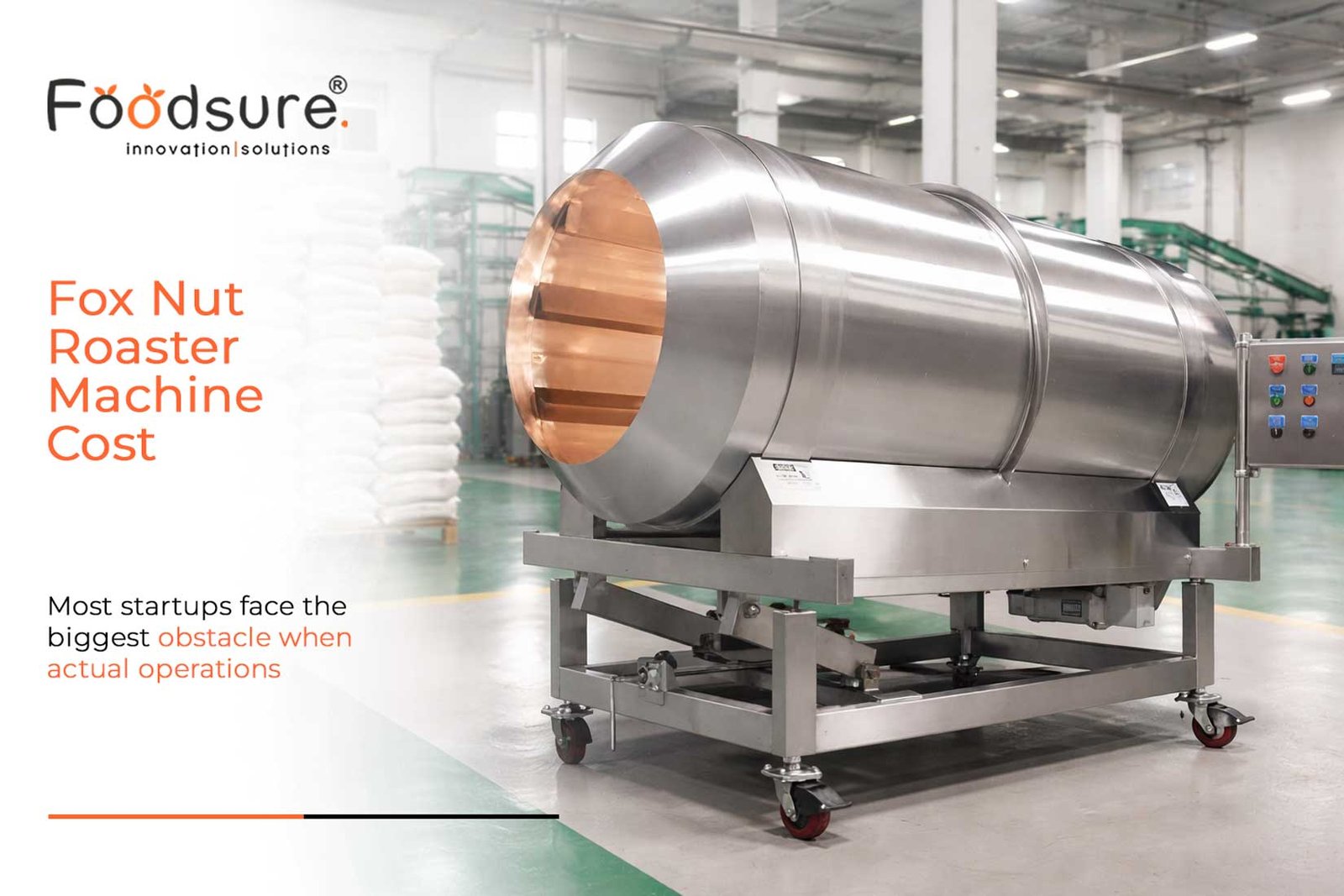
The roasted makhana (fox nut) industry offers entrepreneurs in the superfood market profitable business opportunities that can grow into large enterprises. The development of a production line from its initial design stage demands both financial resources and essential Fox Nut Roaster Machine Cost to achieve operational success.
Most startups face the biggest obstacle when actual operations do not match planned machinery expenditures. Companies that spend too much on industrial capacity will exhaust initial operational resources. At the same time, businesses that spend too little on basic equipment will experience machine breakdowns and produce inconsistent product quality. This guide provides a technical and financial blueprint for establishing a fox nut roasting machine facility, focusing on machine specifications, spatial requirements, and tiered investment structures.
Why Startups Struggle with Makhana Roasting Machine Cost and Makhana Roasting Machine Investment
Fox nut roasting is a thermal process that is usually treated as a simple one in startups; however, the technical reality is that it is a high-sensitivity moisture-management operation. The root cause of failure is usually due to the Scalability Trap, where 10kg batches work but 100kg batches fail due to the source of heat and moisture.
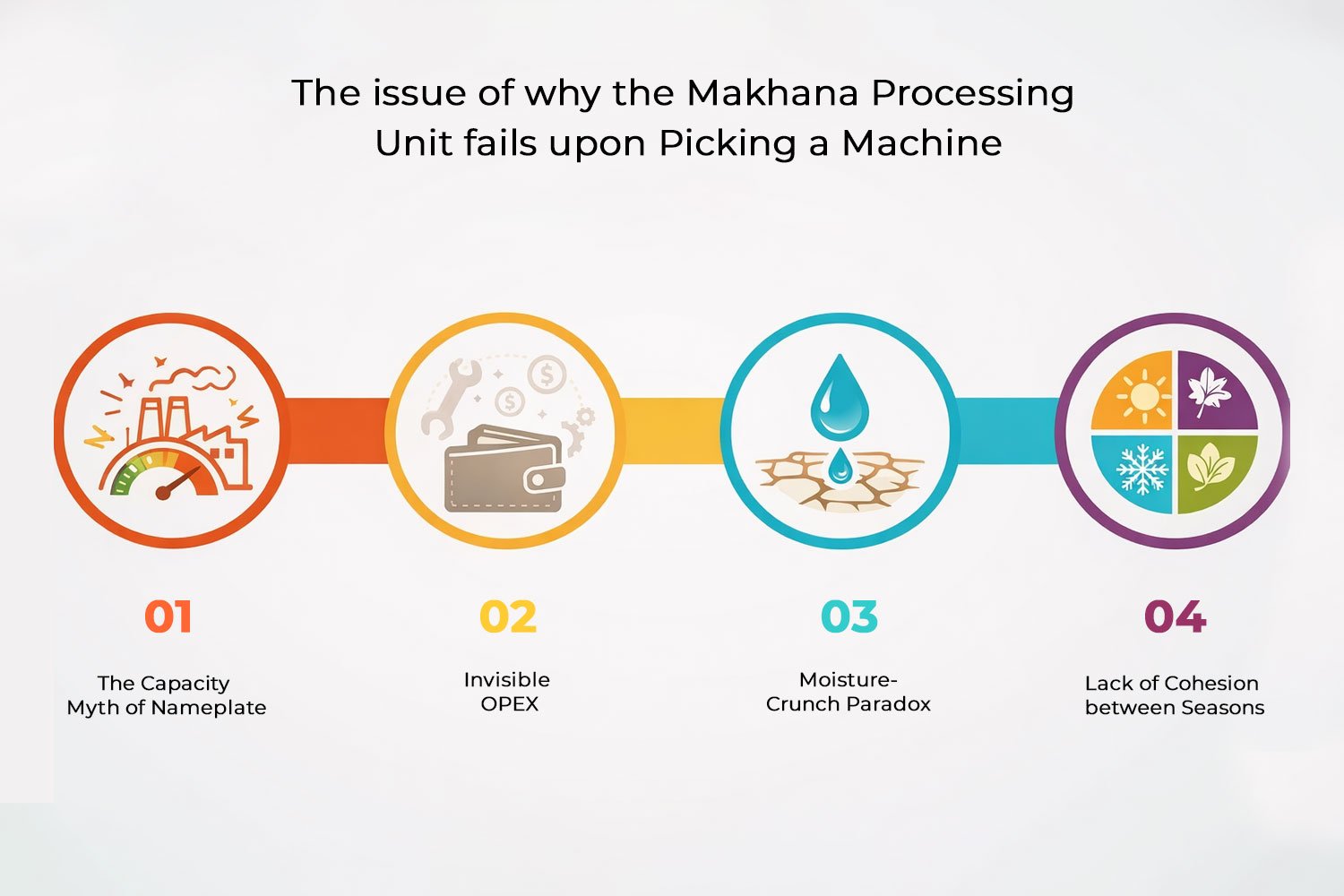
The issue of why the makhana processing unit fails upon picking a machine:
- The Capacity Myth of Nameplate: Most cheap roasters would advertise a capacity of 50/kg/hr, but when operated in the real world, average results are usually only 30% that.
- Invisible OPEX: The budget machines are not properly insulated and have low-quality sensors, which results in ₹15,000-₹25,000 of electric waste and calibration of the heater every month.
- Moisture-Crunch Paradox: The lack of proper cooling of conveyors used after roasting leads to leftover heat trapping of moisture that leaves the masses of stuff soggy and unacceptable by the retailers in a couple of weeks.
- Lack of Cohesion between Seasons: The spice seasoning, unless coated with a synchronised flavouring drum, does not adhere, which results in huge material waste and dissatisfaction with clients.
Fox Nut Roaster Machine Cost in India: What You Actually Pay
The Total Cost of Ownership (TCO) calculation starts from the sticker price, but thermal efficiency determines its actual cost. The use of inexpensive Mild Steel (MS) drums instead of Food-Grade Stainless Steel (SS304) results in contamination through rust and creates uneven hot spots, which lead to high batch rejection rates.
The advanced units control the heating process through PID systems, which regulate the makhana’s expansion curve. The internal moisture inside the product stays at a controlled rate, which creates a consistent pop instead of producing shrunken and tough seeds.
| Setup Tier | Estimated Cost (India) | Key Technical Specification | Hidden Operational Cost |
|---|---|---|---|
| Micro (Batch) | ₹1.5L – ₹2.5L | MS Frame / SS304 Bowl | High labour; 10% batch wastage |
| Startup (Rotary) | ₹3L – ₹5.5L | Variable Frequency Drive (VFD) | Gas / Electricity (₹15k / month) |
| Commercial (Line) | ₹8L – ₹15L+ | Multi-stage Cooling + PLC | 3-Phase Power Infrastructure (₹2L+) |
The Hidden Startup Costs
- Infrastructure: A 50 kg/hr unit requires more work than basic installation because it needs special expertise. The project requires an additional expenditure of between ₹1.5L-₹3L for industrial sheds, high-tension electrical wiring and heavy-duty exhaust chimneys, which FSSAI requires.
- Weight Loss Factor: You pay for raw weight, but sell roasted weight. A standard roasting cycle results in a 3–5% moisture loss; if your machine isn’t calibrated, that can spike to 8%, which will silently reduce your profit margins.
Complete Fox Nut Roaster Machine Cost Setup: Machines Needed Beyond the Roaster
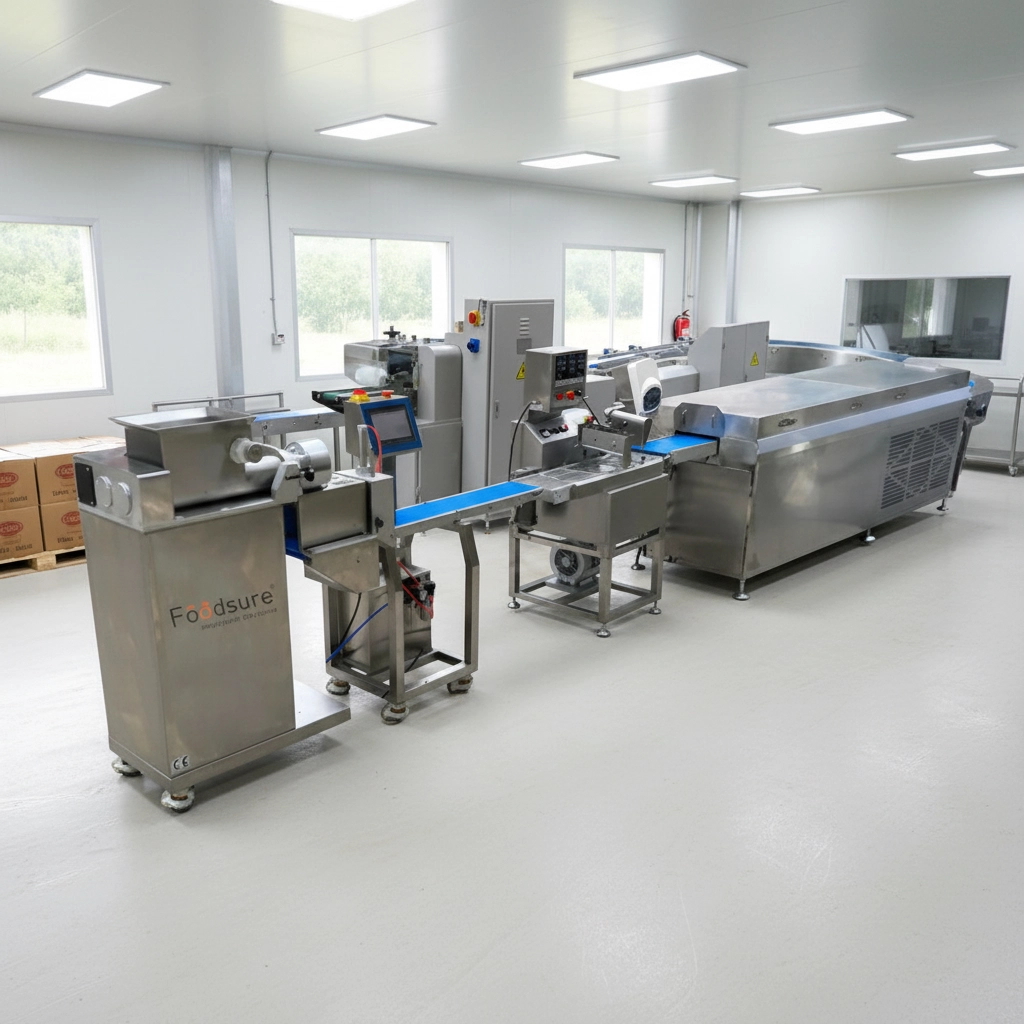
Your setup needs to operate as a synchronised ecosystem to achieve successful scaling from a kitchen experiment to a retail-ready brand. The sequential bottleneck problem represents a common reason why startups fail because companies use fast roasters and rely on slow manual seasoning, which creates product delays that lead to moisture absorption and texture loss.
Advanced Setup Components & Technical Realities
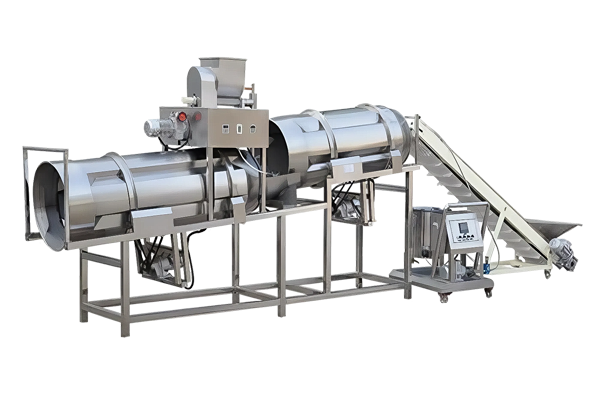
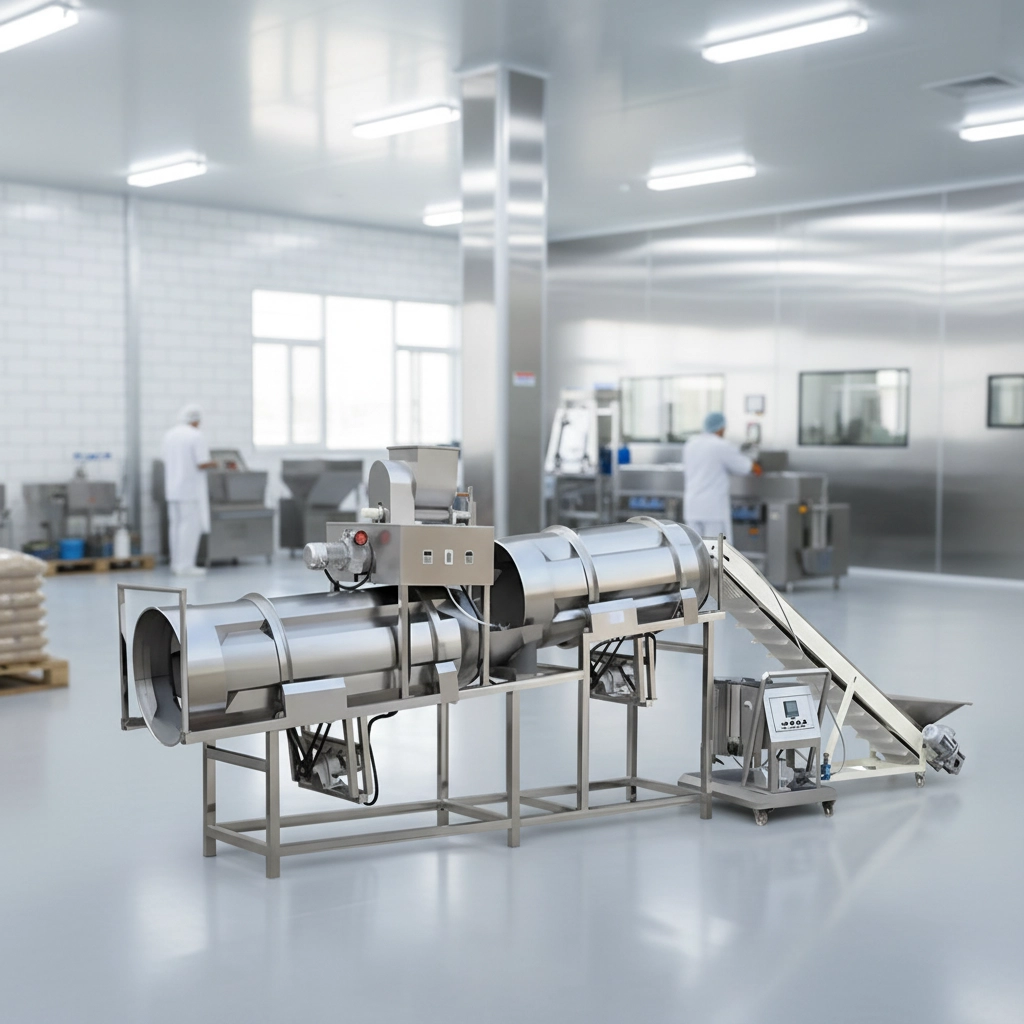
- Integrated Seasoning Drum (Hexagonal): Hexagonal drums deliver complete spice distribution through tumbing mechanism that operates at 360°. Advanced units use slurry dosing pumps to spray a fine mist of oil and masala, which leads to a reduction of seasoning waste by up to 15%.
- Forced-Air Cooling Conveyors: Roasted makhana is hygroscopic because it absorbs moisture through its natural ability to do so. The dedicated cooling conveyor uses food-grade blowers to achieve a temperature reduction from original values to 30°C- 35°C within a few minutes, which preserves the glassy texture essential for extended shelf life.
- VFFS Packaging with Nitrogen Flushing: Standard sealing leads to rancidity within 30 days. You need a Vertical Form Fill Seal (VFFS) machine with a Nitrogen manifold. The process replaces oxygen with inert gas, which extends shelf life to 6-9 months while serving as a protective cushion against transit breakage.
Professional Investment Map:
| Component | Technical Must-Have | Why it Matters |
|---|---|---|
| Seasoning Mixer | Variable Frequency Drive (VFD) | Controls RPM to prevent makhana breakage |
| Cooling Unit | SS304 Mesh Belt | Prevents moisture “sweating” before packing |
| Packaging | Pneumatic Nitrogen Piston | Guarantees 99% oxygen displacement |
How Much Space Is Required for a Fox Nut Roaster Machine Cost Setup
The space requirements for a makhana unit facility depend on its operational needs more than its total space measurements. Your layout design needs to establish separate areas for raw, uncleaned seeds and finished roasted products to meet both FSSAI requirements and international food safety standards (HACCP).
- Zoning Architecture: The area must be divided into three separate areas, which include a Dry/Raw Zone for storage, a Processing Zone for roasting, flavoring and a High-Care Zone for packaging.
- Volumetric Capacity: Makhana exhibits low density but high volumetric capacity. A startup processing 50kg/hr actually handles several hundred bags of raw material daily; your storage area must account for cubic volume, not just floor area.
- The 3-Phase Requirement: Single-phase power sustains basic roasters, but all systems that include Cooling Blowers and VFFS Packaging machines need 3-phase power with a range between 12- 20 kW.
| Scale | Recommended Area | Ideal Electrical Load | Personnel Capacity |
|---|---|---|---|
| Micro | 300–400 sq ft | 5–8 kW (1 Phase) | 2–3 Workers |
| Startup | 600–800 sq ft | 12–18 kW (3 Phase) | 4–6 Workers |
| Industrial | 1200+ sq ft | 25–45 kW (3 Phase) | 8+ Workers |
Production Output & Profit Potential of a Fox Nut Roaster Machine Cost Setup
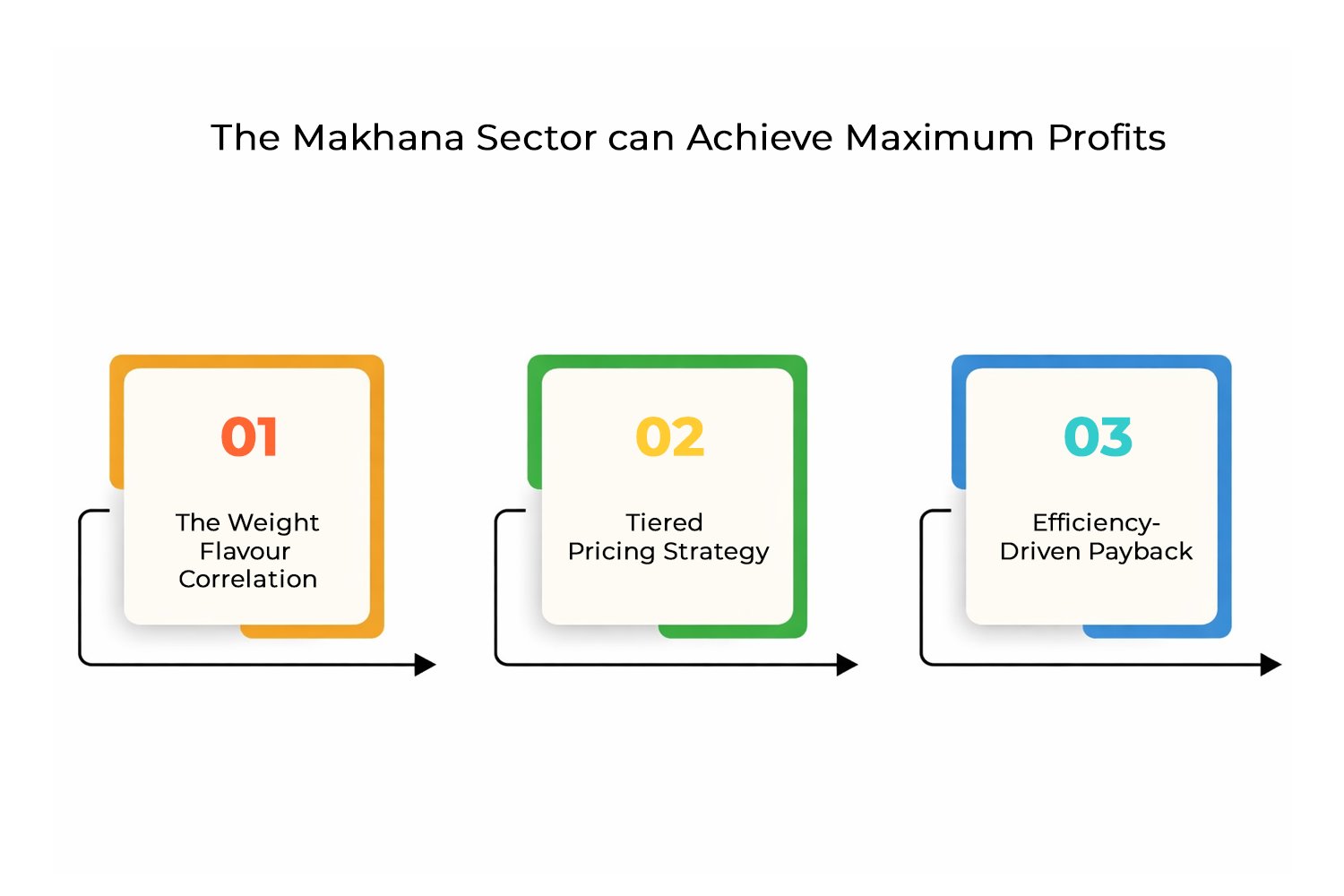
The makhana sector can achieve maximum profits when it shifts its focus from volume to Value-Addition Ratios. The raw makhana market operates as a basic commodity, but the flavoured products function as high-end fast-moving consumer goods that depend on branding for price increases between 200-300%.
- The Weight-Flavour Correlation: In professional setups, profitability is optimised by the coating-to-kernel ratio. The high-efficiency seasoning drums enable a weight gain of 6-10% allow oil and spice to stick to the products. The offset protects your margins because it compensates for the 3-5% moisture loss that occurs during the roasting process.
- Tiered Pricing Strategy: Startups often fail by over-relying on bulk sales, which generate 10-12% profit margins. D2C (Direct-to-Consumer) and Quick Commerce channels, which provide 20g-40g packs, achieve net margins of 35% through their higher per-gram pricing.
- Efficiency-Driven Payback: Machines with low thermal inertia and automated PID controls reduce energy costs by ₹2-₹3/kg. The hidden efficiency that operates at 200 kg/day throughout 300 days of the cycle generates annual savings of nearly ₹1.5 Lakhs, which accelerates your return on investment.
Conclusion
Understanding the right fox nut roaster machine cost helps avoid risky investments. Foodsure Machines provides dependable solutions to customers, while our practical expertise and industry knowledge support startups to build successful roasted makhana enterprises.
FAQ
Q1. What is the fox nut roaster machine cost in India?
Ans: The fox nut roaster machine cost in India starts at ₹1.5 lakhs and reaches up to ₹10 lakhs, which depends on the machine’s production capacity and level of automated features.
Q2. What is the complete roasted makhana setup cost for startups?
Ans: The total cost of a complete roasted makhana setup starts from ₹4 lakhs and reaches up to ₹15 lakhs, which depends on the selected machine configuration and production capacity.
Q3. How much makhana processing unit investment is required to start?
Ans: Makhana processing unit investment for start-ups usually starts from ₹5 lakhs, which goes to Rs. ₹60-85 lakhs for fully automatic operations.
Q4. What is the space requirement for makhana processing unit?
Ans: A makhana processing unit typically requires 300-800 sq ft floor area in the case of small-to-mid-size firms.
Q5. What is the profit potential of roasted makhana business and commercial makhana roasting machine cost?
Ans: The expected profit of makhana roasting alone may hit margins too quickly, falling between 25-40%, and the industrial makhana machines could possibly be priced in the range of ₹6 lakhs to ₹15 lakhs.