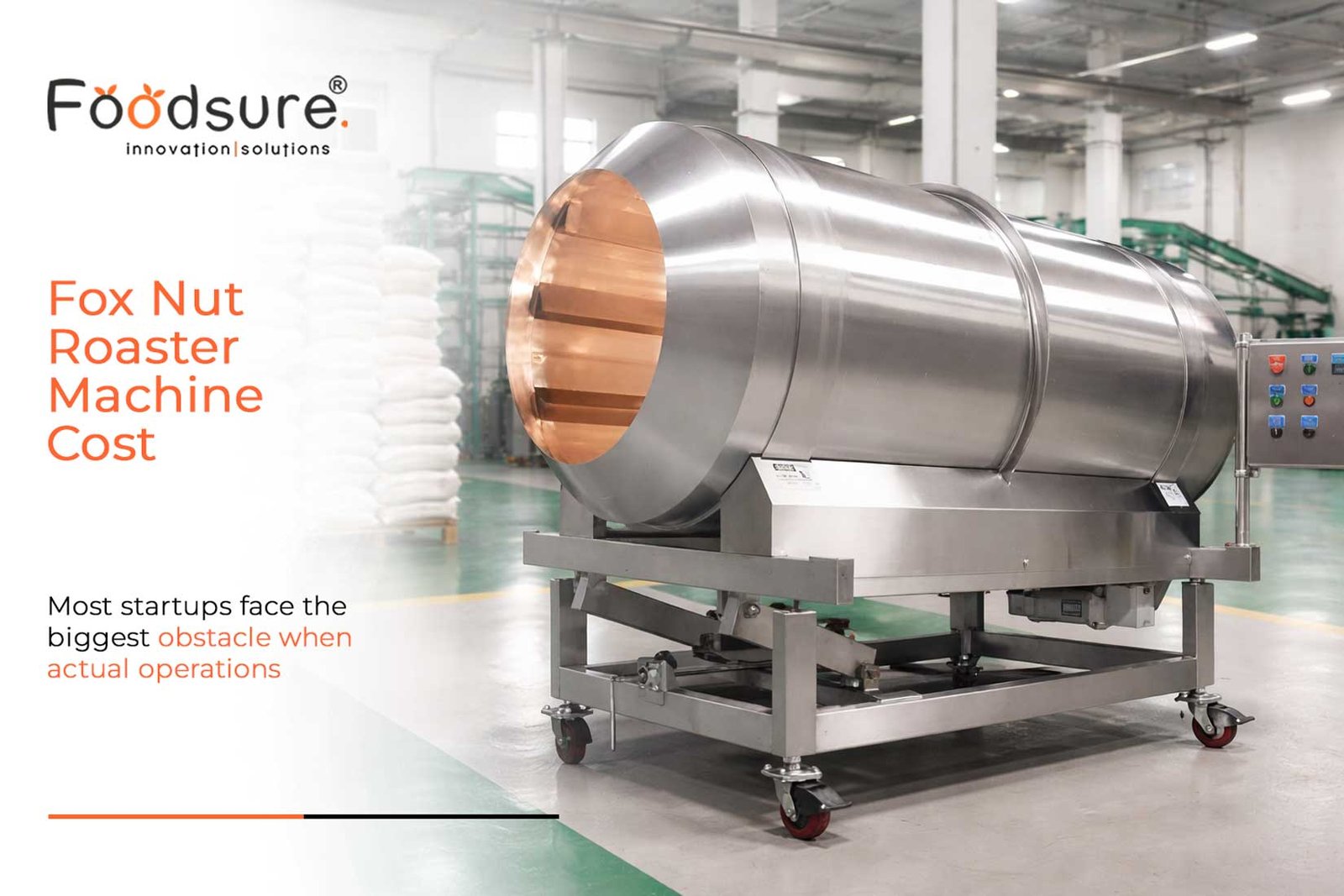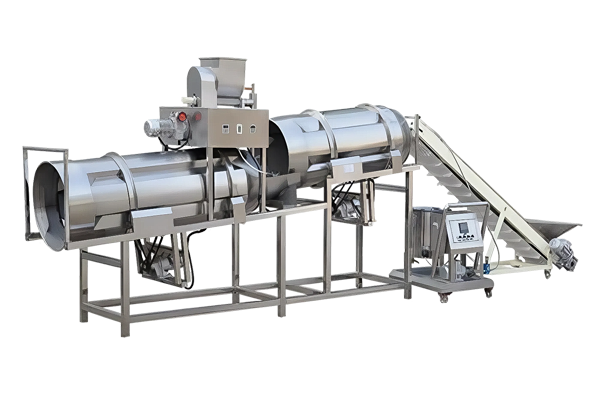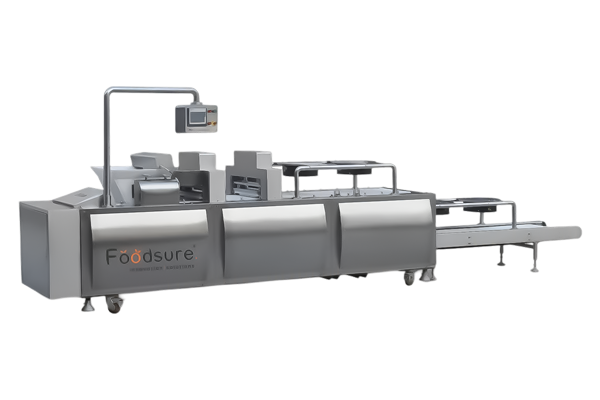

Banks approve loans based on statistics, not on ideologies. For many makhana entrepreneurs, that figure is the monthly EMI, closely linked to the capacity they pledge to operate from the start. Due to pressure to satisfy commissioning and bank deadlines, founders frequently believe that the machine capacity displayed in brochures is equivalent to the output they will achieve on the factory floor. In reality, makhana machine capacity rarely takes operator learning curves, power constraints, batch changes, or moisture variations into account. Instead of failure, the outcome is more subdued and detrimental equipment operating below schedule, fixed EMIs remaining constant, and cash being drained before the brand settles into an established routine.
Bank-Approved Loans vs the Ground Reality of Makhana Processing Machines
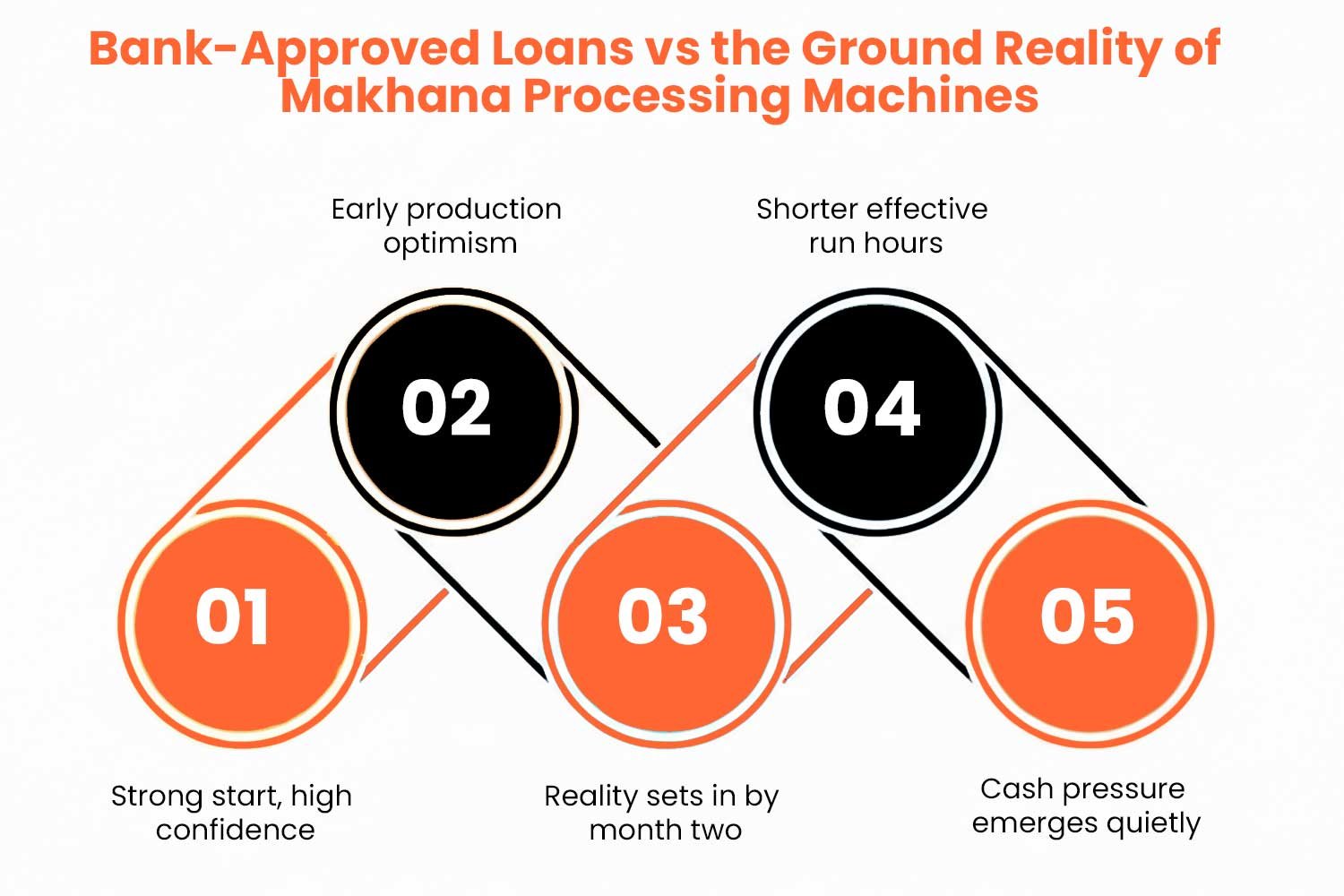
- Strong start, high confidence: Bank approval and DPR numbers made the project secure.
- Early production optimism: Initial trial runs matched expectations for short durations.
- Reality sets in by month two: Moisture variation, uneven roasting, and grading rejects reduce usable output.
- Shorter effective run hours: Cleaning, adjustments, and operator learning cut daily throughput.
- Cash pressure emerges quietly: Output dropped, but EMIs stayed constant, tightening working capital.
This mismatch wasn’t due to an outage machine; it came from planning capacity without accounting for real operating losses. The majority of first-time founders in Bihar and MP discover only after production stabilises.
Founder Snapshot — Ground Reality After 3 Months
| Parameter | What Was Planned | What Actually Happened |
|---|---|---|
| Loan Amount | ₹48–55 Lakh (term loan + working capital) | EMI fixed, cash flexibility limited |
| Machine Rating | 300 kg/hr (brochure capacity) | Achievable only under ideal conditions |
| Saleable Output | 300 kg/hr assumed | 165–190 kg/hr after rejects, moisture loss, downtime |
Where Most Makhana Machine Capacity Calculations Go Wrong
The majority of new entrepreneurs assess the low-capacity roasted makhana machine through integrators’ brochures rather than the plant’s operation. On technical grounds, the calculation appears to be precise. In practical operations, the capacity is decreased in minor ways that add up and seldom reflect in a DPR.
Rated Capacity vs Saleable Capacity
A makhana making machine might be rated at 300 kg/hr, but the saleable production will always be less than that.
- Cleaning loss: The input to roasting is again reduced by broken shells, dust, and undersized kernels; this is the cleaning loss.
- Grading rejection: Mismatched sizes and defective surfaces cause a portion of the produce to be transferred to lower-value grades.
- Moisture loss after roasting: As moisture stabilises, the weight drops, cutting off saleable kilos even when the volume looks steady.
The Time Factor Nobody Calculates
Hourly capacity presumes the operation is running without interruptions, which is hardly the case.
- Batch heating: Roasters require stabilisation time before they start producing uniform output.
- Cooling cycles: The product has to cool down before it can be graded or packed, which is a flow-slowing process.
- Changeovers: Shifts in flavour, changes of sieves, and cleaning are silently consuming productive hours.
One Wrong Machine Bottlenecks Everything
The capacity is only as strong as its weakest part.
- Roaster > grader mismatch: The output coming from the roaster plus the excess of roasted output will either pile up or degrade while waiting.
- Packaging idle time: When the flow upstream varies, the packing lines sit underused.
Why Banks and Consultants Often Miss Makhana Plant Capacity Reality
- Linear financial models are still particularly widespread in determining DPRs: The universal forecasting is that the plant’s full capacity will be used every month, which overlooks the variations in production intensity from day to day and season to season.
- Seasonal raw material quality is implicitly considered: The dimensions of the makhana, its moisture content and the hardness of its shell vary according to the season and the storage time, affecting the cleaning loss, roasting behaviour and grading yield directly.
- Ideal power circumstances are taken for granted: DPRs usually include the provision of stable voltage and smooth power, but many small units experience power cuts and fluctuations that slow heating and lengthen the batch cycle.
- Labour productivity is overreported: DPRs usually take into account the presence of fully trained operators right from the start, but the real-life situation is different. As teams take weeks to get fully efficient, the output from the makhana processing machine is low in the initial period.
- Common practice among small units: Similar gaps have been observed in the case of several small makhana units. Which means these are not exceptions but rather a recurrent planning defect in capacity-linked loan approvals.
The Practical Way to Calculate Makhana Machine Capacity
In calculating your ultimate ROI, it is necessary to go beyond the scale. Because of this, you can lower your running costs by using some advanced parameters:
- The “Turri” Factor: About 15-20% of the input will yield “unpopped seeds” (Turri). These can be sold for livestock feed, or they can be ground into makhana flour, but they should not be counted when calculating your “Grade-A” capacity.
- Moisture Volatility: If the seeds you are using contain more than 14% moisture. Your roasting time will be extended by 10-15% lowering your hourly capacity.
- Grading Precision: Machines with a high capacity usually do not give a good grading quality. For the sake of superior 7+ mm or 9+ mm sizing, the vibratory grader might have to be slowed down, thereby losing about 5-8% of throughput.
The Significance of These Numbers:
If you sign an agreement to supply 2 tons of makhana every week, you might think that investing in a 100 kg/hr machine will be enough for only 20 hours of work. But if you then apply the utilisation of 75% and the yield of 35%, realities:
- A 100 kg/hr machine provides 35 kg finished product per hour at best.
- To get 2,000 kg, you will actually need 57 hrs of runtime.
- If you add in the 75% efficiency limit for cleaning and upkeep. You will need 76 hrs of work each week.
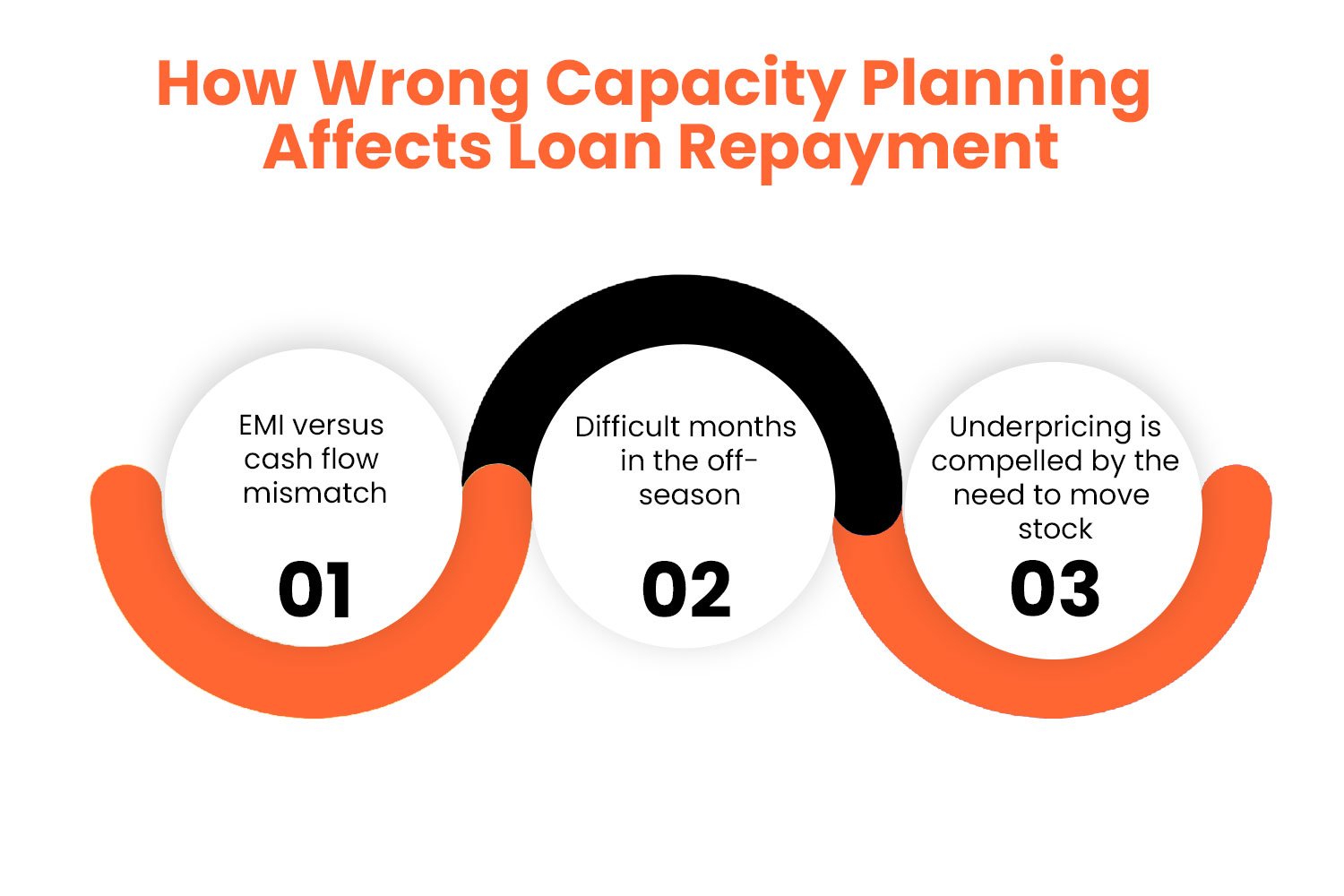
How Wrong Capacity Planning Affects Loan Repayment
A situation where the capacity is overestimated reveals its first impact in the cash flow rather than in the production charts. The fixed EMIs will still be there, but the actual cash inflow will depend on how many saleable makhana leaves the plant each month. In case the average output is lower than the planned one, the gap will have to be filled out of working capital or personal resources.
- EMI versus cash flow mismatch: A 20 – 25% decrease in available output would be enough to transform an easy EMI into a monthly burden.
- Difficult months in the off-season: The demand slowdown and the inconsistent quality of raw materials cause the plant to operate at a lower capacity, just when fixed costs stay the same.
- Underpricing is compelled by the need to move stock: In order to have liquidity, the founders often have to write down their inventory, thus sacrificing the profit margin to keep cash flow secure.
Conclusion
At Foodsure Machines, we’ve observed that underestimating the makhana machine capacity causes cash flow issues that endure until the earnings arrive. Therefore, instead of basing our machines on what is advertised in brochures, we are basing them on actual output. This allows founders to create their businesses. So, they can flourish and repay their debts with ease.
FAQ – Makhana Machine Capacity
What is the makhana machine capacity?
It refers to the amount of saleable makhana the machine actually produces per hour, not just the rated number on the spec sheet.
How is the makhana machine capacity calculated?
Start with rated output, then factor in downtime, grading rejects, and real-world inefficiencies seen during daily operations.
Does bigger capacity always mean faster production?
No. Higher capacity only helps if the entire workflow is balanced and downstream processes can keep pace.
Can wrong capacity affect loan repayment?
Yes. Overestimating output can strain cash flow and make EMI payments difficult, even when machines run continuously.
What is the ideal capacity for a small makhana unit?
Aiming for 70–75% of rated capacity keeps production stable, avoids stress on equipment, and supports predictable operations.