
Did you know that over 60% of small and mid-scale mayonnaise plants see yield drops or inconsistent texture after pilot runs? Why do successful pilots stumble in full-scale production? Scale-up issues, such as uneven emulsification and ingredient mismatch, are the hidden culprits. In this blog, we’ll break down the most common scale up issues mayonnaise, why they happen, and step-by-step strategies to prevent them for smooth, high-yield production.
Common Reasons Why Mayonnaise Production Lines Fail
Production lines for mayonnaise typically suffer from failures that result from equipment mismatches, faulty emulsification processes, inconsistent ingredient quality, and untrained operators. As a result, there is separation, waste, and downtime during the scale-up process. 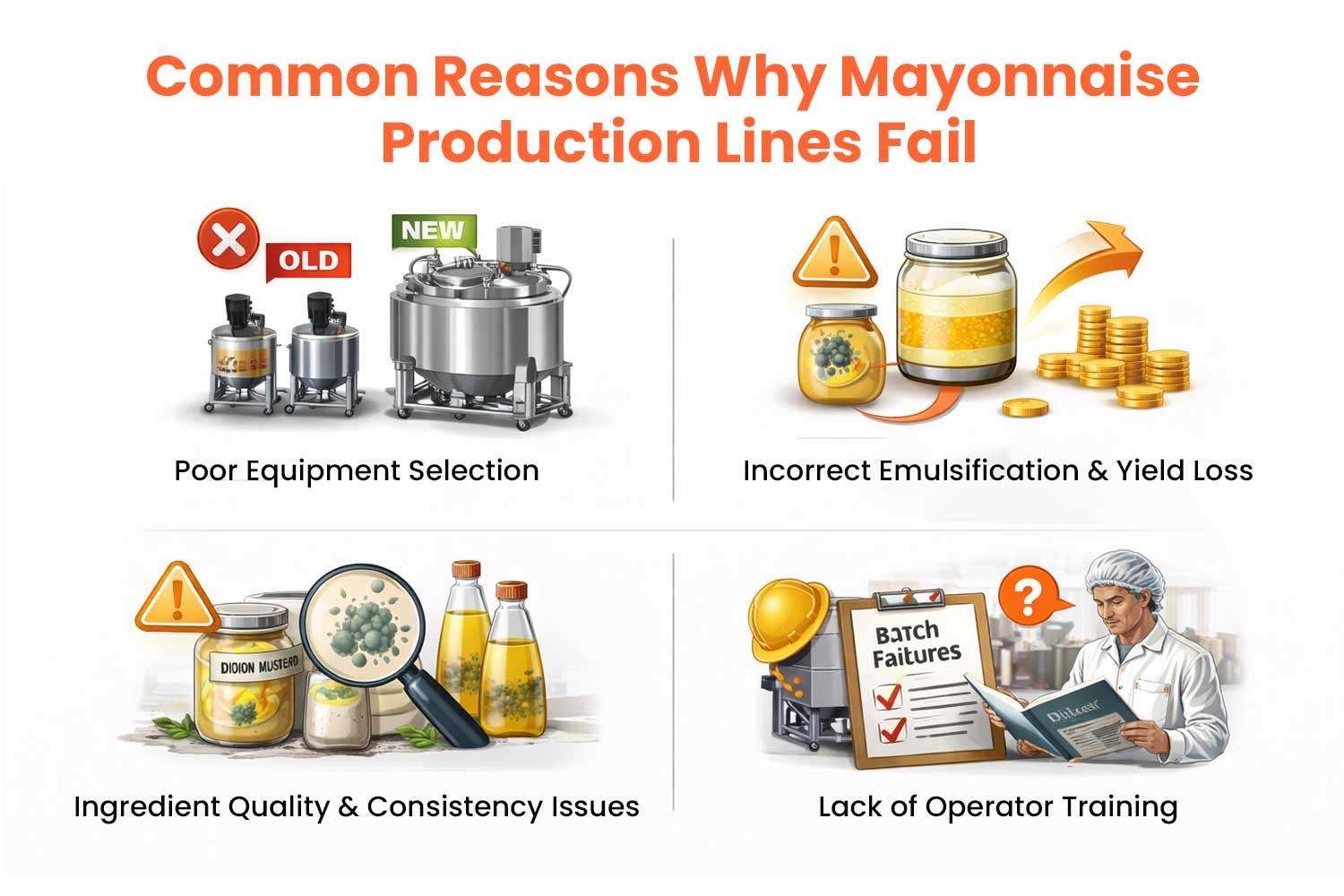
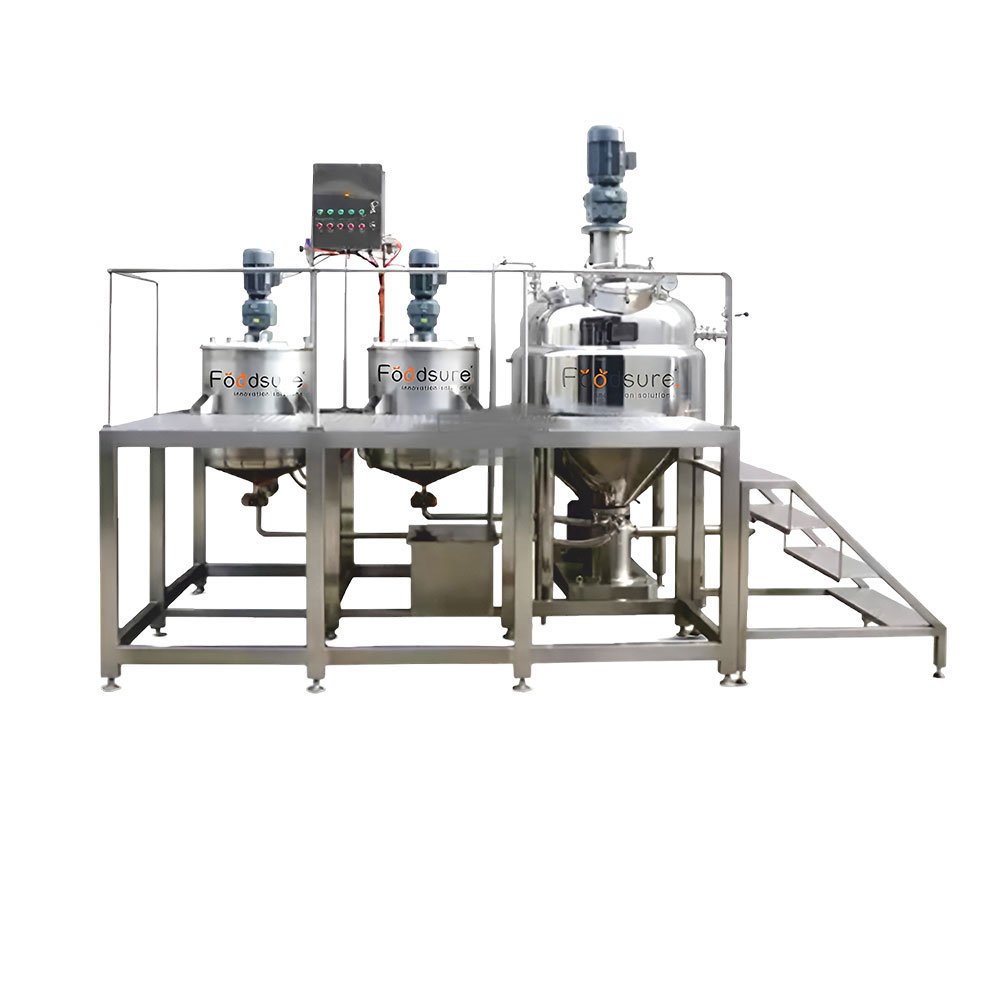
- Poor Equipment Selection: It is a common practice for manufacturers to start their operations with 50 – 200L batch mixers and then increase their demand without making the necessary upgrades to continuous inline homogenisers or colloid mills for 500L+ runs.
- Incorrect Emulsification & Yield Loss: High-shear mixers used in laboratories are capable of creating stable micro-emulsions; however, the industrial ones require staged oil addition (1-5% increments) through metering pumps so as to avoid phase inversion or foam due to cavitation.
- Ingredient Quality & Consistency Issues: Small changes of only 0.2% in the peroxide value of oil (>5 meq/kg), phospholipid content of egg yolk, or xanthan gum hydration rate can cause destabilisation of O/W emulsions, resulting in rejection of the full line.
- Lack of Operator Training: Missing the shear ramp-up (2,000-15,000 rpm over 10 min), which results in entraining air and cutting yield by 12-18%. Not paying attention to temp control (42–48°C optimal), the a risk of bacterial growth or emulsion inversion. Disregard pH monitoring (3.6-4.2) can cause syneresis.
How to Prevent Scale-Up Issues in Mayonnaise in Pilot Runs
To prevent mayonnaise scale-up problems during pilot production, equipment capacity ratio standardisation, training, and KPI follow-through are used to bring uniformity to the process to avoid emulsion failure and yield loss during transition to industrial-scale production.
- Choose the Right Machine Capacity: Select emulsifiers based on 20-50% headroom over pilot requirements, for instance, from existing 300L batch high shear mixers to 500L -1,000L inline colloid mills. This avoids shear fatigue, supports speeds of 15,000–20,000 rpm, and prevents yield declines of 15–25% caused by overloading. Similarity of testing geometries, based on ‘rotor tip speed,’ helps simulate process flow.
- Ingredient & Process Control: Standardisation Enter pilot ratios (for example, oil 70-80%, egg yolks 10-15%) using the same suppliers and variance less than 0.5% for peroxide value or viscosity using pre-blend tanks. Also, strictly follow SOPs for staged oil addition (between 2 – 5 L/min), pH range of 3.8 – 4.2, and temperature at 45°C using PLC (repeat all actions to prevent phase inversion during bulk production).
- Train Operators for Consistency: Run hands-on workshops modelling 300- 500L ramp control shear (start 3,000 rpm -18,000), temp (2 °C), and 25min cycles. Employ digital twins or AR apps for fault drills such as foam detection. Confirm through FSSC 22000 modules on CIP and deviations.
- Track KPI Metrics: Analyze yield (target >92%), viscosity CV (<5%), downtime (<2%), and waste (<8%) through Excel dashboards or SCADA software. Record per batch of emulsion stability (centrifuge test), sensory scores, and O/W droplet size (<5 μm microscopy).
Trend analysis helps spot issues early, for example, a yield dip can signal a shear mismatch, enabling up to 95% first-pass success during scale-up.
Read More: Mayonnaise Production Equipment That Scales Your Food Business Profitably
Quick Preventive Checklist for Scale-Up Success
A quick preventive checklist may be an excellent tool in a mayonnaise scale-up from pilot to production when the aim is to avoid emulsion failure, yield loss, and downtime by verifying key controls upfront.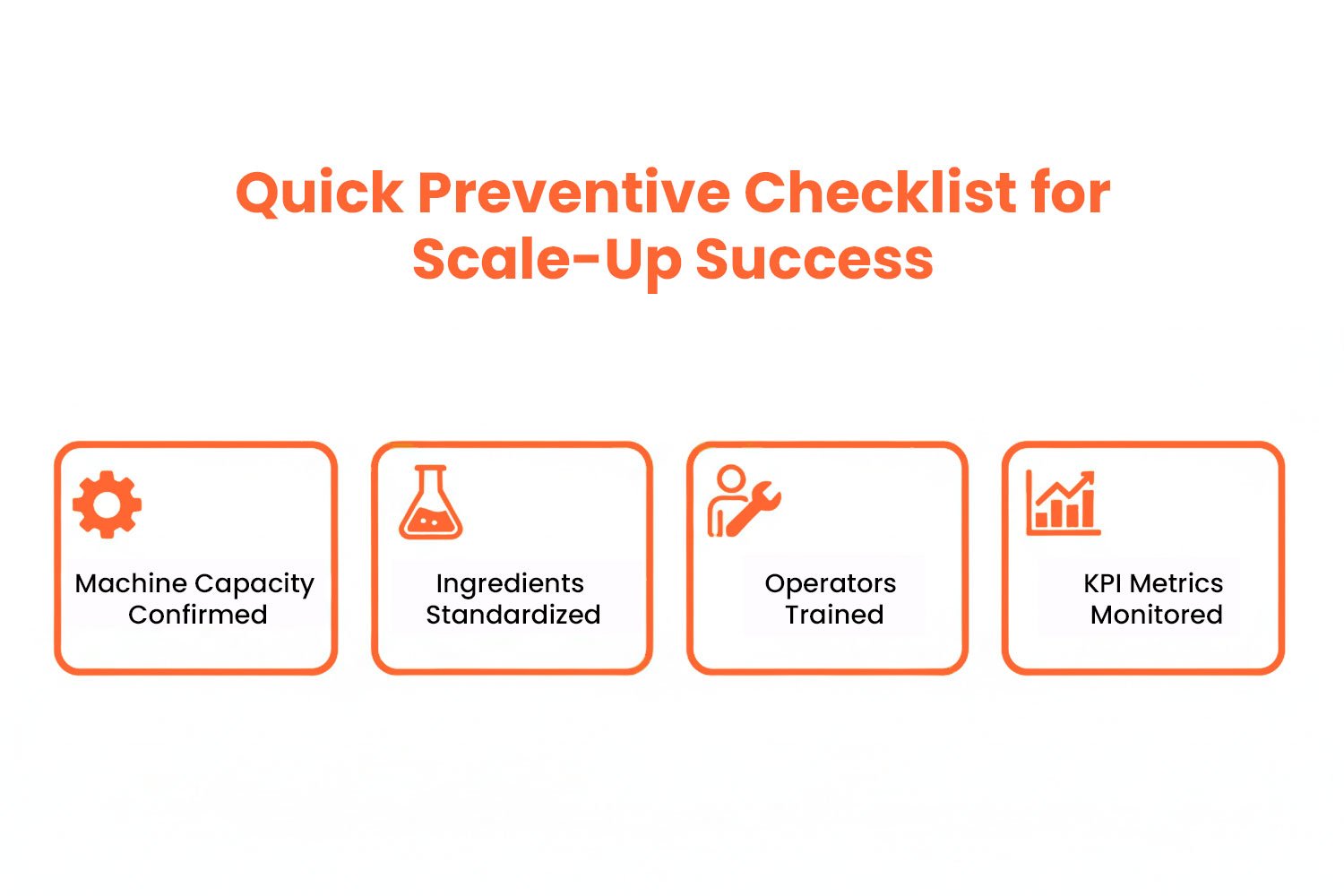
Machine Capacity Confirmed
- First of all, it is necessary to verify 20- 30% overcapacity (e.g., 400L – 300L pilots) with matching shear rates (15 000+ rpm).
- In order to prevent overload inconsistencies, test the rotor, stator geometry, and flow rates.
Ingredients Standardized
- One of the points is to secure supplier specs: oil PV <3Meqq/kg, egg yolk at 10- 12%, stabilisers <1% variance.
- Batch pre-mixes should be prepared in the holding tanks, SOPs for ratios, pH 3.8-4.2.
Operators Trained
- Individuals performing the hands-on drills are the best preparation for a ramp-up (speed/temp/timing). Staff should also be certified on CIP and deviations.
- Foaming fault simulation through AR tools can result in the reduction of errors by 90%.
KPI Metrics Monitored
- Keep an eye on yield (>92%), viscosity CV (<5%), and waste (<5%) either by using spreadsheets or SCADA.
- Daily size of the droplets (<5 µm) and stability tests should be recorded.
Read More: Mayonnaise Manufacturing Plant in India: Complete Setup, Machines & ROI Insights
Conclusion
Most scale up issues mayonnaise are not really problems of the recipe but are more related to equipment and process deficiencies. At Foodsure Machines, we build our mayonnaise making machine in such a way that it can be scaled up without any loss of yield or inconsistency. The result of a well-thought-out growth plan is that the performance does not drop; rather, it gets better.
Frequently Asked Questions
Why do most food startups fail after the pilot stage?
Most failures occur due to poor scale readiness, cost miscalculations, supply chain gaps, regulatory issues, and lack of working capital.
Does pilot success guarantee commercial success?
No. Pilot success validates the product idea but does not confirm operational, financial, or market scalability.
What is the biggest mistake startups make during scale-up?
Assuming the pilot formulation, costs, and processes will behave the same at the commercial scale.
How important is formulation optimisation before scaling?
Extremely important. Scale-ready formulations ensure consistency, shelf life, and product stability in large volumes.
When should regulatory compliance be addressed?
Regulatory planning should begin during pilot development, not after scaling begins.
Why is shelf-life testing critical before launch?
Shelf-life failures lead to recalls, brand damage, and financial losses once products enter wider distribution.
Can the wrong manufacturing partner cause failure?
Yes. Manufacturing misalignment often leads to inconsistency, delays, cost overruns, and quality issues.
Is early consumer feedback reliable for scaling decisions?
Early feedback is useful but limited and may not reflect mass-market behaviour or price sensitivity.
How much working capital is needed after pilot scale?
More than most founders expect. Inventory, distribution margins, and delayed payments create heavy cash-flow pressure.
How can startups reduce the risk of pilot failure?
By planning for scale early, validating costs and supply chains, conducting stability studies, and building a clear go-to-market strategy.5