
Buying a tomato sauce machine should be easy, but many manufacturers in India face challenges. Every supplier claims “best quality”, but price quotes widely, and half of the machines do not even match your requirements for output. You want clarity – which model is right for your production capacity? What is the actual setup cost? How much automation do you really need? And most importantly, what should you pay in 2026 to avoid being overcharged? If these types of questions are already in your mind, then you are in the right place. In this blog, we will get to know about tomato sauce machine buyers guide, honest price ranges, setup costs for small to large-scale units, and clear all your doubts you get.
Why Tomato Sauce Manufacturing is Growing in India
India tomato ketchup market size reached USD 659.6 Million in 2024. To elaborate, fast food outlets, quick service restaurants (QSRs), and prepared meals all utilize tomato-based condiments as components for the consumer. This has resulted in condiments such as sauce making machine market and sauces being moved off the shelf year-round. Due to individuals working longer hours, cooking from scratch is becoming more and more impractical. Packaged, ready-to-use sauces and dressings support this behavioral and functional food market.
Supermarkets and e-commerce sites are making it much easier for consumers to buy domestic and international brands. This clearly adds opportunity and more competition.
Read More: Tomato Ketchup Market 2026: ₹3,500 Cr Growth Trends
Tomato Sauce Manufacturing Plant Cost Range & Key Price Drivers
|
Machine Type / Capacity |
Approx Price (INR) |
Key Cost Factors |
|
Semi-Scale (50–200 kg/hour) |
₹3.5 lakh – ₹10 lakh |
SS 304 construction, basic mixing, semi-automatic operation |
|
Medium-Scale (200–800 kg/hour) |
₹12 lakh – ₹25 lakh |
SS 304 or SS 316L, improved mixing systems, semi-automatic with partial automation |
|
Large-Scale Fully Automatic (800–2000+ kg/hour) |
₹40 lakh – ₹85 lakh |
SS 316L, high-efficiency homogenizers, full automation, CNC-grade fabrication for precision |
Read More: Tomato Ketchup Machine Price In India: Complete Cost Guide
What is a Tomato Sauce Machine and How Does it Work?

Best ketchup machine India is much more than just a machine that crushes tomatoes; in fact, it’s nice to know every step matters to how the sauce will taste and “feel” when eating it, as well as how safe it will be to eat. If you miss or mishandle one step, then all bets are off- that sauce won’t be right.
- Washing
The first step is the washing step. Water jets clean off the dirt, debri, and any thing you wouldn’t like. The cleanness of the tomatoes is not determined by you. If they are not clean, you will not make a good sauce.
- Pulping
The second step is sending the tomatoes to a pulper. Properly separating the juice and pulp from the skins and seeds is what generates a liquid base to cook.
- Heating
Then you are heating the pulp. Again, not just to cook the pulp, but to generate thickness in the sauce, generate flavor, and to pasteurize for stability and food safety.
- Mixing
Now I get to the step of the process that truly takes intentionality in how you handle it, where you can add and properly mix in any salt, sugar, vinegar, or spices.
Types of Tomato Sauce Machines in India
Choosing tomato sauce manufacturing machine is crucial to ensure efficiency, quality, and cost-effectiveness for your production needs.
Semi-Scale Tomato Sauce Machine (50–200 kg/h)
For small businesses or startups, a semi-automatic machine is your best bet. With prices ranging from ₹3.5 lakh – ₹10 lakh, these machines are compact, budget-friendly, and perfect for low to medium production. They can easily fit into small spaces, saving you overhead costs while delivering great quality.
The workflow includes a few key units:
- A washer
- A pulper or crusher.
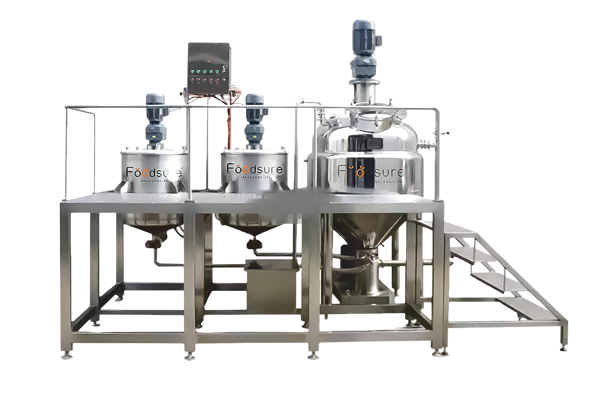
- A steam-jacketed kettle for cooking.
- A semi-automatic filling machine
Fully Automatic Tomato Sauce Processing Line (800–2000+ kg/hour)
For large-scale operations, you need a fully automated line capable of handling 800 kg/hour to 2,000+ kg/hour. These machines, priced between ₹40 lakh – ₹85 lakh, offer high efficiency and reduced manual labor, making them perfect for enterprises looking to maintain consistent, large-scale production with minimal downtime.
Key components are:
- Preheaters or hot break systems
- Vacuum-based evaporators for concentration
- Standardization tanks
This means less manual work, steady quality, and the chance to grow without delays.
Important Features to Compare Before Investing in a Tomato Sauce Machine
Choosing the tomato ketchup machine selection is governed by cost, and is simply in terms of features. Features impact efficiency, quality of product, and future costs.
1. Capacity
The tomato sauce processing machine should match your batch size. You need enough headspace for the tomatoes and ingredients. This helps them circulate well without spilling or overloading the system. Get this wrong, and production slows down or becomes messy.
2. Heating System
Different sauces need different heating. Jacketed kettles are great for most batches. However, for thick or sticky sauces, a scraped-surface system is better. It prevents burning and cooks evenly. The right heating system directly affects taste, texture, and efficiency.
3. Agitator and Mixing Platform
Anchors, propellers, and scrapers handle different viscosities. Scrapers are key for jacketed vessels. They keep the sauce moving and prevent sticking. Proper agitation ensures a smooth, uniform product.
4. Homogenization
What texture do you want in your sauce? High-shear homogenizers are capable of processing 1–5 μm particles while providing stability at sub-micron levels using high-pressure systems. Use the process for the texture and emulsifying quality your brand promises.
5. CIP Cleaning
Cleaning isn’t optional. A self-draining design and full spray coverage make cleaning faster. Cleanable seals also help keep things safe and easy to sanitize. It keeps the machine hygienic and reduces downtime.
6. Consumption
Check water and power usage. Two machines may perform the same task, but efficiency varies. Minimizing kW and liters per hour helps control long-term operating costs.
7. Process Customization
Flexibility matters. Variable Speed Drives and recipe controls let you change mixing, heating, and timing for various products. This makes the machine versatile instead of limiting you to a single product style.
8. Warranty and After-Sales Support
This means that downtime can be more expensive than the machine itself.
Read More: Tomato Sauce Manufacturing Machine in India: Your Partner for Scalable Production
Conclusion
Foodsure Machines builds tomato sauce equipment that actually works for your business. Our machines deliver consistent quality, efficiency, and hygiene. This applies to both semi-automatic and fully automatic options. You get clear pricing and dependable support. This helps you scale production across India without surprises or downtime.
Request Your Free Quote Fast
Please reach out to us anytime via phone or email.
FAQ
What is the price of a tomato sauce machine in India?
₹3.5 lakh to ₹85 lakh depending on the scale and features.
What capacity tomato sauce machine should I buy?
It depends on your production needs: 50–200 kg/h for small businesses, 200–800 kg/h for mid-scale, and 800–2000+ kg/h for large enterprises.
How much automation is needed for a small business?
Semi-automatic machines are ideal for small businesses.
Can I use a tomato sauce machine for other types of sauces?
Yes, some machines can be customized to handle different types of sauces.
How often do I need to clean a tomato sauce machine?
Regular cleaning is essential, especially after every batch.
What is the power requirement for these machines?
Typically, machines require 2–5 kW depending on the capacity.
Are these machines easy to maintain?
Semi-automatic machines require less maintenance, while fully automated ones need more technical upkeep.
What material is the best for tomato sauce machines?
Stainless steel (SS 304 or SS 316L) is preferred for hygiene and durability.
How long does a tomato sauce machine last?
A well-maintained machine can last for 10+ years.
Do I need a skilled operator for these machines?
Semi-automatic machines are easier to operate, while fully automated systems may require trained personnel.